OFCE's logo OFCE's logo
  • OFCE
  • FR
Categories
Business Cycles
Climate Change
Competivity
Dette Publique
Environment
États-Unis
Euro Area
Europe
Finances Publiques
Fiscal policy
Forecasting
Foreign trade
France
Gender
Growth
Industrial policy
Inequalities
Inflation
Innovation
Interest Rates
Investment
Monetary policy
Monetary Policy
Politique budgétaire
Politique monétaire
Poverty
Prévision OFCE
Productivity
Public debt
Purchase power
Purchasing Power
Taxation
Trade
United States
USA

Will Donald Trump’s economic policy restore purchasing power to American households?

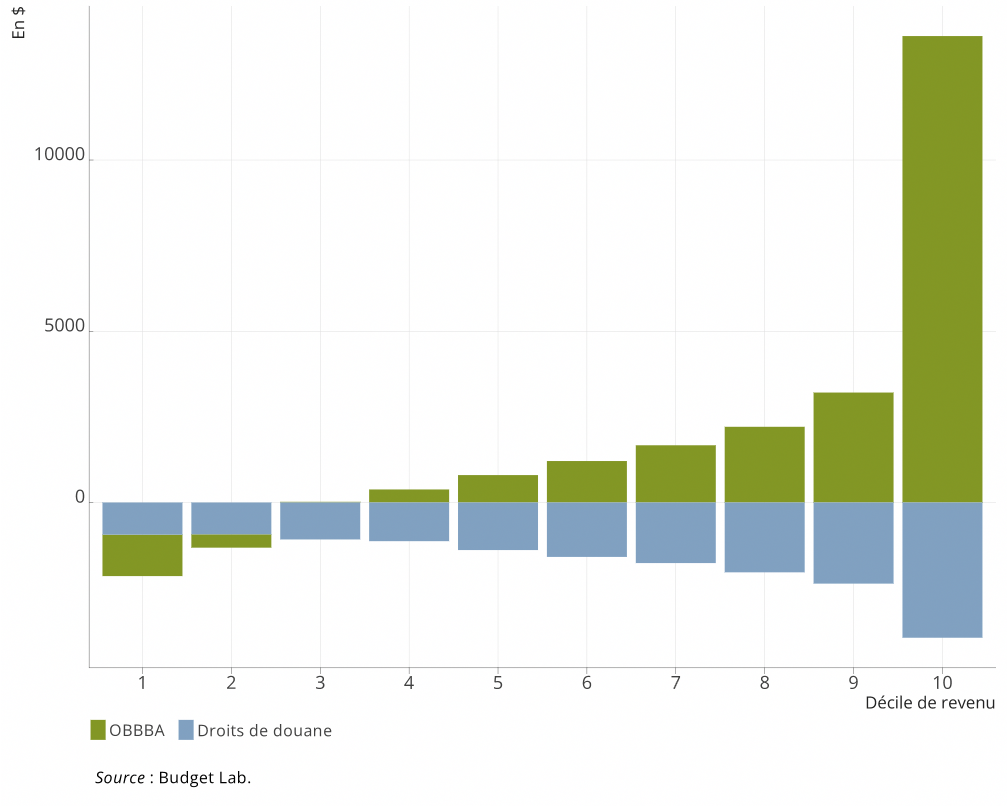
Beyond their effects on growth and foreign trade, the tariff and fiscal policies implemented by Donald Trump since his return to the White House will have an impact on the distribution of income among American households. Tax cuts will certainly increase income, but they will be offset by spending cuts and tariff increases, with a net negative effect on the poorest households.

Christophe Blot

Jan 23, 2026

All the Nicolas in the world

Who is Nicolas (the meme)? The WID’s distributed accounts provide an answer: in France, 70% of the least wealthy individuals are net beneficiaries of redistribution, which corresponds to a gross income excluding pension contributions of more than €4,200/month/person, or a net income after tax of €2,550 per month (for a single person without children). This income, which balances taxes paid with public benefits and expenditures received, has increased over the last 30 years.

Xavier Timbeau

Jan 15, 2026

A high share of wages in Added Value in France in 2025

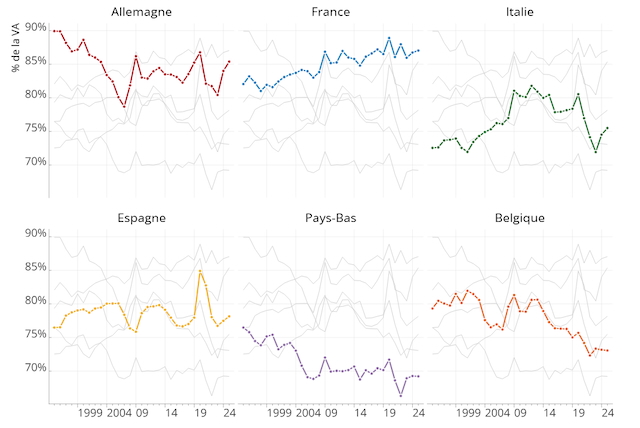
We explore different ways of calculating the share of wages in value added. The preferred concept is that of the share of wages adjusted for non-wage compensation through mixed income in value added net of fixed capital consumption in market sectors excluding real estate services. This reveals France’s unique position, where the share of wages is higher and has increased significantly

Xavier Timbeau

Nov 28, 2025

Fighting poverty: is France falling behind?

The monetary poverty rate, a benchmark indicator defined as the proportion of the population living with a standard of living below 60% of the national median, reached 15.4% in 2023 in metropolitan France, according to the latest figures from INSEE.

Pierre Madec

Nov 26, 2025

Politics and public deficits: England in 1976

This blog explains the Labour Party’s recourse to the IMF in Great Britain in 1976

Xavier Ragot

Sep 8, 2025

Is public debt a right-wing or left-wing issue?

This blog discusses the relationship between the political leanings of governments and public debt.

Xavier Ragot

Sep 8, 2025

The Anatomy of Government Bond Yield Synchronization in the Euro Area

Interest rate synchronization is vital for the effective transmission of common monetary policy in the Eurozone. We study the synchronization of government bond yields, identifying three phases: pre-crisis, crisis, and recovery. Using a novel factor-based method, we show how yield divergence during crises hindered policy transmission. The analysis also provides a financial interpretation via optimal portfolios and flight-to-quality dynamics.

Claudio Barbieri, Mattia Guerini, Mauro Napoletano

Aug 25, 2025

Le double dilemme de la Réserve fédérale

Since his return to the White House, Donald Trump has relentlessly pressured the Federal Reserve Chairman to lower interest rates. He has repeatedly hurled invectives and even insults at Jerome Powell, going so far as to suggest the possibility of attempting to dismiss him.

Christophe Blot

Jun 17, 2025

Tariffs and retaliation: a quantitative analysis

Trade wars can have significant macroeconomic consequences. Yet the interaction between trade policies and optimal macroeconomic strategies remains little explored. This post proposes an analysis in the context of various monetary policy rules.

Stéphane Auray, Aurélien Eyquem, Michael Devereux

Jun 3, 2025


Is Europe falling behind the United States?

According to the Draghi report Europe is falling behind. We propose an analysis from the point of view of individual incomes and their distribution, instead of the usual macro or sectoral approach. For the poorest 50%, Europe is a more attractive model than the United States. France has managed to maintain a fairly egalitarian model (at the cost of high taxation of the richest 1%), while the United States is marked by extreme polarisation. Strong growth in the United States mainly benefits the richest and the very rich, leaving a large part of the population on the sidelines without any trickle-down benefits.

Xavier Timbeau

May 21, 2025

Can Donald Trump Derail American Growth?

The early weeks of Donald Trump’s second term are strongly marked by multiple announcements regarding tariffs. It must be noted that this new trade war is experiencing numerous twists and turns that are not economically neutral.

Christophe Blot

Apr 28, 2025

Germany: Public Investment to the Rescue of Growth

At the end of 2024, German production is barely above its pre-COVID level. The grand coalition of CDU/CSU-SPD, formed after the snap elections, plans a massive investment in defense and infrastructure, outside the traditional debt framework. Public investment thus potentially becomes the key to Germany’s economic recovery.

Céline Antonin

Apr 24, 2025

Regardless of the outcome, uncertainty in trade policy will have significant effects on global trade

Since the beginning of his second term, D. Trump has continued to make announcements in various directions regarding trade policy. In March 2025, before “Liberation Day”, the trade policy uncertainty index constructed by Caldara et al. (2020) stood at a level 13 times higher than its historical standard deviation.

Raul Sampognaro

Apr 22, 2025

Reconciling funding emergencies in Europe: Defense, Climate, and Social Issues

Europe must finance three priorities at the same time: European defense, the climate and digital transition, and the strengthening of European infrastructure and the social model. This is possible and necessary, and it is crucial to emphasize the need to simultaneously address these three priorities.

Luiz Awazu Pereira da Silva

Mar 24, 2025

February 11: International Day of Women and Girls in STEM

Worldwide, the proportion of women in STEM fields is increasing, but unevenly. In the United States, for example, women earned 49% of STEM degrees in 2017. However, while they are the majority in biology (62%), their presence drops sharply in quantitative disciplines: 39% in geosciences, 22% in engineering, 42% in mathematics, 19% in computer science, and 40% in physical sciences.

Montserrat Botey

Feb 27, 2025

The Federal Reserve vs Donald Trump: Act I

The beginning of November was marked not only by the outcome of the US presidential elections. On 7 November, the FOMC (Federal Open Market Committee) announced a 0.25 point cut in the Federal Reserve’s target rate

Christophe Blot

Nov 21, 2024

The ECB’s monetary policy stance in perspective

When the ECB started to reduce policy rates - the first cut dates back to June 2024 -, there were rising concerns that the monetary stance might still weigh down on economic activity, at least in the short-term. But how far had that restrictive monetary stance been? Are the shifts in the interest rates sufficient to assess the monetary policy stance or should we also account for the economic context and also for measures taken by the ECB beyond the policy rate?

Christophe Blot, Jerome Creel

Nov 19, 2024

The Widening Productivity Gap and the Underperformance of ICT-Intensive Sectors in France

Over the last three decades, labor productivity increased more rapidly in the U.S. than in Europe. In 2019, hourly productivity in the euro area was 82% of that in the U.S., compared to 98% in 1995

Sébastien Bock, Penelope Gelman

Nov 18, 2024

Green and Smart?

While green and smart technologies are essential for reducing emissions, their sustainability depends on optimizing their life cycle, particularly in material sourcing, recycling, and waste management. The blog examines their life-cycle impact and highlights the urgent need for sustainable practices at every stage—from extraction to disposal—to ensure they truly contribute to a low-carbon sustainable development.

Jessica Coria

Nov 4, 2024

What impact does a freeze on the income tax scale have?

It would seem that the idea of total or partial freezing of the income tax scale, debated in recent weeks, has been (for the moment) abandoned by the government… With the help of the micro- simulation, we still propose here an evaluation of the budgetary savings that can be expected from such a measure as well as its redistributive impacts.

Pierre Madec

Oct 1, 2024

Should the ECB Revise its inflation target ?

The inflation rate in the Eurozone continues to decline. In February, it dropped to 2.6%, more than two percentage points lower than the August. The inflation rate is still above the ECB 2% inflation target despite the monetary policy tightening implemented since Summer 2022.

Christophe Blot, Francesco Saraceno

Mar 18, 2024

No matching items


powered by