Why and How Should the Richest Be Taxed?
The Zucman Tax (ZT) or the Ascertainable Comprehensive Income Tax (ACIT)?
Authors&Summary

Published in 2013, Capital in the Twenty-First Century (Piketty, 2013) documented growing wealth inequality, both in terms of the rising weight of capital — measured by the ratio of household wealth to national income — and of the growing concentration of wealth among the upper quantiles. The latter finding has been confirmed on more recent data produced by the World Income Database (WID). According to the latest World Inequality Report, the share of wealth held by the world’s richest 0.001% (56,000 adults) rose from 3.8% in 1995 to 6.1% in 2025 (Chancel et al., 2026). The WID report also documents the regressivity of effective tax rates for centimillionaires and billionaires (in wealth). Income from wealth — particularly from business assets — is taxed less than labour income.
This raises the question of wealth taxation, notably through the various types of wealth taxes. Few countries tax households’ net wealth. In 2018, the OECD observed that the number of countries with such a tax had fallen from 12 in 1990 to 4 in 2017. France, Norway, Spain and Switzerland were the four remaining countries. Since then, France has abolished its wealth tax (ISF), which taxed wealth excluding business assets, replacing it with a real-estate wealth tax (IFI) that exempts all movable assets. Excluding the French IFI, only three countries still tax net wealth today: Spain, where the revenue from this tax amounts to 0.2% of GDP, Norway (0.6%) and Switzerland (1.2%)1.
1 OECD Revenue Statistics 2023. Taxation of household net wealth.
The disappearance of wealth taxes (notably in Germany, Denmark and Sweden) thus occurred at a time when the value of household wealth was rising relative to income. According to the WID, household wealth worldwide was equivalent to 4.3 years of income in 1993; by 2023 the ratio stood at 6.1. In France, net household wealth rose from 4.8 years of income in 1995 to 7.9 years in 2024 — an increase of three years of disposable income over thirty years, despite higher inflation at the end of the period (OFCE, 2024, based on the French national wealth accounts, INSEE).
Is it paradoxical that wealth taxes shrink just as the value of wealth increases?2 On the one hand, one may think that the potential tax base of a tax on household net wealth has grown considerably relative to GDP, and that this is « good news » for the Treasury (Trannoy and Wasmer, 2022). On the other hand, one may point out that households pay taxes by drawing on their disposable income, not on the value of the square meters they own. Moreover, the larger the base, the bigger the problems a tax raises (notably in terms of equity), since governments do not generally adjust tax thresholds in real time. Paradoxical or not, the coincidence of rising wealth inequality and the abolition of taxes designed to reduce it poses both an equity problem and a political problem.
2 Masson (2018) raises the same question with regard to inheritance taxation.
4 In 2022, in an IPSOS poll for Le Monde, the real-estate wealth tax (IFI) was the tax respondents found most justified (81%), while inheritance duties were perceived as the least justified (17%). The same was already true of the ISF. As for the Zucman tax, it is approved by 68% of respondents according to Cluster 17, and by 86% according to Ifop.
It is in this context that Gabriel Zucman has proposed a 2% floor tax on individuals with very large wealth, first in a blueprint published under the Brazilian presidency of the G20 (Zucman, 2024) and then in the French debate (Zucman, 2025). The bill establishing a 2% floor tax on the wealth of the ultra-rich, introduced by members of the Écologiste et Social group (the Sas bill) and passed at first reading in the National Assembly in January 20253, follows from this proposal. In this paper, the term « Zucman tax » (ZT) refers to the proposal in the 2025 book for France and to the bill (the two are the same proposal). It provides for a floor tax on wealth where the net value of household assets exceeds €100 million. The base is the one used for inheritance, excluding tax reliefs (the Dutreil pact). The text was rejected by the Senate and then referred back to the Finance Committee. During the examination of the 2026 budget bill, deputies rejected the amendments seeking to introduce the tax, despite its popularity. Indeed, in successive surveys and opinion polls, taxation of inheritance is as unpopular as taxation of large fortunes appears highly popular4.
The Zucman tax proposal follows past experiences of taxing « fortunes » (movable and immovable) between 1982 and 1986 (IGF) and then between 1989 and 2017 (ISF). In 1981, the Mauroy government created the tax on large fortunes (IGF), levied on wealth whose value exceeded 3 million francs. The tax was justified by the fact that wealth increases the ability to pay, beyond the income it generates, and by the objective of reducing wealth inequality. Business assets — notably the assets needed for industrial, commercial, artisanal and agricultural production (including farmland) and shares in companies managed and more than 25% owned by the owner or his family — were not subject to the tax, nor were antiques or works of art. The aim was to spare the working tool. However, at the time, and to prevent this exemption from allowing small business owners to include personal-use assets in the exempt base, the law provided that the provision applied only to « the fraction of the value of the shares corresponding to the assets necessary for the industrial, commercial, artisanal, agricultural or liberal activity of the company »5. It was the working tool — the physical assets used for production — that was exempt, not the value of the company. Put differently, only the difference between the market value of the firm and its net physical assets was taxable. The firm’s capital was spared, but not the individual’s fortune. The IGF was abolished in 1986 and then restored in 1989 under the name ISF. The earlier mechanism was abandoned, and business assets (including companies managed and more than 25% owned) were simply excluded from the base. One consequence is that the exemption now encompasses holding companies6. The capital/wealth distinction disappeared. A cap on taxation was also introduced, limiting the ISF as a percentage of fiscal income, so that minority shareholders receiving no dividends could likewise benefit from low taxation. The ISF was then criticized for being « the tax of millionaires but not of billionaires » (Herlin-Giret, 2017)… and was eventually replaced by the real-estate wealth tax (IFI) in 2018. Paradoxically, the IFI no longer taxes billionaires at all beyond their real-estate holdings. The criticism levelled at the ISF applies even more strongly to the IFI. It does, however, tax all real-estate wealth homogeneously, which is satisfactory from the standpoint of horizontal equity.
6 Jean-Louis Trousset, « ISF : les limites de l’exonération des biens professionnels », Les Echos, 19 May 1998, https://www.lesechos.fr/1998/05/isf-les-limites-de-lexoneration-des-biens-professionnels-792462
7 The Common Program of 27 June 1972 between the Socialist Party and the Communist Party thus provided: « A new annual, progressive, low-rate tax shall be instituted on the capital of companies and on large fortunes. » It thereby proposed taxing « capital » and « fortune » at the same rate.
With the « Zucman tax », the debate over the relevant wealth base starts over from the beginning. From 1970 onwards, the communists and socialists proposed a tax on capital as a whole; then, in 1976, the socialists opted for a proposal to tax big or large fortunes while exempting business assets. The communists, for their part, kept stressing that the « working tool » bears fruit only through the exploitation of wage-earners, and that there is a continuity between large fortunes and corporate capital (Herlin-Giret, 2017). By including business assets in the tax computation — by not distinguishing capital from wealth — the Zucman tax thus returns to the original position of the communists and socialists of the early 1970s7.
The debate over the « Zucman tax », a floor tax on wealth, brings into play the representation of inequality and raises the question of tax equity. Before taxing wealth or income, one must be able to define them. Yet the definition is not as obvious as it seems. In this paper, we review the various public-policy arguments concerning the Zucman tax. We first present the arguments in favour of the Zucman tax (Section 1). We then discuss the objections (Section 2). Finally, we discuss an alternative pursuing the same objectives while answering the objections (Section 3).
1 The arguments in favour of the Zucman tax
1.1 The Zucman tax: a floor tax on large fortunes
By « Zucman tax » (ZT) we mean here the bill establishing a 2% floor tax on the wealth of the ultra-rich, which is also the proposal discussed in the book Les milliardaires ne paient pas d’impôt sur le revenu et nous allons y mettre fin (« Billionaires pay no income tax, and we are going to put an end to it »), published by Seuil in 2025.
Precisely,
\begin{aligned} ZT = & \max(2\% \times \text{Net wealth} \\ & - IR -IFI - \text{CDHR}, 0) \end{aligned}
for a net wealth value above €100 million (the tax threshold), where IR is the personal income tax; IFI the real-estate wealth tax; and \text{CDHR} the Differential Contribution on High Incomes (Contribution Différentielle sur les Hauts Revenus).
Net wealth is valued using the same method as for inheritance duties. Assets, located in France or abroad, are valued at their market value (valeur vénale) based on an estimate declared by the taxpayers (individuals whose tax residence is in France). The market value equals the market price on January 1st. The value of shares in unlisted companies must be assessed by taking into account all the elements making it possible to arrive at « a figure as close as possible to that which would have resulted from the normal interplay of supply and demand ». A plurality of valuation methods is allowed for valuing unlisted companies. The method preferred (by the tax administration) consists of using the average price-earnings ratio of a group of similar listed firms. It is also possible to compare gross operating surpluses, cash flows, etc.8 (cf. BOFiP).
8 See the documentation of the Directorate-General of Public Finances (DGFiP): « L’évaluation des entreprises et des titres de sociétés »
1.2 Restoring progressivity at the top
Gabriel Zucman’s initial argument (Zucman, 2024) is relatively simple, which is both a strength and a weakness. The diagnosis is summarized by graphique 1, taken from Bozio et al. (2023), which plots the effective tax rate on « economic » income against the percentile of « economic » income, for the wealthiest 10% of households (3.8 million tax units). This tax rate is computed as all taxes paid (personal income tax, corporate income tax, property taxes, flat tax (PFU), CSG9) divided by « economic » income, which adds further elements to the usual or legal fiscal income (see encadré 1).
9 Indirect taxes such as VAT are not included. For the income levels considered, this changes the tax rate by no more than one percentage point, as consumption is a negligible fraction of income: for a household with an income of €60 million (a 6% return on €1 billion), it seems difficult to consume (goods or services subject to VAT) more than a few percent of income, and hence to pay more than 20% of those few percent.
10 The regressivity of the tax system had already been diagnosed by Landais, Piketty and Saez (2011) in Pour une révolution fiscale. In the chart on p. 50, regressivity begins much earlier: « tax rates rise slightly with income up to the 95th percentile, then fall with income for the richest 5% ».
The effective tax rate so defined declines (on average) from P99.9 onwards, i.e., the wealthiest 0.1% (38,000) of households. It falls from 46.0% at P99.9 to 26.2% from P99.9998 (75 households) upwards10. For these 38,000 households, total taxation is regressive — the rate declines as income rises. Gabriel Zucman argues that this regressivity is an unintended anomaly of the tax system and must be corrected. It is said to result from the growing use of companies to conceal individual income (Zucman, 2024):
To understand the issue, one needs first to note that ultra-high-net-worth individuals derive their income not from the wages they earn but from the wealth they own—more precisely, in most cases, from the businesses they own. These businesses make profits, which are typically subject to the corporate income tax. The core limitation of the individual income tax is that wealthy individuals can structure their wealth to report little to no taxable individual income, and thus avoid the individual income tax. This tax avoidance is done in two main ways: (i) by avoiding dividend distribution and capital gains realizations; (ii) by using holding companies and similar legal structures.
A 2% differential tax on wealth, above €100 million of wealth, would make it possible to eliminate the regressivity measured at the quantile level — or even, depending on what is included in the differential, to restore progressivity. It would raise €19.4 billion in revenue in France, and €67.2 billion at the European Union level (Parrinello, Varaschin and Zucman, 2025).
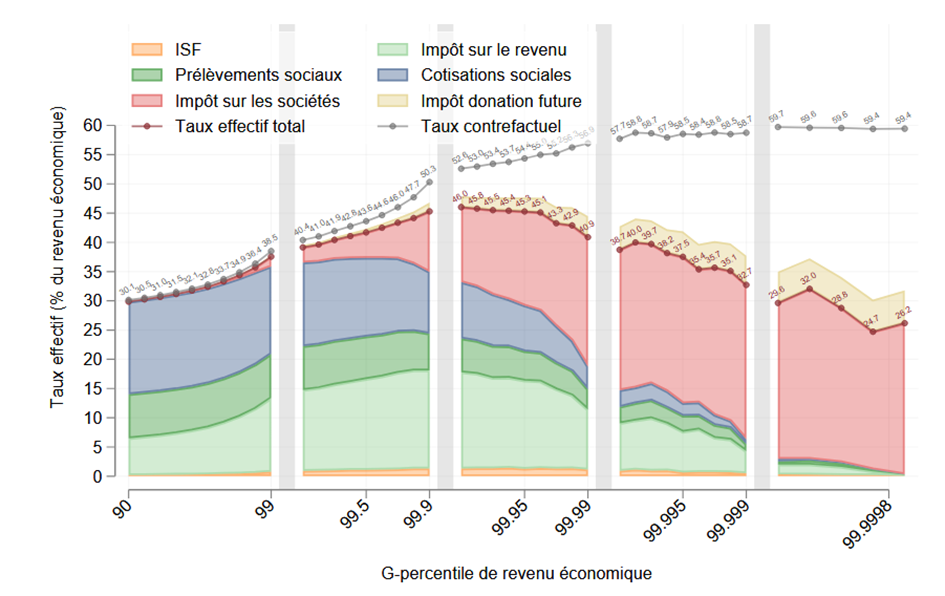
Key (chart in French): ISF = wealth tax; Prélèvements sociaux = social levies; Impôt sur les sociétés = corporate income tax; Taux effectif total = total effective rate; Impôt sur le revenu = personal income tax; Cotisations sociales = social security contributions; Impôt donation future = future gift tax; Taux contrefactuel = counterfactual rate. Horizontal axis: percentile of economic income.
The originality of the method used by the Institut des Politiques Publiques (IPP) is to distinguish households’ « economic income » from their « fiscal income ». Economic income includes more elements than fiscal income, because not all so-called economic income is treated by the legislator as income for income-tax purposes. Notably, as regards the wealthiest, in the IPP note the undistributed profits of companies (retained and reinvested) are included in economic income, whereas these incomes are not included in fiscal income (Bozio et al., 2023). The authors thus impute to households the « undistributed profits of companies controlled by tax households, in proportion to their effective ownership ». This method is used only where companies are deemed to be controlled by tax households (defined as an ownership stake above 10%).
The tax rate thus computed therefore stems from a convention specific to the authors. The regressivity of the tax rate so computed raises a manifest problem of (vertical) equity, but it is not a legal problem. The law reasons on individual cases, not on populations on average; in tax matters, the Constitutional Council reviews each instrument separately; it reviews the rule, not its economic effects. Economic income has no legal existence: the legislator has never chosen economic income as a tax base.
11 It is therefore possible, legal and consistent with the spirit of the law to enjoy a high level of consumption with no fiscal or economic income: it suffices to dissave (an inheritance, for example). One could tax consumption rather than income, but that would mean exempting income that is not consumed.
(a) Thus, the application of the exit tax to an individual who takes up residence outside France requires the declaration of unrealized capital gains on, for example, securities held; but the tax due is paid only when the gain is realized, i.e., when the securities are sold. The gain then becomes realized rather than latent, and its amount is enforceable because it is no longer speculative, by virtue of the disposal of the securities [Dalloz (2025); CGI, Art. 91 quindecies A].
There are several accounting ways of apprehending economic income. In the IPP note, to avoid double counting, the authors choose to remove capital gains on securities from household income, because undistributed profits translate into capital gains (latent or realized). Indeed, if profits are stored somewhere in a company or a holding, the value of that company’s shares should, mutatis mutandis, increase by the same amount. The existence of potential double counting shows that, even when agreeing on the same definition of economic income, one can apprehend economic income either through profits or through capital gains.
The way the effective tax rate is computed in the IPP chart includes corporate income tax, consistently with the inclusion of undistributed profits in economic income. One can see (1) that corporate income tax accounts for practically all the tax paid by the very rich (above P99.999, i.e., 378 households) and (2) that the inclusion of corporate income tax is not enough to restore tax progressivity.
1.3 Capital taxation as a force for economic efficiency
Wealth taxation has often been presented as having a low cost in terms of efficiency, or even as being efficient (Allais, 1977).
It is unlikely that centimillionaires who continue to reside in France would be induced to save less or to invest less on French territory, since the tax targets individuals according to their residence, not according to the destination of their savings. The Zucman tax thus answers an objection raised against taxes targeting firms rather than their shareholders, notably so-called production taxes (Martin and Trannoy, 2019). With free movement of capital, and under certain assumptions discussed below, wealth taxation is supposed not to harm the competitiveness of French industry.
It is unlikely that these centimillionaires would be less inclined to work to make their capital grow, since they keep 98% of the value of that capital.
The marginal incentive to make capital bear fruit is little affected, in contrast with a tax based on income, which taxes the creation of wealth. From an incentive standpoint, taxing wealth at 2% is not equivalent to taxing capital income at 50%, even if average returns are 4%. The wealth tax would thus be less of a disincentive than the income tax. Some go further and argue that wealth taxation would be a positive incentive. Indeed, a billionaire capitalist earning only a 1% return on his wealth will see his wealth melt away relative to a billionaire earning a 5% return. In a closed economy, a tax on the stock of wealth could lead to assets being controlled by the best entrepreneur/manager capitalists. This is Maurice Allais’s argument in L’impôt sur le capital et la réforme monétaire (Allais, 1977):
The tax on capital constitutes a premium for production and a penalty for the inefficient, if not passive, owner, whose inaction the income tax currently encourages. (…) An annual tax on capital, far from penalizing creative activity as our current taxes do, would on the contrary grant it a premium that would multiply useful efforts and increase productivity. This tax would favour the accession of the most capable to wealth and thereby to economic power; it would make it difficult for large amounts of capital to remain in the hands of the less capable, and would thus foster social advancement (pp. 116–117).
In the book, Allais (1977) quotes George (1887) at length:
To abolish the taxation, which acting and reacting now hampers every wheel of exchange and presses upon every form of industry, would be like removing an immense weight from a powerful spring. […] Instead of saying to the producer, as it does now, « The more you add to the general wealth the more shall you be taxed! » the Government would say, « Be as industrious, as thrifty, as enterprising as you choose, you shall have your full reward! You shall not be fined for making two blades of grass grow where one grew before; you shall not be taxed for adding to the aggregate wealth. » (Progress and Poverty, 1879, Book IX, Chap. 1 — quoted by Allais, p. 116, from the 1887 French edition)
Maurice Allais proposes abolishing the income tax and replacing it with a tax on capital… of 2% on capital as a whole. Taxing the rich would not be enough:
In any event, the proceeds of a capital tax limited to large fortunes would have only a relatively low yield. Considering the statistical data for 1976 and a basic allowance of 2 million francs, the tax base would amount to 200 billion, i.e., for the envisaged rate of 1.5%, a yield of around 3 billion, or roughly 0.25% of national income.
The book relies on data for 1976. The 2% rate is a share of the « pure real interest rate », estimated at 5%, which would make it possible to confiscate pure rents entirely. The 2% rate confiscates less than half of this pure rent. The proceeds of the tax would reach 8% of national income and would replace the general income tax, the tax on corporate profits and the tax on real-estate transfers.
Alain Trannoy and Étienne Wasmer make a similar proposal targeted at land wealth in Le grand retour de la Terre dans les patrimoines, et pourquoi c’est une bonne nouvelle (Trannoy and Wasmer, 2022). The argument is framed mainly in terms of efficiency. Land is not mobile: the Earth will not go into exile abroad; tax instruments do not make it possible to escape land taxation. This inelastic tax base should therefore be taxed. This echoes the Ramsey rule whereby, other things being equal, the more inelastic bases — which induce the smallest distortions — should be taxed more heavily (Ramsey, 1927).
The argument in favour of the Zucman tax is simple: it is about raising revenue (€15–20 billion) from the very rich (wealth above €100 million), making it possible to restore the progressivity of the tax system at a time when some of these individuals escape taxation, their wealth generating no fiscal income (Zucman, 2025). Such a mechanism has the advantage of covering all the possible ways of minimizing one’s fiscal income. At such a level, wealth would be a better proxy for economic income and ability to pay than fiscal income. At the current average return on these fortunes (7.5% net of inflation), a 2% reduction in the net return would not significantly reduce the incentives to invest (Zucman, 2024).
2 Objections to the Zucman tax
2.1 A tax based on wealth to remedy the regressivity of income taxation
There is a fundamental contradiction — starting with the very title of Gabriel Zucman’s book — between the diagnosis that billionaires pay no income tax and the solution, which involves taxing wealth.
The IPP computation includes undistributed profits in the analysis of regressivity, but that is not the base chosen by Zucman. The floor tax allows the deduction of individual taxes, but not of corporate income tax — nearly all of the tax paid by the ultra-rich. The tax is de facto a flat levy on wealth.
The explanatory memorandum of the floor-tax bill thus insists on income:
Today, our tax system is regressive for the richest 0.1%: relative to their income, they pay proportionally less tax than the average French citizen. (…)
In ten years, the 500 largest French fortunes have seen their wealth increase by €1,000 billion, from €200 to €1,200 billion. Over this period, their wealth has grown by 8 to 10% per year. More generally, capital income rose by 7.3% in 2022 and by 15.5% in 2023 — three times faster than labour income — and inequality keeps widening.
Yet the proposed tax has as its base the declared current net value of wealth.
A solution consistent with the diagnosis would have been to tax individuals on the profits of the firms they own, so that firms would be transparent (like transparent SCIs). That is not the solution adopted (for good reasons, see below).
There is indeed a link between wealth and income: the value of wealth is, at least in theory, a function of all the future income and benefits an owner or potential buyer expects to derive from it. A profit rate anticipated as constant is equivalent to an income that is a proportion of wealth. This is the assumption made by Gabriel Zucman to justify the 2% rate (Zucman, 2025):
The 2% rate, moreover, was not chosen at random: it is the rate that would erase the regressivity of the current tax system. For billionaires, the rate of return on wealth averages 6% a year. An incompressible contribution equal to 2% of wealth would cut this return by one third; it would therefore be equivalent, on average, to a 33% income tax. Added to the corporate income tax that the ultra-rich pay through the companies they own, it would bring their total compulsory levy rate to 50–55%, roughly what the average French person pays. It would thus be a mere alignment of our tax laws with our fundamental constitutional principle of equality before taxation. In this sense, it is impossible to go below 2%: a lower rate would amount to endorsing the principle that billionaires are entitled to contribute less to public finances than the rest of the population.
The inconsistency between a diagnosis in terms of income and a recommendation bearing on wealth would disappear if wealth had a constant, certain and homogeneous return across all taxpayers. Wealth would then be a good proxy for capital income. But that is not the case. The return on wealth is not constant — over time, across asset classes, or across individuals — hence the complexity of valuing wealth and its volatility over time (when its valuation is revised).
Income and wealth are nevertheless not perfectly correlated: future incomes are more or less distant and, above all, more or less certain. There can also be marked differences in the appraisal of the value of any given asset. Not all assets are regularly traded on the market, so their « value » is not necessarily easy to determine, whether from a practical or even a theoretical standpoint. What is the value of the remaining 99.9% of a company that has just opened 0.1% of its capital to an investor shareholder? Is this value the same for all shareholders, or does it depend on shareholder agreements and other conditions set at the time of the transaction, without being public? How should one weigh the high risk of this investment, and thus the possibility that in some time the value of the firm will be very different: far higher in the event of unhoped-for success, almost nil in the event of possible failure — since precisely this mode of financing was the only one available to the entrepreneurs, given a future yet to be proven? The history of nascent firms (start-ups) teaches us that initial valuations are nothing but the at-best-informed speculation of an investor and an entrepreneur, often against the opinion of the rest of the world; they are a bet — or a dream — rather than the revelation of a value that would be well determined but known only to insiders. Consequently, this valuation (at the time the capital is opened) is not deferred income, which would make its taxation illegitimate (see encadré 1).
By reasoning in averages by quantile, on a household or individual supposed to be representative of an income class, the argument struggles to take into account the specificities of individuals and their situations. It moves too quickly from the individual situation to its mathematical expectation or to the aggregate which, even if well defined (in the probabilistic sense), is not legally enforceable against each of the individuals in the class — all the more so as membership of the class itself depends on the assessment of that income.
2.2 Does market value always exist?
Most arguments against the homogeneous taxation of wealth at its market value point out, in one way or another, either that capital is not homogeneous or that it is difficult or impossible to value it equitably following the concept of fair market value.
Wealth taxation could also put investment at risk. In our entrepreneurial economies, with imperfect capital markets, venture-capital-type investment could in practice be prevented by a tax such as a floor tax on net wealth, owing to the deterrent effect it would have through the obligation to value invested capital before knowing the outcome of a project.
The problem stems from the difficulty of valuing unlisted wealth. Under the tax code, for gratuitous transfer duties — i.e., the valuation method proposed by the floor-tax bill — assets must be declared at their « market value » (valeur vénale). The difficulty consists in valuing companies not listed on the stock exchange, certain real-estate properties, paintings, etc. Céline Bessière and Sibylle Gollac show in Le Genre du capital (Bessière and Gollac, 2020) how, at the time of transfers, these assets are valued « in the shadow of the market », so as to favour the transfer of the firm to the (male) heir-entrepreneur. The legal-family arrangements facilitated by notaries are sometimes tested in the event of conflict: the valuation gaps on asset values can then be very large. The authors show how succession arrangements differ across social classes, the type of wealth to be transferred and families’ familiarity with the law — with, however, two invariants: the will to minimize taxation, which acts as a factor of family unity, and the will to keep assets intact within the family, generally at the expense of female heirs.
What is true of the small family or farm business is also true of the largest unlisted companies. If subject to a tax on the market value of his wealth, an entrepreneur could stand to gain from staying « in the shadow of the market » and of objective valuations. Thus, an entrepreneur would see a risk in opening 10% of his capital, lest the remaining 90% of his wealth be valued at that price and he be made to pay 2% of that amount in tax every year.
The case of nascent firms (start-ups) illustrates the ambiguity of this valuation method. The value that a start-up’s founders and shareholders hope for is not yet realized and may never be. A 2% headline tax rate on the current value of the firm could then have harmful consequences. It would be paid by the individuals, diluting them over time — and quite quickly: 2% a year of their virtual capital corresponds to 20% a year of the funds invested in the case of an opening of 10% of the capital. This would force the founders to sell their shares. The proposal made by G. Zucman to pay the tax by handing over shares to the tax authorities suggests that, in the event of bad fortune, the tax paid would shrink along with the firm’s value. There would no longer be a problem — except that the 2% rate would have been applied to wealth of less than €100 million and that it would not have hit all shareholders alike (depending on whether they are an investment fund representing hundreds of shareholders, a large company with floating capital, or foreign residents). This asymmetry, even if, at the end of the story, it amounts to the loss of a few scraps of paper for the founders, is enough to disturb the already complex game of the world of innovation.
This case is not an extreme or marginal example; it is at the heart of modern capitalism. One can cite an example known to the public. In September 2025, Mistral AI announced that it had raised €1.7 billion at a price valuing the company at €11.7 billion after a capital increase. At its previous capital increase, in June 2024, Mistral AI was valued at just under €6 billion. If the three founders hold about 50% of the capital, then following the latest operation, a 2% wealth tax would rise to €100 million after the capital increase, against €60 million before it. Mistral’s annual revenue is estimated at €300 million in 2025 (for an almost nil profit). It would be perfectly absurd to force one third of the company’s turnover to be devoted to paying a tax, or to dilute the founders. Such taxation could curb capital increases, to the detriment of the firm’s development and capacity to innovate.
The problem of valuing an unlisted company does not concern Mistral alone. Alain and Gérard Wertheimer, 4th and 5th in the 2024 Forbes France ranking, own Chanel, an unlisted company. They are domiciled in New York and in Switzerland, respectively. Emmanuel Besnier, 6th in the ranking, is the CEO of Lactalis, an unlisted company. Of the ten largest French fortunes, three consist mainly of unlisted companies. But the risk is less in this proportion than in endogeneity: taxing wealth at its current value risks creating an incentive to move « into the shadow of the market ».
Delisting has two advantages: the systematic undervaluation allowed by uncertainty as to the best valuation method; and the avoidance of taxation during « bubbles » — sharp rises followed by sharp falls. By comparison, the stock-market fluctuations of LVMH (Bernard Arnault) or Kering (François Pinault) could generate either litigation or an incentive to delist. Delisting could indeed forestall the fluctuations inherent in financial markets. For example, LVMH traded at €901 on 21 April 2023… and at €449 on 27 June 2025. Kering reached a peak in August 2021 (€788) before falling to €125 in 2025. If François Pinault, Kering’s main shareholder, had borrowed to pay a tax amounting to 2% of his wealth held in Kering on 2 January 2020, 2021, 2022, 2023 and 2024, this borrowing would have been equivalent, in principal, to 19% of his wealth on 2 January 2025 (excluding interest charges). Under such conditions, many billionaires would not come through a speculative bubble unscathed. These swings obviously cast doubt on the assumption of homogeneous returns: should these returns be measured at the peak or at the trough?
How much is Chanel worth? Lactalis? The valuation of unlisted companies is neither a minor nor a consensual issue, whether in business law or in financial theory. For example, Rijken, Booij and Buckley (1999) estimate the discount of unlisted relative to listed companies at 40%. If all companies were unlisted, it would suffice to multiply the tax rate by 2 — but is it desirable, from an efficiency standpoint, for companies to be unlisted?
One paradox is that one of the most reliable ways of valuing companies is the use of a profit multiplier, assuming a price/earnings (P/E) ratio that is stable across firms in the same sector, or a multiple of EBITDA, of operating income, or of the gross operating surplus…12 But (1) this ultimately amounts to taxing income (within a given sector); and (2) it amounts to taxing this income at different rates for each sector, with the sectors of the future taxed more heavily (their P/E is higher because of larger prospective future income, but also because of higher risks). For some start-ups, taxing the value of the equity capital, assessed on the basis of the latest capital increase, is not merely an advance payment of income tax (in the manner of the corporate tax): it is an advance payment of tax on future income as anticipated, on average for the sector, by the market.
12 See the guide to the valuation of businesses and company securities (Direction générale des Finances Publiques)
Yet, by introducing the Zucman tax, one completely modifies the games of capitalism and the bets on the future values of a project that are at the heart of capitalism and of its financing. These modifications would no doubt strongly push actors to seek spaces less disturbed by tax rules (tax exile), to conceal these virtual valuations in agreements or contracts — even at the cost of tying their own hands — or to integrate the tax consequences into the players’ game, especially when they are not subject to the same consequences.
2.3 What is equality in taxation?
The principle of equality in taxation is an important constitutional principle. It translates underlying principles that can be discussed.
The objection raised against the Zucman tax is that, until now, the Constitutional Council has required a cap on wealth taxation (ISF then IFI) relative to income, so that taxation is not confiscatory — in the sense that owners must not have to sell (their wealth) to pay the tax. While the Council has not formally defined the term confiscatory, de Crouy-Chanel points out in the Nouveaux cahiers du Conseil constitutionnel (Crouy-Chanel, 2011) that:
Presumably, a tax would be confiscatory if, exceeding the taxpayer’s income, it obliged him to dispose of part of his wealth to pay the tax.
The jurist meets the economist with an argument that echoes Hicks’s definition (see encadré 1).
The ZT proposal answers this objection in a clever, but not riskless, way. The proposed tax threshold — net wealth of €100 million, i.e., about 1,800 households (the richest 0.0005%, or P99.9995) — is meant to circumvent the confiscatory character of the tax: at that level of wealth, individuals either have liquidity or must be able to borrow it. According to Gabriel Zucman in Le Monde:
Above €100 million in wealth, it is obvious that the persons concerned have a strong ability to pay and that no exemption is necessary, especially for a tax at a rate that remains low.
In another op-ed, a group of legal scholars writing in Le Monde likewise stress the purpose of this aspect of the law:
It is careful, however, to forestall the risk of « confiscation » reviewed by the Constitutional Council, by maintaining an exempt stock of €100 million.
The argument is as follows: the floor tax would not be confiscatory because, at that level, no one would have to sell a real-estate or business asset to pay the tax, since the level of fortune would guarantee access to liquidity and the fortune would be vast and diversified enough to keep growing at a rate above 2% a year. This very high threshold of €100 million is thus explicitly set to rule out a confiscatory character — at the price of a few assumptions that have historically held true, but which could reverse themselves in particular circumstances: a stock-market crash abruptly depreciating a centimillionaire’s entire fortune would force an additional loss upon him. And if he fell below the €100 million threshold, would he be exempt?
There is, at the very least, a strong tension between Allais’s economic argument in terms of allocative efficiency and the Constitutional Council’s case law on the non-confiscatory nature of taxation. Arguing that rich entrepreneurs should sell 2% of their company to the State or to their employees is counterproductive from the standpoint of the legal argument, since this eventuality is explicitly recognized as confiscatory by the Constitutional Council. However, our argument is not primarily a legal one: our point is to stress that the legal and economic logics converge.
Note that the Council recognizes the legislator’s legitimacy in taxing the ability to pay that wealth provides over and above the income it yields (Fouquet, 2011) (see also encadré 1):
The Constitutional Council’s decisions of 29 September 2010, No. 2010-44 QPC, M. and Mme Mathieu, cited above, and of 11 February 2011, No. 2010-99 QPC, Mme Noblins, indicated that the base of this tax is composed of all the household’s taxable goods, rights and values « whether or not they generate income », and that taking ability to pay into account does not imply that only income-generating assets enter the base of this tax.
The « Mistral AI » objection — and the many other similar cases — must nonetheless be answered. If Arthur Mensch, one of the start-up’s founders, holds shares in Mistral AI that can be valued at €3 billion after a funding round13, and if the company makes no or hardly any profit, he will not have enough liquidity to pay the €60 million in tax he owes. This is, in a way, the equivalent of the so-called « Île de Ré farmer » objection raised against the ISF. In both cases, the value of the wealth is disconnected from the profit or income it yields to its owners.
13 Taking Mistral AI as an example exposes one to a story of frenzied funding rounds. For the sake of the example, we keep the figures of €3 billion and a 50% founders’ stake. The latest funding round took Mistral AI’s valuation to €11.7 billion, which merely multiplies by 4 what we say here for €3 billion — up to the founders’ share.
Moreover, the problem with Mistral AI is not that profits are not distributed, but that there are no profits to distribute for the time being, because future profits are uncertain. The economic income in both cases consists of latent capital gains — rather poorly assured — resting on expectations of future economic success. The farmer’s field on the Île de Ré may well one day be sold to build a second home with a swimming pool; Mistral AI will build on its developments to generate revenue in the future, or will be sold to an investor, or even to a competitor, but without obliging the founders to stay in the company.
In both cases, the question can be posed differently: what is the best moment to tax this economic income? When it is still a promise (which is implicit in taxing wealth and in valuing it by the latest funding round), or when it is realized (our proposal)?
To answer this question, one may ask what would happen if the wind turned. Suppose that the value of Mistral AI’s shares was halved and that, next year, the net wealth of Arthur Mensch — as can be valued in the light of a new round among shareholders — were not €3 billion but €1.5 billion. The start-up’s prospects have been revised downwards; they remain promising, but the shareholders have injected fresh capital to continue a development that would otherwise have come to a halt. If they are the same shareholders as in the previous round, they are playing their strategic game — easing the cash constraint by putting more money into the pot — while the founders’ forecasts are revised downwards.
Arthur Mensch’s economic income over the year would be a loss (or dissaving) of −€1.5 billion (in Hicks’s sense). He would have to pay €30 million this year under the ZT floor tax — justified by the low taxation of high incomes (on average) — after paying €60 million the previous year. One could just as well consider that his income of €3 billion the previous year was an illusion, and that over the two years he would have an equivalent income of €1.5 billion (the rise in the value of his wealth), i.e., €750 million per year.
There is a substantial gap between the stated objective (in terms of minimum taxation of income) and the proposed means (a taxation of wealth valued with the available information, which hits households whether their economic income is positive or negative).
The proposals put forward by the defenders of the Zucman tax are unsatisfactory: selling shares to the State or to employees at their notional values would penalize both the seller (who would be diluted) and the buyer (who would have to take as given the value resulting from the funding-round discussion and from the balance of power between funders and founders, and exchange those shares for cash, even though they have no market value).
A more robust way of answering this objection would be to tax wealth, not as a floor, but for the ability to pay that this capital provides. In Arthur Mensch’s case, that ability is nil. The bill does not go in that direction.
2.4 Why a €100 million threshold?
The problems linked to tax optimization and to the non-taxation of certain economic income begin well before the €100 million threshold. Holding companies and undistributed profits are used by many high earners, not only by billionaires. The mechanism is simple: profits are not distributed in the form of wages or dividends. This creates latent capital gains somewhere (for example, at the holding-company level), but when they are realized, these gains will benefit either from erasure upon transfer to heirs (extinction at death), or from large allowances on capital gains upon disposal (85% for shares held for at least 8 years, a fixed €500,000 allowance for executives retiring…). This mechanism is widely used, well beyond centimillionaires alone.
More simply, anyone has access to financial assets such as accumulating ETFs — funds that automatically reinvest the dividends generated by the shares making up the replicated index. These assets generate no fiscal income… and can benefit from the erasure of capital gains at gift or inheritance (see Allègre (2022)).
There is another exemption of income from wealth that benefits more than half the population: the exemption of capital gains on the main residence, together with the holding-period allowances for other residences. De facto, virtually all real-estate capital gains escape taxation. Yet these capital gains, which are real, can be substantial — for example for someone who bought a 100 m² apartment in Paris thirty years ago. Some retort that this apartment is still 100 m² thirty years on, so that there is no capital gain as measured in square meters (Bonnet et al., 2015). De facto, this apartment will be passed on to heirs, the transfer will be largely exempt, and if the heirs sell immediately after inheriting, they will pay no capital-gains tax, even though their bank account will be credited in euros and not in square meters. In the name of the fight against double taxation (capital gains, inheritance duties), the system organizes double non-taxation. While this system benefits all owners (and their children), it is still better to inherit in the third arrondissement of Paris than in Troyes (Allègre and Timbeau, 2015), all the more so as 100 m² in Paris are now worth a small château in the Aube.
Another missing tax on income from wealth is the non-taxation of the (imputed) rents of owner-occupiers (Chapelle and Botey, 2023). The authors estimate the advantage linked to this non-taxation at €11 billion a year.
The problem of the non-taxation of certain economic income thus extends well beyond billionaires alone, or centimillionaires, or even millionaires. It potentially concerns the better-off half of the French population.
A €100 million threshold could be justified if the objective were not to raise tax revenue or to reduce the accumulation of capital, but to send a message against greed (this is Branko Milanovic’s conclusion in a column). In the manner of the old sumptuary laws targeting conspicuous consumption, the tax would target excessive accumulation. It would aim at maintaining the social order, consolidating consent to taxation by demonstrating that the better-off are still part of society. But for that, the tax must be passed by Parliament, be found consistent with constitutional law, and be paid (without an appeal that would force its reimbursement, encadré 3).
2.5 The question of tax exile
To answer the question of possible tax exile, one cannot really rely on studies of taxes that exempted business assets (of the ISF type), given that the objective of a tax on centimillionaires is to tax mainly business assets. One must also take into account the fact that the proposed tax is highly concentrated on very few households: the Arnault family alone, shareholder of LVMH, accounts for nearly 15% of the estimated €20 billion in Zucman tax revenue (that is, €3 billion a year). As we saw above, 70% of the regressivity problem comes from the 75 wealthiest households (in income).
The Sas bill provided for an « exit tax » mechanism, with the aim of limiting the risk of tax exile, by providing that « individuals who have been domiciled in France continuously for more than ten years will remain taxable on their assets located in France and abroad for the five years following their departure from France. » The exit tax is generally an instrument for taxing at the time of departure. The European Commission defines it as follows: exit taxes « are taxes on accrued but unrealized capital gains levied on assets at the time of a transfer of residence » (Commission Europénne, 2026). The purpose of an exit tax is thus to prevent the evasion of untaxed income through emigration. The exit tax mechanism of the Sas bill is different, since its purpose is to continue taxing individuals after they leave the territory, and not to tax accrued income at the time of leaving the territory. It is justified by fiscal neutrality (otherwise, capital gains risk being erased even though they would be due upon a sale if the person remained in France). It is doubtful that European law on freedom of movement allows individuals residing abroad to be taxed for so long. In this standard case, the French tax authorities do not tax capital gains realized abroad14.
14 European case law explicitly requires that leaving the country not be excessively penalized, and calls for an automatic deferral of payment until the securities are sold, together with account being taken of a possible fall in value between departure and disposal.
As for the cost of exile, the public-policy problem is the following. If the Arnaults move to Italy, like the Mulliez family, France loses the tax base. This aspect is not so serious, since what the Arnaults pay in personal income tax is practically nil. What is lost in tax terms is therefore small, because the corporate income tax is still due: its payment depends on the location of the firm’s activity, not on the residence of its shareholders. The problem possibly comes from the influence of the shareholders’ residence on activity and investment. The Conseil d’Analyse Économique (CAE) published a focus on this subject in 2025 (Fiscalité du capital : quels sont les effets de l’exil fiscal sur l’économie ?), based mainly on Scandinavian data (Jakobsen et al., 2024).
But while the CAE study asks the right question, it cannot, by construction, give precisely the answer that interests us — namely, the impact the Zucman tax would have on tax exile in France. Sweden is not France, and the 75 largest French fortunes are not the richest 2% of Swedes: in 1999, 8% of Swedish households were above the threshold, and in 2006, 2%. The estimates of the impact of taxation — the migration elasticities — are made around these thresholds. In the Scandinavian study and in the CAE simulation for France, the people affected by the taxes are the top 2% or 1%. That is relevant for studying the average impact of an extension of the ISF to business assets. But it is difficult to use these elasticities, estimated on millionaires, for a tax that concerns centimillionaires, the top 0.005%. Raising €5 billion from 150,000 taxpayers (€33,000 on average) is one thing; raising €20 billion from 1,800 tax households (€11 million on average), including several billion from 75 households (€66 million on average) or from the richest of these taxpayers (several billion euros in tax), is quite another. Linear extrapolation is simply not possible. The uncertainty is all the higher because the behaviour of these households will not necessarily be independent of one another. Moreover, exile is cumulative — the flow of exiles feeds a stock — and the sum of these uncertainties is particularly difficult to handle for this type of mechanism.
In an op-ed published in Le Monde that had a wide echo, seven economists, among them Philippe Aghion, the 2025 Nobel laureate in economics, conclude:
Applying the observed ratio between mechanical and actual revenue, one concludes that the Zucman tax could generate a reduction of the structural deficit of €5 billion, not €20 billion.
In reality, at this stage, one cannot truly adjudicate between the figures put forward by the two sides (€15–20 billion on the one hand, €5 billion on the other) on the basis of evaluations of past experiences and of a workable taxation scheme. Our intuition is not to neglect the risks of a low net yield.
Experimentation through the implementation of the proposed measure could in theory settle part of the dispute, but only a small part. The dispute would continue over the long-run adjustments in taxpayers’ behaviour, over the representativeness of an experimental sample, over its capacity to manipulate the outcome by anticipating the reading that would be made of its reactions, over the very small number of taxpayers targeted, and over their specificities. And the experiment would probably exhaust the initial potential of the tax.
Evaluating such a tax would be all the more complicated as the proposed tax concerns only 1,800 households, as the majority of the revenue would be borne by about a hundred households, and as the 3 or 4 most heavily taxed households would be taxed for considerable sums. What would happen if these households knew that the very existence of the tax depends partly on their behaviour, scrutinized by all sides? Making a highly publicized tax rest on so few households poses a problem of stability. It also pushes the risk of the tyranny of the majority to an absolute extreme (personalizing a tax to that degree — designating the losers in advance and by name, 1,800 or 75 families — runs counter to the idea that justice must be impartial).
3 In favour of Ascertainable Comprehensive Income Taxation (ACIT)
The most coherent solution for restoring tax progressivity according to economic income is, in our view, to tax this economic income progressively or proportionally, while eliminating the possibilities of circumvention. Such a mechanism ensures, by construction, both macro equity — on average across quantiles — and inter-individual equity, between the individuals of a given quantile according to the source of their economic income. One possibility would be to tax Haig–Simons income, but there are legitimate reasons not to do so. We propose Ascertainable comprehensive income taxation (AEIT) whose base would include all realized capital gains (the notion of realization being taken in a broad sense, including gifts and inheritances, for example). This taxation would come close to what is known in the American debate as comprehensive income taxation (see Pechman (1957), Pechman (1967) and Musgrave (1967)) and close to contemporary debates about Capital Gain Taxation at death (CGT at death).
It is a way of answering the main objections raised both against the Zucman tax and against inheritance duties.
3.1 Taxing Haig–Simons income annually?
One solution to the regressivity of personal taxation according to economic income would be to tax annually the economic income as defined by Haig and Simons (encadré 1), and thus notably to include latent capital gains in fiscal income. Yet there are many reasons not to tax latent capital gains — see Commission Europénne (2026), but also, already, Pechman (1967). They are partly the same reasons that make it difficult to tax the stock of wealth at its current market value. Both forms of taxation (wealth or latent gains) are problematic in the presence of excessive market valuations (bubbles) or of phases of sharply rising then falling prices: when (housing) prices rise for a period and then fall, taxation weighs at the top of the bubble (Allègre, Plane and Timbeau, 2012). One would have to imagine a reversible tax — positive when prices rise, negative when there is a latent capital loss. The annual taxation of latent capital gains at the flat-tax rate would require the introduction of a negative tax for latent losses (otherwise, the average tax would be too high). This negative tax would raise problems of incentives and implementation: what should be done in the case of a firm that goes bankrupt? Should the clumsy or unlucky entrepreneur be compensated? How should capital losses due to poor maintenance be taken into account? How can capital-loss fraud (a lower price agreed between two parties) be avoided? For the tax authorities, the risk of overstated losses is much higher than that of understated profits. At worst, in the latter case, they fail to levy tax on an existing base; in the former, they would commit themselves to writing cheques on demand.
Another solution, if the IPP diagnosis is taken seriously, would be to tax individuals according to the profits of the companies they control. Firms would be fiscally transparent. There are recognized and legitimate reasons for taxing firms as legal persons (see encadré 4).
3.2 Ascertainable Comprehensive Income Taxation (ACIT)
Given that taxing latent capital gains is not desirable, one solution for taxing all economic income is to tax all realized capital gains at a uniform rate of 30%, while eliminating all the possibilities of dodging taxation (but retaining the possibility of deferring it). Capital gains would be deemed realized upon the following taxable events:
the sale of the asset (as is the case today);
the transfer of ownership of the asset free of charge (gift, inheritance), separately from transfer duties (which prevents the extinction of the capital gain at death);
the exit of the asset from the territory (« exit tax »);
the mobilization of the asset pledged as collateral for a loan (which would close an important scheme for extinguishing capital gains);
more generally, anything that at least partially lifts the ambiguity over future income (and which, as such, would constitute a general principle for judging the circumventions devised in the future).
The base for capital gains would be real capital gains, taking inflation into account (see encadré 5). In practice, the acquisition price would be revalued according to the consumer price index:
- Real capital gain = Max(sale price − inflation-adjusted acquisition cost; 0)
For real-estate properties, the inflation-adjusted value of repair and improvement costs must also be taken into account, so that the capital gain truly reflects real income. Improvements can be deducted on the basis of a simple declaration or substantiated by invoices or other documents (alternatively, in a transition phase and for assets acquired more than 10 years ago, improvement costs can be taken into account through a flat annual rate).
This taxation scheme (AEIT) enjoys strong legitimacy in principle, since it rests on income. There is broad agreement that taxation should be based on ability to pay, and hence on income. We address below the cases in which the realized capital gain might not correspond to income.
The advantage of taxation at the time of transfers is that, at that moment, the amount of the income is known and certain, whether in the form of a sale price or in the form of a transfer price. Admittedly, the transfer price may be undervalued, but through chaining this merely defers taxation (since the transfer price becomes the acquisition price upon a resale). In the end — provided the discount rate is right and the deferrals are not eternal — this mechanism makes it possible to tax all real income.
The exit tax would be an exit tax consistent with international practice, levied on latent capital gains upon exit from the territory.
Not only would there be no longer any erasure of capital gains upon transfers (Hannezo and Fipaddict (anonyme), 2022 ; Marini, 2002), but gifts and inheritances would give rise to a payment of capital-gains tax, on the view that they then constitute a transfer of ownership. This makes it possible to avoid the eternal deferral of dynastic capital gains (as in Sweden after the erasure of capital gains upon transfers was replaced by a carryover of the acquisition cost).
Holding-period allowances on capital gains are thus replaced by an allowance for the effect of inflation, by taxing only real capital gains. The difference from the current system is notable because the allowance can lead to zero tax on capital gains after a certain time, even though those gains may be considerable (in real terms). Moreover, rather than creating an incentive to hold assets for a long period, an interest rate on the deferral of taxation could be computed, implicitly spreading the capital gain evenly between the acquisition date and the realization date (Halperin and Warren, 2014). This is pertinent for long holding periods.
This strategy has the advantage (in terms of public policy, if not of politics) of treating all taxpayers in the same way, with no threshold effects. It answers the initial diagnosis of the regressivity of taxation according to economic income by taxing an « economic » income extended to the main optimization vehicles. Because the capital gain is realized, the income is assessed in line with the reality of the ability to pay and of the possibilities of consuming it, unlike wealth valued in a « speculative » way — thereby avoiding legal challenges such as those in the Netherlands (encadré 3).
The greatest novelty of this mechanism within the tax system lies in the taxation of capital gains at the time of gratuitous transfers (Allègre, 2022 ; Allègre, Plane and Timbeau, 2012). Today, these transfers give rise to an erasure of capital gains, which explains a large share of the missing tax among the very highest incomes. From a legal standpoint, taxation at that moment is consistent with current law, under which an heir who resells an asset declares as the acquisition value the value of the asset at the time of the transfer. Tax is then paid on the difference between the sale value and the transfer value, and the capital gain realized from acquisition to transfer has thus never been taxed. Sale values are not chained. The current system, justified by non-double taxation between capital gains and inheritance, has as its practical consequence a double non-taxation.
Within the OECD, three countries — Denmark, Hungary and Canada — tax capital gains upon gratuitous transfers; fifteen countries, including Germany, Switzerland, Sweden and Japan, do not erase capital gains upon such transfers (CPO, 2025).
Taxation at the time of transfers is desirable because this system puts a stop to the infinite holding of assets by families and dynasties. This is desirable both for reasons of economic efficiency, to avoid the immobility of assets, and for a question of tax yield and hence of equity (if families never sell, the tax is never due, which reduces equity and revenue). The larger the capital gains, the greater the incentive to keep the assets. Taxing at the time of transfers puts a stop to this drift. For reasons of equity and efficiency, taxation must bear on the real capital gain, adjusted for inflation (if future taxation is credible, there is then neutrality between selling and holding), possibly corrected for the holding period.
This system would allow an almost ideal treatment of nascent firms. As long as the capital gain remains imaginary — indeed nothing more than a strategic game among shareholders — nothing is due. But if Arthur Mensch decides to realize part of his capital in Mistral AI to buy a yacht, he will then be taxed on the capital gain (the real gain, plus « late-payment » interest). Whether he sells some of his shares, pledges them to take out a bullet loan, or transfers them to his children or to others, the tax treatment will be the same. Everything he holds, by contrast, is exempt from any tax surveillance, leaving him free to negotiate with his investors or his partners. One day or another, Arthur Mensch will dispose of his capital. On that day, the income, even deferred, will be taxed like any income (in this case, like any capital gain — an income from the tax standpoint, currently taxed in France at the uniform rate of 30%). Any scheme to escape this fiscal fatality must be prevented — but without taxing anything that would not, beyond the shadow of a doubt, be assimilable to actual income.
3.3 Answering the objections raised against AEIT
It is possible to answer a few objections raised against this taxation. The first concerns the transfer of a family home or business, and reinvestment in housing (sale followed by purchase of the main residence). A second objection concerns an excessively distant deferral of taxation and, possibly, the risk of time inconsistency of such a tax, were a tax amnesty ever to be decided one day.
If one sells and buys back square meters, has one really realized a capital gain? To answer this objection — and to avoid reducing homeowners’ mobility — a deferral of taxation is desirable in the case of real-estate properties sold as part of a real-estate reinvestment (this deferral may or may not be limited to the main residence). The payment of the capital-gains tax would concern only the amounts not reinvested (pro rata), in the event of a partial exit from the housing market. The taxable event would nonetheless be the sale, and the tax would therefore be due; a tax debt would be created (which has advantages from the standpoint of intertemporal consistency, since it is easier to abolish a tax than a tax debt). It would, however, be adjusted to the final capital gain. Even if I sold at the peak, only to buy again at the peak, when, years later, I decide to realize my housing capital, the capital gain would be computed between the first purchase price and the last — or, to be more rigorous, taking any capital losses into account.
The question of the transfer of the family home or of certain businesses is a delicate one. Indeed, where the heirs decide to keep the assets (for their symbolic or productive value), the question of their valuation arises: is market value not too volatile? To address this, and to avoid hindering the production and transfer of certain dynastic assets (the family home), it is possible to allow the new owners a deferral of taxation (and not an erasure or an allowance). This deferral of taxation can be accompanied by the payment of interest on the tax debt. Also, in order to prevent assets from being held indefinitely, this deferral option can apply only to illiquid assets and be subject to a tax provision computed on an estimate of the capital gain, which would be revised at the time of actual realization. These facilities would make it possible to handle borderline cases, but the point is not to introduce new loopholes that would enable tax optimization. Note that what is at stake is the taxation of real capital gains, and that in many cases the family home or the family business does not share the fate of a Paris apartment or of an extraordinary start-up. When these real capital gains are small (or nil), the heirs have an interest in valuing and declaring them.
To sum up: for the system to work, it should admit no exemptions, no erasures of capital gains, and no allowances that accumulate over time. It can, on the other hand, admit deferrals for assets that remain within the family (family business, family second home). What matters in that case is that the asset is nonetheless taxed upon resale.
One political difficulty is to break, at the time of inheritance, the coalition observed by Masson (2018) between the liberals — who prioritize the market, work, merit and the freedom to dispose of oneself — and the familialists, who plead for solidarity between parents and children. This coalition explains the unpopularity of inheritance duties, even for high inheritance amounts (Stantcheva, 2021). But taxing real capital gains at the time of inheritance can rest on two strong arguments. First, the proposal we are making highlights the time inconsistency between liberalism and familialism. One can agree with the liberals that taxation must not be confiscatory for Arthur Mensch (it should not push him to sell his Mistral shares) and consider that this argument should not extend to his children and grandchildren. Second, the argument can rest on equality before taxation of realized, never-taxed, inherited income. Such a tax seeks equality before taxation — neutrality; it does not penalize family transmission but merely restores tax equity whether or not assets are transferred. It thus answers the familialist objection in terms of « double taxation ». Inheritance duties do indeed have the effect of disadvantaging transmission to the children relative to the parents’ consumption. The taxation of realized capital gains in fact does more than answer this objection: it fulfils the promise that taxation will be the same whether there is a transfer or not. There is neither double taxation nor double non-taxation. Our proposal thus answers both the objection raised against inheritance duties and the objection raised by Arthur Mensch against the Zucman tax.
One way to make this system robust over time is for it to raise substantial revenue from the very first years. A future government will not be able to do without 1 to 2 points of GDP in revenue (but it will always be able to create exemptions that limit the yield of the tax). Taxing capital gains at the time of inheritance would make it possible to raise revenue from the very first years of implementation, because elderly people today hold many assets — and consequently many assets taxable in respect of capital gains — and because well-off individuals die every year (the less well-off die too, but are not taxable). Such a system would not push taxation back by 50 years, as is sometimes heard — at least not in the general case. If it defers Arthur Mensch’s taxation, that effect is intended. Dherbécourt et al. (2021) estimate the annual economic flow of inheritance at about 15% of national income. If real capital gains represent 40% of the value of assets and the tax rate is 30%, the fiscal potential is 1.8% of national income. Such revenue from the very first years would make the permanence of the system more credible.
Nevertheless, the conclusion to date is a touch disappointing in terms of net additional revenue, if the aim is to replace the current taxes on transfers. The fiscal potential of this measure is barely above current revenue from gratuitous transfer duties (€19.5 billion in 2023, i.e., 0.7 points of GDP), transfer duties for consideration (about 0.7 points of GDP on average over the past 4 years), and capital gains (€5.7 billion, 0.2 points of GDP) — 1.6 points of GDP in all. The main interest therefore lies not in the net financial revenue, but in a distribution of the tax burden that is more consistent with economic income (in line with the IPP’s initial diagnosis).
If the aim is to find new tax revenue, the taxation of economic income proposed here can be supplemented by broad-based, low-rate inheritance duties (for example 10%). The top marginal rates of current inheritance duties can reach 45% in the direct line and 60% in the indirect line and are not compatible with a taxation of real capital gains at the flat-tax rate.
However, should the rise in large fortunes — and hence in the associated inequalities — be confirmed, and should there be, as Zucman (2025) fears, a cumulative effect amplified by the possibility of tax evasion, then such taxation could have a higher yield than the figures mentioned here and, above all, contribute to mitigating this dynamic, which is deleterious for social cohesion and public finances.
More than an emergency measure targeting centimillionaires alone, it is a tax revolution that appears necessary. It is sketched out here: taxation of income defined extensively, rather than of transfers or of stocks; a broad and complete base; and a uniform rate.
4 Conclusion: a tax that answers the initial diagnosis
The Zucman tax proposes to respond to the regressivity of taxation of economic income with a tax on the wealth of centimillionaires. The diagnosis is correct and the objective desirable, but there is an inconsistency between a diagnosis in terms of economic income and a recommendation in terms of wealth. Our proposal consists of a tax on ascertainable comprehensive income. The idea is that if all economic income is taxed proportionally or progressively, then taxation will be progressive according to the quantile of economic income, and inter-individual equity will also be respected. Indeed, the regressivity problem highlighted by Zucman and by the World Inequality Report does not begin at the €100 million threshold. The problem is not due to the regressivity of the tax schedules, but to a problem of composition: part of capital income — notably capital gains — is never taxed. Ascertainable Comprehensive Income Taxation (ACIT) aims to plug this hole.
In a 2026 report on Wealth Taxation, the European Commission finds that, as a matter of fact, these taxes (net wealth taxes, taxes on latent capital gains, taxes on realized capital gains, taxes on gifts and inheritances) do not currently generate substantial revenue in most Member States (Commission Europénne, 2026):
The report attributes this pattern to the cumulative impact of high thresholds, extensive reliefs and exemptions, preferential regimes and, in some cases, declining rates. These design choices, frequently intended to address specific concerns about liquidity, competitiveness or family businesses, have also narrowed tax bases and limited progressivity (executive summary, p.12).
This challenge calls for « carefully designed » mechanisms.
We argue here that taxing all realized, inflation-adjusted capital gains, with possibilities of deferral in the cases where the reality of the capital gain is in fact uncertain (transfer of a family business, real-estate reinvestment, exit from the territory), meets this demand for careful design. It may even be the only way of meeting it carefully, since it is the most consistent with the logic of economic income by which these reforms are evaluated today.
The political acceptance of a reform is, at best, a matter of co-construction between experts and politicians. A few advantages of the proposed reform can be highlighted. While it is preferable to adopt the full reform, it can be adopted partially or gradually. A first step would consist of abolishing the erasure of capital gains upon gifts and inheritances, along the lines of the proposal by Hannezo and Fipaddict (anonyme) (2022), but including real-estate capital gains, and of taxing capital gains on securities and on non-main residences on the basis of a real-capital-gains base, with no allowance and no extinction.
The taxation of all real capital gains can also be part of an ambitious comprehensive reform, replacing in particular — in the case of real-estate transactions — the transfer duties for consideration (DMTO), and/or the duties on gifts and inheritances (DMTG) (see Allègre, 2022). This aspect would create many visible winners (divorcees, the youngest, the mobile, and in general all those who do not inherit capital gains). Abolishing the DMTO would foster mobility. These reforms will be evaluated in a forthcoming paper.
We share with Gabriel Zucman the idea that a tax reform on wealth must be justified from the standpoint of tax revenue and of equity, according to the principle « equal ability to pay, equal tax ». Our proposal aims at fiscal neutrality across types of income and is not intended to make the tax base on which it rests disappear. Reducing wealth inequality beyond that — redistributing power — requires other instruments. Limiting the accumulation of inequality doubtless requires understanding the mechanisms that allow it and identifying the associated market failures. The fortune of the Arnault family alone (about €150 billion) is 15 times the stock-market capitalization of the four largest listed French media companies (Lagardère, Canal+, M6 and TF1, about €10 billion). In the immediate term, from a democratic standpoint, the public-policy priority is to prevent this economic power from turning into political power, by regulating the media sector (Cagé and Huet, 2021) and by reforming the financing of political parties (Cagé, 2018).
References
Text length
The document contains 14669 words.
Reuse
Citation
@article{allègre2026,
  author = {Allègre, Guillaume and Timbeau, Xavier},
  title = {Why and {How} {Should} the {Richest} {Be} {Taxed?}},
  journal = {Document de travail de l’OFCE},
  number = {2026-10},
  date = {2026-08-18},
  url = {https://www.ofce.fr/wp/2026/10/},
  langid = {en},
  abstract = {We re-examine here the proposal for a floor tax on wealth
    above €100 million, known as the “Zucman tax”, and propose an
    alternative tax (ACIT). The “Zucman tax” attempts to respond to the
    decline in effective tax rates at the top of the distribution of
    “economic” income. A floor tax on large fortunes would restore
    progressivity, block certain avoidance strategies, and bring the
    contribution of the ultra-rich closer to the principle of taxation
    according to ability to pay. However, while the objective is
    legitimate, the proposal to tax wealth is inconsistent with the
    problem identified — the under-taxation of economic income — because
    wealth is not a good proxy for income at the individual level.
    Moreover, if the tax base depends on market valuation, agents have
    an incentive to avoid its revelation. Staying “in the shadow of the
    market” allows both a systemic undervaluation of wealth and the
    avoidance of taxation during sharp rises followed by falls. By tying
    the tax to observable price signals, such as those produced by
    funding rounds or initial public offerings, the tax could discourage
    market participation — which is precisely what makes it possible to
    establish these valuations. There is an alternative that pursues the
    same objectives and answers the main objections. Rather than relying
    on imperfect wealth proxies, we propose to tax economic income
    directly, that is, annual income flows augmented by capital gains.
    Current tax law, in France and in other countries, largely exempts
    realized capital gains. A tax on ascertainable comprehensive income
    (ACIT) — “ascertainable” in the sense of realized and known with
    certainty — would eliminate these possibilities of erasure by taxing
    all capital gains upon sale, as well as upon transfers for
    consideration or free of charge (gifts and inheritances).}
}