Gender Differences in Attitudes Toward Parenthood
Empirical Evidence Among French Adults Aged 20–35
Auteurs&résumé
gender, parenthood, fertility intentions
J11, J13, J16, Z13
This study examines young adults’ perceptions and intentions regarding parenthood in France among individuals aged 20–35, with particular attention to gender, sexual orientation, social norms, and socioeconomic factors. Drawing on an original survey, it documents how young adults perceive parenthood and identifies distinct approaches to parenthood using principal component analysis. A typology is developed separately for childless individuals and parents, revealing a strong gender dimension in perceptions of parenthood. Childless young women are more likely to perceive parenthood as constraining, whereas women with one or more children are more likely to adopt an enthusiastic or fulfilling approach, suggesting strong selection into motherhood. By contrast, men are more likely to adopt a conformist approach to parenthood, regardless of whether they have children, reflecting a stronger alignment with prevailing social expectations surrounding childbearing. These findings contribute to a better understanding of contemporary parenthood intentions and gender differences, while shedding light on broader transformations in family formation and fertility in France.
I gratefully acknowledge the General Secretariat of the HCFEA Family Council and the members of the Council for providing access to the data used in this study. I am also grateful to Maxime Parodi for his valuable contributions and insightful comments.
1 Introduction
Fertility projections are a central theme in contemporary demographic and social science research, particularly in the context of the low-fertility regimes observed across Europe (Balbo, Billari and Mills, 2012 ; Billari and Kohler, 2004). Three related but distinct concepts structure this literature. Ideal childbearing—the ideal number of children for a family in general—primarily reflects social norms. Childbearing aspirations—how many children individuals wish to have—capture individual preferences and values. Fertility intentions—how many children individuals think they will actually have—reflect the interaction of both dimensions, combining contextual and individual-level factors with the anticipation of constraints, not only material ones, that shape their realization. Fertility intentions therefore constitute a broader concept than the other two, as this measure incorporates social norms—such as the perceived pressure to have children—alongside individuals’ life circumstances, including their economic situation and personal aspirations, as well as the real or perceived role of public policies in supporting individuals or couples in their fertility projects (Hagewen and Morgan, 2005 ; Morgan and Rackin, 2010 ; Philipov, Spéder and Billari, 2006). Thus, by integrating these structural, social, and individual dimensions, fertility intentions offer a more nuanced understanding of reproductive decision-making than ideals or aspirations alone, and are more closely linked to the timing and likelihood of actual childbearing (Spéder and Kapitány, 2009). Although there is a strong correlation between intended and actual fertility (Schoen et al., 1999), the gap between the two persists in most European countries (Beaujouan and Berghammer, 2019 ; Kapitány and Spéder, 2012 ; Sobotka, 2009). Documenting the factors that shape fertility intentions is therefore essential to capturing long-term fertility trends.
As far as socio-economic factors are concerned, the uncertainty and material constraint plays a central role in shaping fertility intentions across European countries, with substantial cross-national heterogeneity in both intentions and outcomes (Régnier-Loilier and Vignoli, 2011 ; Spéder and Bálint, 2024). Comparative research shows that economic uncertainty and labour market conditions significantly affect first-birth intentions among both women and men across diverse European institutional settings. Societal economic uncertainty is negatively associated with short-term parenthood intentions, especially for men. Using European Social Survey data from 2004 and 2011, Fahlén and Oláh (2018) show that economic uncertainty shapes fertility plans—especially for men, who identify as primary breadwinners—while job security functions as a precondition for first birth among young employed women, whose transition to motherhood after age 30 can serve as an alternative to unemployment.
These dynamics are closely linked to broader transformations in family forms, gender relations, and life-course trajectories, as well as to the evolving role of public policy in shaping the conditions under which individuals and couples plan for parenthood. Public policies may also affect fertility intentions both by improving work-life balance and by socializing part of the cost of children. However, the effect of family policies on fertility trends remains unclear: while some studies find a small positive effect, others report no statistically significant impact, and some suggest that policies mainly influence the timing rather than the completed level of fertility (Gauthier and Gietel-Basten, 2024 ; Hoem, 2008).
Part of the literature also emphasizes the uncertainty, flexibility, and variability of parenthood plans over the life course (Barker and Buber-Ennser, 2024 ; Sobotka, 2009). Young adults’ evolving perception of parenthood is embedded in the broader transition to adulthood, which encompasses the completion of schooling, participation in higher education, entry into the labour market, and the formation of a first union. Comparative research has documented distinct models of this transition across European countries (Buchmann and Kriesi, 2011). As key life events—completing education, securing a first stable job, entering a cohabiting union, and becoming a parent—have been increasingly postponed in recent decades, the transition to adulthood has lengthened, and young adults now project parenthood further into the future (Bergström and Maillochon, 2024).
Social norms, closely intertwined with gender norms, particularly expectations regarding the division of domestic labour and childcare, and the compatibility of motherhood with female employment; where traditional gender roles prevail, the perceived cost of childbearing for women tends to be higher, which can depress fertility intentions, whereas more egalitarian norms around shared parenting tend to be associated with higher intentions (Doepke and Kindermann, 2019 ; Goldin, 2026). Other social norms, such as parenting norms, have grown increasingly demanding, placing heightened expectations on parents to secure their children’s success: education competition then constitutes a channel through which traditional values now suppress childbearing, particularly in Asian countries (Fang and Liu, 2026).
Finally, sexual minorities, more widely recognized and more frequent (Rault, 2023), tend to report lower fertility and parenting intentions than heterosexual individuals across different countries (Baiocco and Laghi, 2013 ; Riskind and Patterson, 2010 ; Vseviov, Puur and Gortfelder, 2023), while transgender individuals express specific and distinct desires for parenthood (Tornello and Bos, 2017). These differences, however, do not necessarily reflect weaker underlying preferences for parenthood; they may instead result from anticipated social, legal, and reproductive barriers that constrain access to family formation.
Thus, fertility intentions are shaped by the interplay of values, social norms, and material and economic constraints, raising the question of which of these dimensions contributes most to their formation. Recent evidence identifies shifting attitudes as key drivers of declining fertility intentions, including a growing perception that children constrain parental freedom, more progressive views on maternal employment, and, above all, a weakening belief that parenthood is necessary for a fulfilled life (Fernández, Berniell and Onofri, 2026).
This paper contributes to this line of research by focusing on the French case. The case of France is interesting for several reasons. First, since the late 1990s, its fertility rate has been among the highest in the European Union. Second, although it declined gradually and slightly from 2010 when the fertility rate stood at 2.02 children per woman, the decrease has strengthened since 2021, reaching 1.62 in 2024 (Thélot, 2025). Recent data confirm a continued decline in childbearing intentions among younger generations. According to Bouchet-Valat and Toulemon (2025), the average number of children desired has dropped sharply since 1998, particularly among those under 30: it fell from about 2.5 to 1.9 children for women, and from 2.3 to 1.8 for men. This decline in aspirations is closely linked to changing family representations and to uncertainty regarding the future among young adults. These changes occur within broader transformations of gender norms and family relations. The authors show that egalitarian views on men’s and women’s roles are now associated with lower fertility intentions, reflecting the complex interplay between expectations of gender equality and family planning.
This paper relies on an original survey examining young adults’ short- and long-term projections regarding parenthood, conducted in 2025 in France on behalf of the Family Council by Toluna Harris Interactive. The aim is to document relatively unexplored aspects of the intentions of the French population aged 20 to 35 in 2025 concerning parenthood. The survey was conducted among 2,039 individuals representative of this age group in France.
The questionnaire allows for an understanding not only of the reasons why individuals may not wish to become parents or have an additional child, but also of the motivations for wanting to become a parent or have another child. Furthermore, the survey sheds light on the material, social, and cultural challenges that respondents associate with parenthood. We employ a principal component analysis to identify a typology of attitudes and projections regarding parenthood. The statistical analysis confirms the robustness of the typologies identified through the principal component analysis and the consistency of respondents’ answers.
The first section describes the survey and the data, details the profile of respondents, and examines young adults’ expectations regarding parenthood, as well as the importance they attach to becoming parents over the course of their lives, regardless of whether they already have children. The second section presents the method and provides details on the implementation and calibration of the Principal Component Analysis (PCA). The analysis is conducted separately for childless individuals and parents, based on their responses regarding the reasons that may lead someone to wish or not wish to become a parent (or to have another child, in the case of parents). The third and fourth sections present the results and describe the composition of the groups identified through PCA among non-parents and parents. Finally, we use the general question on the importance of becoming a parent over the life course to test the external validity of the two typologies (childless individuals and parents) and assess the consistency of the survey responses.
2 Data and Descriptive Statistics
2.1 The survey
The data used in this study come from an online survey administered by Toluna Harris Interactive in March 2025 among 2,039 young adults living in mainland France (excluding the overseas departments and territories). The questionnaire was developed by a working group of the HCFEA Family Council with the aim of capturing young adults’ expectations and perceptions regarding parenthood in France. The survey was administered to a quota-based sample designed to reflect the socio-demographic structure of the French population aged 20 to 35 years. Quotas and post-stratification weighting procedures were implemented to ensure the representativeness of the sample with respect to key population characteristics. This procedure was applied based on the following variables: gender, age, socio-professional category, region, and size of the municipality of residence. Although survey weights are used for descriptive statistics to ensure representativeness, the changes induced by weighting are very limited, as the weights only slightly adjust the sample composition1.
1 The distribution of weights is narrow, with a mean weight of 1, a median weight of 0.9261, and values ranging from 0.4316 to 2.6766.
The survey included a detailed socio-demographic section collected information on household composition, partnership status, family background, education, economic situation, housing conditions, political orientation, sexual orientation, gender identity, religion, and other characteristics relevant to the study of fertility intentions and family formation. Respondents were then asked about their expectations regarding future parenthood, and, where relevant, the timing and number of children they expected to have. Childless respondents were then presented with two sets of questions examining the motivations for and barriers to becoming a parent. Each set comprised around twenty statements covering themes such as personal values, couple relationships, career aspirations, economic constraints, environmental concerns, and health-related issues. For each statement, respondents indicated the extent to which it applied to their situation using a four-point Likert scale ranging from “Does not apply at all” to “Fully applies.” The order of the statements was randomized to limit order effects.
Respondents who already had children were asked similar questions retrospectively about the reasons that had influenced their decision to become parents. They were also questioned about their satisfaction with the timing of their first child, possible parental regret, and their intentions to have additional children. Two additional batteries of items explored the motivations for having another child (16 statements) and the reasons for not wanting another child (20 statements), using the same four-point response scale as that used for childless respondents.
In addition to the classical sociodemographic characteristics, the survey includes questions regarding sexual orientation and gender minority status. The survey does not allow for a detailed analysis of gender minorities. In response to the question “Are you… a man / a woman / other?” only one participant selected “other”. To capture the position of gender minorities, an additional question was included at the end of the questionnaire: “Would you say that your sex/gender corresponds to the one assigned to you at birth?”. Only 9% of participants did not answer this question, 1.3% reported not knowing, and 2.75% (a total of 56 individuals) responded “no”. Given the small size of this group, this variable cannot be exploited in the statistical analysis. Regarding sexual minorities, the following question was asked at the end of the questionnaire: “How would you define your sexual orientation?” 9.7% did not respond, 79.3% identified as heterosexual, 3.6% as homosexual, 5.7% as bisexual, and 1.7% indicated another orientation. By grouping the responses into two categories — “heterosexual” and “non-heterosexual” — this dimension can be explored in the statistical analysis.
Childless individuals constitute 61.4% of the sample. The population contains 50.4% of women. The average age of respondents is 27.7 years: childless individuals are significantly younger than parents, with a mean age of 26.3 years compared with 29.9 years for parents. Women are more likely than men to declare themselves non-heterosexual (14% versus 10%).
2.2 On the Importance of Parenthood
To measure childbearing intentions, childless respondents were first asked: “Do you think you will become a parent at some point in your life? Please answer based on how you expect your future to unfold, rather than on whether or not you would like to have children” . Those who answered affirmatively were then asked: “How many children do you think you will have?” Parents were asked: “Do you think you will have a child or any additional children in the future?” Respondents who answered affirmatively were subsequently asked: “How many more children do you think you will have?” These questions focus on respondents’ childbearing intentions rather than on the number of children they would ideally like to have. This wording allows respondents to incorporate their expectations about future parenthood, as well as the social and material constraints they anticipate facing. Combining the responses makes it possible to estimate the expected number of children for both parents and childless respondents.
Among childless respondents, 20% do not intend to become parents, and 8.3% are unsure. Thus, the majority (72.2%) project themselves as future parents. Among those who plan to become parents, 69% report having always planned to do so, compared to 24% who did not, whereas this sense of certainty is only 49% among those who do not expect to become parents. Planned parenthood generally occurs in the short to medium term, with 23% expecting to become parents within 1–2 years and 40% within 3–5 years.
Among parents, women are slightly overrepresented (54.3%). The majority of parents have one child (57.5%), while 32.8% have two children and 9.7% have three or more children. Interestingly, 10.4% of parents report regretting having a child, with this proportion being slightly higher among men (11.8%)2.
2 Parents were asked the following question: “Personally, do you regret becoming a parent?”.
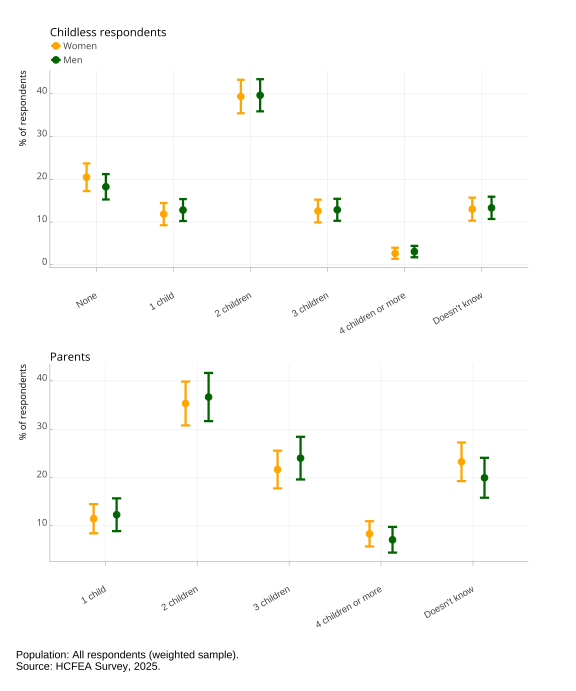
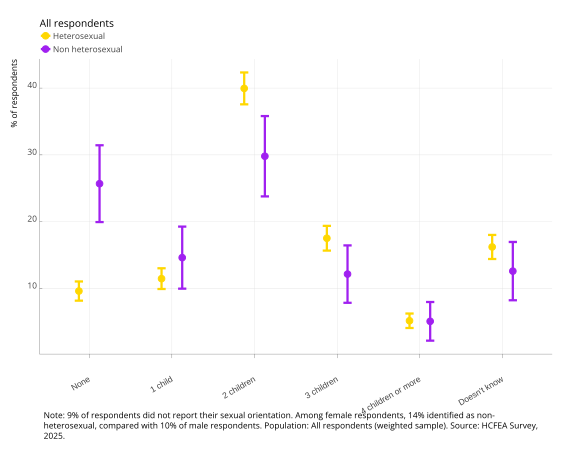
Figure 1 shows the expected number of children by gender and sexual orientation. Among childless respondents, women are more likely than men not to plan on becoming parents. Among parents, women are also more likely to be uncertain about the number of children they expect to have. Figure 2 shows that non-heterosexual respondents are more likely to report that they do not plan to become parents or to have additional children. These findings align with those of Bouchet-Valat and Toulemon (2025), which show a gradual shift in France from a three-child family norm to a two-child norm.
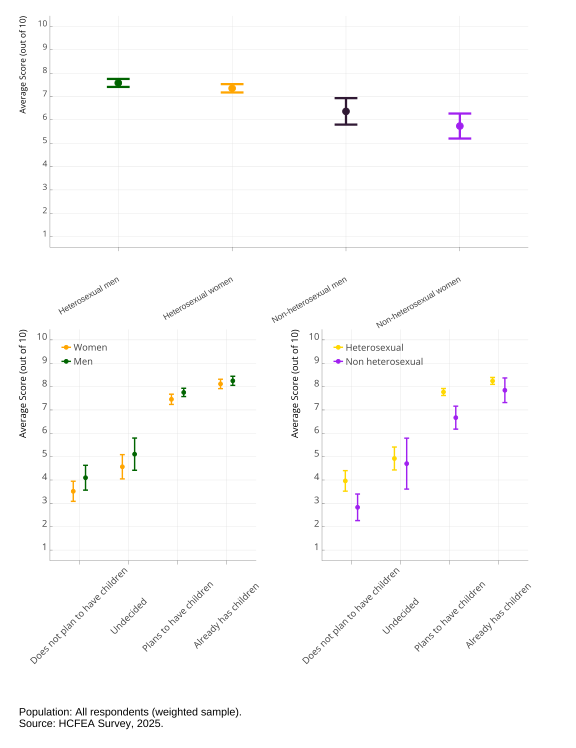
All respondents, whether parents or not, were asked about the importance they attach to becoming a parent. More specifically, they were asked to rate the importance of becoming a parent over the course of their life on a scale from 1 (not important) to 10 (very important). The average score among all respondents is 7.3 out of 10. This average varies substantially depending on individuals’ family situation and their parenthood projections. It reaches 8.2 among respondents who already have children, compared with 6.2 among those who do not have children at the time of the survey. Within the latter subgroup, further distinctions can be made according to respondents’ projections: those who plan to have children assign an average score of 7.6 out of 10, compared with 3.7 among those who do not plan to become parents. Respondents who are uncertain report an intermediate average score of 5 out of 10. The Figure 3 shows that childless women consistently assign lower scores than men, regardless of their parenthood intentions.
To assess the relative impact of these different individual characteristics on the importance attached to becoming a parent over the life course, we estimate a linear regression model in which the dependent variable is the score assigned by respondents. The explanatory variables include information on the individual’s family history, current situation, and political or religious orientation. Overall, the model is statistically robust (Table 1).
| All respondants | |
|---|---|
| Gender (ref. women) | 0,3** |
| (0,1) | |
| 25-29 years (ref. 20-24 years) | 0,0 |
| (0,1) | |
| 30-35 years (ref. 20-24 years) | 0,0 |
| (0,1) | |
| Bachelor’s degree (ref. Bac or less) | -0,1 |
| (0,1) | |
| Master’s degree or higher (ref. Bac or less) | 0,1 |
| (0,1) | |
| Currently a student (ref. Bac or less) | 0,2 |
| (0,2) | |
| Complex household (ref. couple) | -0,1 |
| (0,1) | |
| Lives alone (ref. couple) | 0,1 |
| (0,1) | |
| Non-heterosexual (ref. heterosexual) | -0,8*** |
| (0,1) | |
| Parental separation (ref. no) | -0,1 |
| (0,1) | |
| One sibling (ref. only child) | 0,2 |
| (0,2) | |
| Two siblings or more (ref. only child) | 0,4* |
| (0,2) | |
| Religious affiliation (ref. none) | 0,7*** |
| (0,1) | |
| Far-left (ref. no response / none) | -0,2 |
| (0,1) | |
| Left (ref. no response / none) | 0,0 |
| (0,2) | |
| Greens / Ecologists (ref. no resp./none) | -0,2 |
| (0,2) | |
| Right / Center-right (ref. no resp./none) | 0,1 |
| (0,2) | |
| Far-right (ref. no response / none) | 0,4** |
| (0,1) | |
| Material situation allows parenthood (ref. no) | 0,4*** |
| (0,1) | |
| Undecided (ref. Does not plan to have children) | 1,2*** |
| (0,2) | |
| Plans to have children (ref. Does not plan to have children) | 3,7*** |
| (0,2) | |
| Already has children (ref. Does not plan to have children) | 4,2*** |
| (0,2) | |
| Num.Obs. | 1791 |
| R2 | 0,421 |
| R2 Adj. | 0,414 |
| RMSE | 1,90 |
| + p < 0,1, * p < 0,05, ** p < 0,01, *** p < 0,001 | |
| Source: HCFEA Survey, 2025. Note: Unweighted data | |
Among socio-demographic characteristics, age, highest level of education, and marital status do not have a significant effect on the score assigned to the importance of becoming a parent. In contrast, gender and sexual orientation influence this score, all else being equal:
Non-heterosexual respondents assign an average score 0.8 points lower than heterosexual respondents. These results are consistent with previous studies on fertility intentions and sexual orientation (Baiocco and Laghi, 2013 ; Vseviov, Puur and Gortfelder, 2023). As suggested by the findings of Baiocco and Laghi (2013), this pattern may reflect, in particular, the anticipation of — or awareness of — the challenges that same-sex couples may face in their transition to parenthood.
Men assign an average score 0.3 points higher to the importance of becoming a parent over the life course compared with women.
Regarding individual family history, having experienced parental separation during childhood or adolescence does not influence the score assigned to the importance of parenthood. In contrast, sibling size has a significant effect:
- Individuals with brothers and/or sisters place greater value on becoming a parent than only children. The effect increases with the size of the family of origin (+0.4 points for two siblings or more).
Ideological and religious affiliations are also significant predictors of the score respondents assign to the importance of becoming a parent:
Individuals reporting a religious affiliation assign 0.7 points higher to the importance of parenthood.
Those identifying as close to a far-right political party assign 0.4 points higher compared with respondents without a declared political affiliation.
Respondents who report that their current material situation would allow them to have another child assign a score 0.4 points higher than those who do not consider it feasible. Finally, unsurprisingly, individual parenthood projections have the strongest effect. Compared with the reference category (those who do not plan to have children):
Respondents who are unsure assign a score 1.2 points higher.
Those who plan to become parents assign 3.7 points higher.
Respondents who are already parents assign 4.1 points higher.
3 The Method
3.1 Principal Component Analysis (PCA)
This study aims to develop a typology of perceptions of parenthood by combining the information provided by respondents across multiple statements capturing the reasons for wanting or not wanting to become a parent and, among parents, the reasons for wanting or not wanting to have an additional child.
The statements presented to respondents about the reasons for having a child (or another child for parents ), as well as those concerning the reasons for not wanting a child (or another child for parents), make it possible to capture in a nuanced way the perceptions of 20–35-year-olds regarding parenthood. Indeed, individuals may agree with certain reasons for not wanting a child (or another child), as well as with certain reasons for wanting one (or another child). In order to process all the information collected, responses to the 41 items for non-parents and 36 items for parents were coded on a four-point Likert-type scale, assigning a value of 1 to “Does not apply at all,” 2 to “Does not really apply,” 3 to “Rather applies,” and 4 to “Fully applies”. Based on these responses, we aim to identify typical profiles of expectations and projections regarding parenthood.
We perform a principal component analysis (PCA) following standard multivariate analysis procedures to identify the underlying dimensions structuring participants’ responses using the unweighted data. This method makes it possible to reduce the information contained in a set of correlated variables into a limited number of interpretable components, while retaining the maximum possible proportion of the observed variance. The extracted dimensions are then used to identify differentiated profiles of representations and projections regarding parenthood.
The PCA was conducted on the Likert-type items measuring expectations and representations regarding parenthood. The active variables consisted of the survey items, while socio-demographic variables were introduced as supplementary qualitative variables and did not contribute to the construction of the components. All active variables were standardized before the analysis. Since the items were measured using a four-point Likert-type scale, this normalization centered each variable around its mean and divided it by its standard deviation, resulting in standardized variables with a mean of zero and a variance of one. Although all items were measured on the same response scale, their observed distributions and variances may differ substantially across respondents, with some statements being more consensual than others. Standardization therefore ensures that each item contributes equally to the factorial solution and prevents items with greater variability from disproportionately influencing the construction of the components. The factorial structure thus reflects the underlying correlations between items rather than differences in their dispersion.
The PCA is based on the observation of p numerical variables, here the responses to a set of statements measured on a four-point scale ranging from 1 to 4 for each individual. We therefore obtain p vectors x_1,\ldots,x_p of dimension n, which together form the data matrix X \in \mathbb{R}^{n \times p}. For childless respondents (parents), we observe n = 1,034 (n = 935) individuals who answered p = 41 (p = 36) statements. The objective is to identify linear combinations of the columns of X that maximize the variance of the projected observations. These linear combinations constitute the principal components of the dataset.
Formally, the k-th principal component is defined as :
{ \begin{aligned} C_k = X a_k \end{aligned} }
where a_k is the vector of coefficients maximizing the variance of C_k subject to orthogonality constraints. Each principal component is associated with an eigenvalue \lambda_k, which measures the amount of total variance explained by that component. The eigenvalues are ordered such that:
{\begin{aligned}\lambda_1 \geq \lambda_2 \geq \cdots \geq \lambda_p\end{aligned}}
with the first component explaining the largest share of the variance.
The proportion of variance explained by component k is given by :
\frac{\lambda_k}{\sum_{j=1}^{p} \lambda_j}
3.2 PCA Specification, Calibration and clustering
The selection of the number of factors was based on a combination of statistical and substantive considerations. No single criterion was considered sufficient on its own. Following (Hair et al., 2019 ; Jolliffe and Cadima, 2016), several complementary indicators were therefore examined. We first retain the following indicators:
the Kaiser criterion that implies retaining factors with eigenvalues greater than one. This leads to retain only the dimensions that explain more variance than their average share across the 41 dimensions for childless (i.e., more than 2.44%) and across the 36 dimensions for parents (i.e. more than 2.88%).
the proportion of total variance explained, and inspection of the scree plot to identify the point at which additional factors contributed only marginally to explaining the variance.
The interpretability of the factor structure was also a key consideration, as the retained solution needed to provide a coherent and meaningful representation of the underlying dimensions captured by the survey items. To assess the robustness of the results, alternative solutions with one additional factor and one fewer factor were compared before selecting the final specification. The final number of factors was chosen on the basis of both statistical adequacy and substantive relevance.
Finally, we retain 6 dimensions for the ACP on childless individuals and 5 dimensions for parents. The retained components accounted for 53.4% of the total variance for childless individuals and 55.3% for the parents (see Table 7 in appendix for more details).
To identify distinct profiles of perceptions of parenthood, we performed a hierarchical clustering analysis based on the dimensions extracted from the principal component analysis (PCA). The clustering procedure was applied to the individuals’ coordinates on the first six principal components for childless and parents which capture the main patterns of variation in respondents’ answers. Euclidean distances were calculated between individuals, and the Ward.D2 method was used to progressively group respondents while minimizing within-cluster variance and maximizing differences between clusters.
This approach enabled the identification of homogeneous groups of respondents sharing similar configurations of attitudes and motivations towards parenthood. Among childless respondents, three groups were identified based on their reasons for wanting or not wanting to become parents. Among parents, four groups were identified based on their reasons for wanting or not wanting an additional child. The resulting clusters were interpreted as distinct typologies of perceptions of parenthood.
4 Results for childless individuals
4.1 Three Types of Approaches to Parenthood
Figure 4 shows the distribution of childless individuals in the two-dimensional space defined by the first two principal components. The two axes can be interpreted as follows:
The horizontal axis represents the value placed on parenthood: on the positive side of the axis, parenthood is perceived as a source of “happiness”, whereas on the negative side, the constraints associated with parenthood are emphasised. The items with the strongest positive loadings on this axis are “Giving meaning to my life” (loading = 0.71), “Taking care of a child, looking after them, and watching them grow” (loading = 0.689), “Making life more beautiful” (loading = 0.66), and “Providing love to a child” (loading = 0.63). Conversely, the negative side of the axis is characterised by items such as “I wish to maintain my freedom and not have someone who depends on me” (loading = -0.57), “I prefer to devote myself to my leisure activities, passions, and voluntary commitments” (loading = -0.51), « I do not like being around children » ( loading = -0.49) and “It takes too much time and energy” (loading = -0.49).
The vertical axis contrasts motivations for considering parenthood: on the positive side of the axis, motivations are mainly “social” (norms, expectations, and social roles), whereas on the negative side they are more related to private or “intimate” considerations (personal desire, family enjoyment, and emotional bonds). The items with the strongest positive loadings on this axis are “You want to do what most people around you do” (loading = 0.59), “Doing what people around me do” (loading = 0.55), and “Finding my place in society” (loading = 0.51). The negative side of the axis is associated with items such as “Taking care of a child, looking after them, and watching them grow” (loading = -0.10) and “Having moments of joy and closeness within the family” (loading = -0.08). This side may therefore reflect less the presence of a distinct set of intimate motivations than the absence of socially oriented considerations in the decision to become a parent.
Based on the PCA results, the three groups of respondents can be characterised by distinct orientations towards parenthood. The first group subscribes to a conformist approach to parenthood, characterised by a stronger emphasis on social norms and expectations and by the view of parenthood as a socially valued life transition. The second group endorses a constraining approach to parenthood, in which the constraints, loss of freedom, and costs associated with raising children are more salient. Finally, the third group adopts a fulfilling approach to parenthood, viewing it primarily through its positive emotional and personal dimensions, such as meaning, family bonds, and opportunities for personal fulfilment.
Whereas the first two groups comprise almost 80% of childless respondents (40.4% for the conformist approach and 38.3% for the constraint-oriented approach), the group corresponding to a fulfilling approach to parenthood is significantly smaller, comprising just 21.2% of childless respondents. This distribution is partly explained by individuals’ self-selection into childlessness.
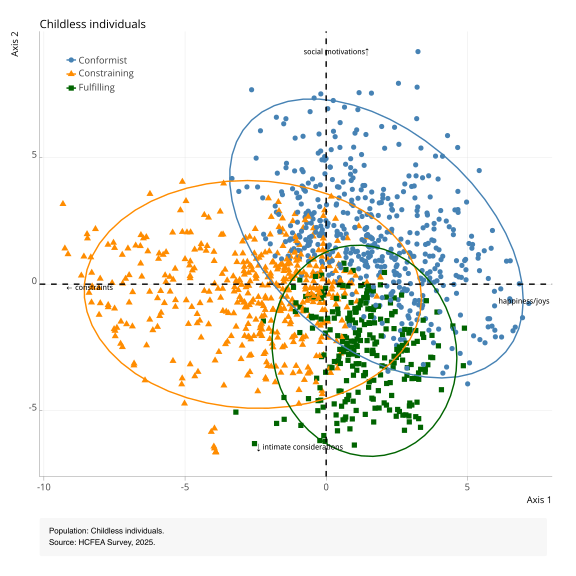
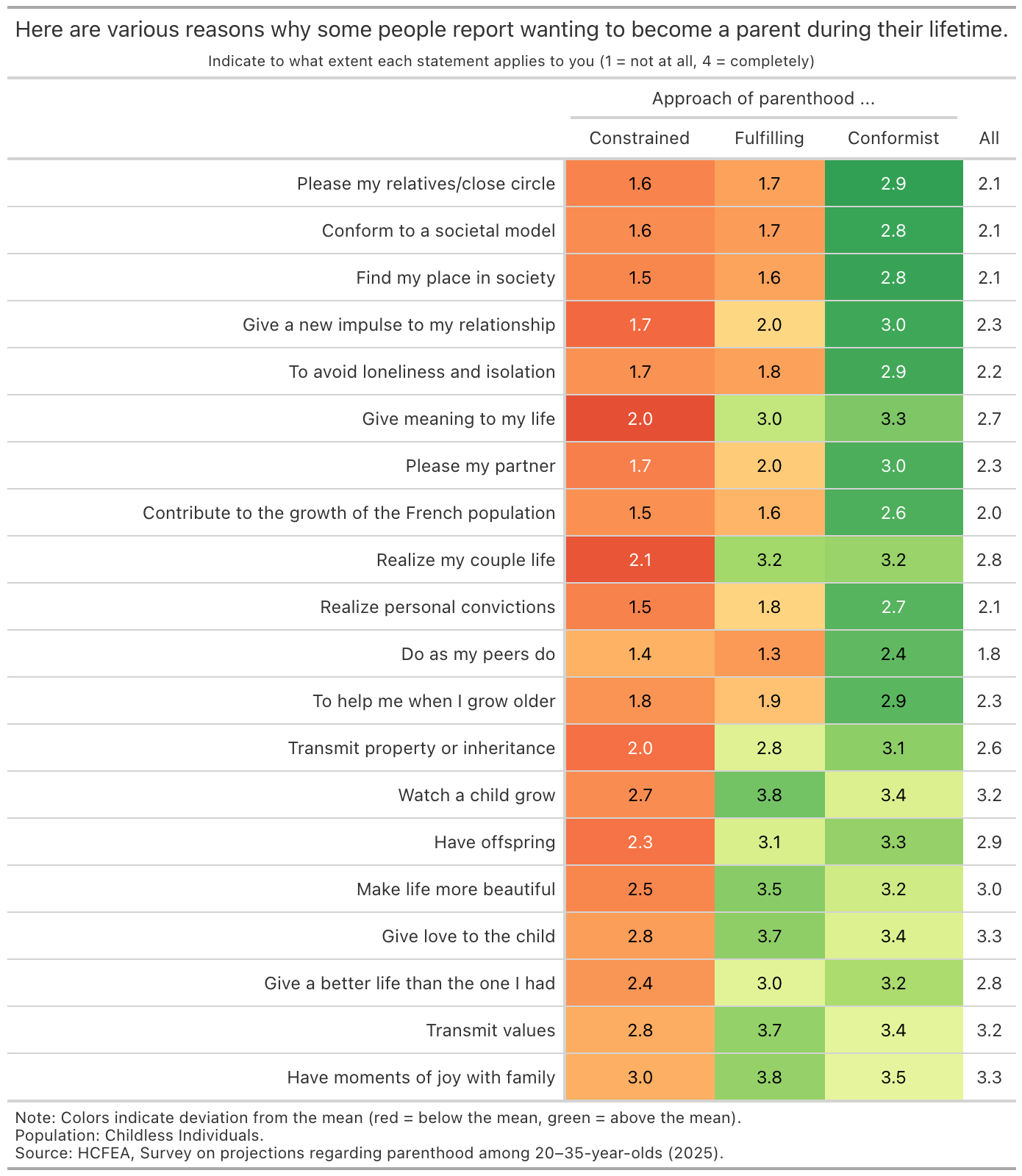
Table 2 compares responses regarding the reasons why one might want to become a parent during their lifetime, while Table 3 focuses on the reasons for not wanting to become a parent. For each statement, a mean score above 2 indicates that individuals in the group consider the statement to apply to their situation. Conversely, a score below 2 indicates that they consider it not to apply. The mean score assigned to each statement by the different groups can also be compared to the overall mean observed across all respondents.
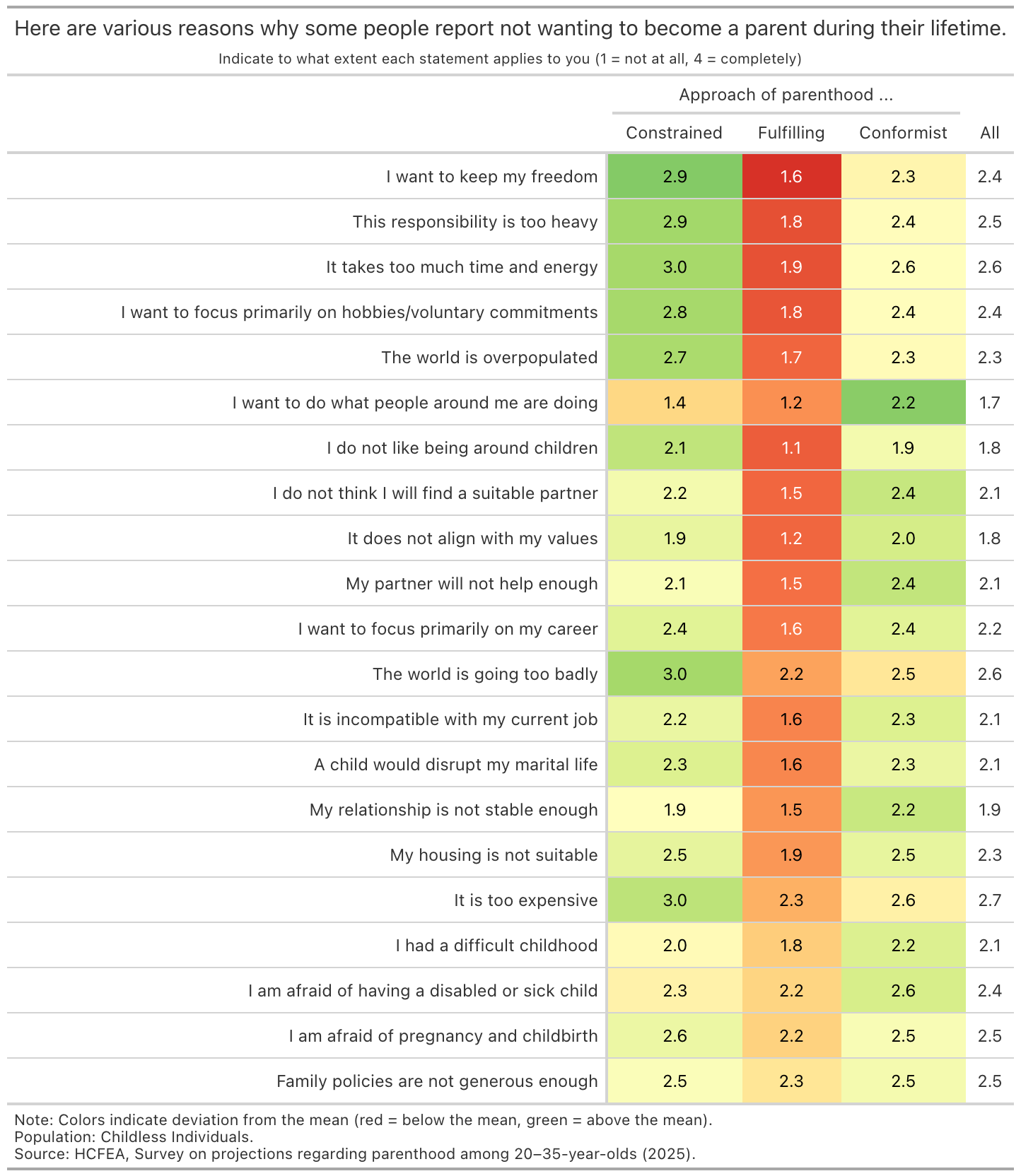
Regarding the reasons for wanting to become a parent, individuals with a conformist approach to parenthood identify with statements such as “to please those around me” (with an average score of 2.9 out of 4), “to conform to a societal model” and “to find my place in society” (with an average score of 2.8 out of 4). They also endorse motivations such as “to help me when I grow older,” “to avoid being alone” “to have offspring” and “to pass on property”. Finally, they place greater importance than the average on the statement “to contribute to the growth of the French population” Regarding the reasons for not wanting to become a parent, members of this group identify with most of the items presented, except for the following: “I do not like being around children” (score of 1.9 out of 4). Additionally, this group endorses the statement “I want to do as people around me do” (with a score of 2.2), unlike the other two groups.
The fulfillment-oriented approach differs from the conformist approach. Individuals who adhere to this perspective do not identify with parental motivations that can be described as “social” (such as conforming to a family model or pleasing those around them). Instead, they are more aligned with reasons related to happiness and the joy of being with family, such as: “watch a child grow” (average score 3.8), “give love to a child” (average score 3.4 out of 4), “transmit values”, “have moments of joy” or “make life more beautiful”. Regarding the reasons for not wanting to become a parent, this group stands out from the other two by consistently assigning scores below 2 to nearly all statements, with the exception of items related to “the world is going too badly”, fears of pregnancy or the possibility of having a sick child, the cost of raising a child, or the lack of generosity in family policies. Even for these reasons, however, their scores remain lower than those of the other two groups. This reflects a strong positive view of parenthood. These individuals place intimate relationships and values of sharing at the heart of their approach to parenthood.
The constraining approach of parenthood is clearly distinct from the other two. Individuals in this group rarely endorse reasons for wanting to become a parent, whether social or intimate. They show only slight agreement with certain motivations related to family happiness, which were particularly emphasized by the previous fulfillment-oriented group, but to a much lesser extent. In contrast, this group consistently assigns higher-than-average scores to reasons for not wanting to become a parent. The most highly rated motivations are: “It takes too much time and energy” (average score 3.0 out of 4), “to maintain my freedom” (average score 2.9 out of 4), “to focus on hobbies or personal commitments” as well as broader considerations such as “the Earth is overpopulated” (score 2.7) or “The world is going too badly” (score 3.0 out of 4). This group cannot be considered purely individualistic, as ecological and societal considerations are clearly taken into account in their approach to parenthood. Moreover, they also place some importance—albeit less pronounced than the other two groups—on intimate motivations that might lead them to want to become a parent: “to give love to a child” (score 2.8 out of 4) and “to have moments of joy with family” (score 3.5 out of 4).
4.2 Profiles Associated with the Three of Projections
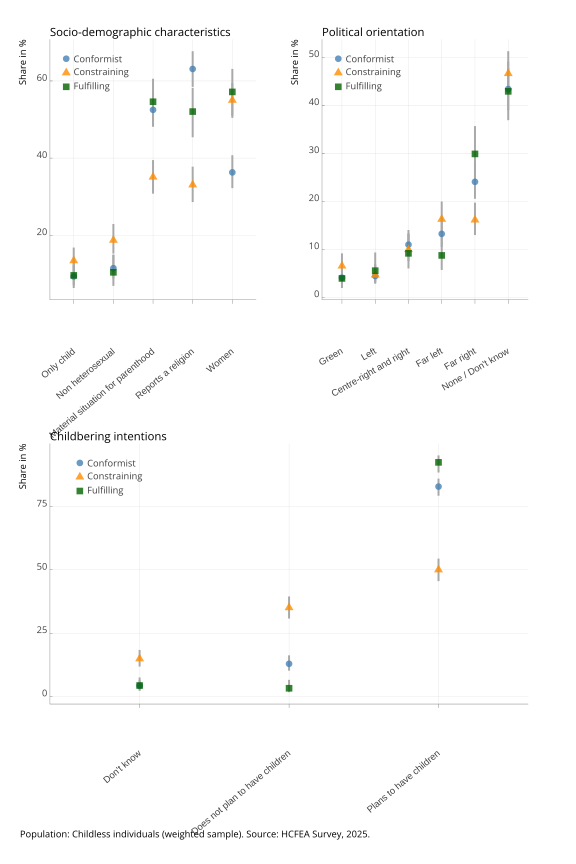
Individuals adhering to the three approaches to parenthood display distinct socio-demographic profiles, levels of political commitment, and childbearing intentions. Figure 5 presents the distribution of different characteristics within each parenthood approach.
Gender appears to be a strong marker of these three profiles. Women are significantly less likely to adopt a conformist approach to parenthood, representing one-thirds of this group. In contrast, more than 55% of individuals who adopt a constraint-oriented view of parenthood are women. Similarly, the group of individuals who view parenthood primarily as a source of fulfilment also includes a slight majority of women (57%). Thus, almost half of male childless respondents adopt a conformist approach to parenthood, whereas women are more likely to belong to the constraint-oriented approach group, which accounts for 44% of female childless respondents.
Sexual orientation also represents a significant distinction, with an overrepresentation of non-heterosexual individuals among those adopting a constraint-oriented approach to parenthood. More than 50% of non-heterosexual respondents adopt a constraint-oriented approach to parenthood. This pattern may reflect greater difficulties in envisioning themselves as parents.
Among those adhering to a conformist view of parenthood, 63% report having a religion, compared with 52% among those with a fulfilment-oriented approach. In contrast, fewer than 30% of individuals with a constraint-oriented approach to parenthood report having a religion.
Childless individuals adhering to a constraint-oriented view of parenthood were disproportionately likely to have had no siblings themselves compared with individuals in the other groups. Individuals adopting a conformist view of parenthood are less likely to have experienced parental separation during childhood or adolescence (32%), compared with 38% and 39% in the fulfilment-oriented and constraint-oriented groups, respectively. However, these differences are not significant.
As far as political orientation is concerned, only 16% of individuals who adhere to a constraint-oriented view of parenthood identify with the far right, compared with 24% of those adopting a conformist approach and 30% of those who view parenthood as a source of fulfilment. This pattern reflect a more traditional view of the family and parenthood, which is often associated with far-right political orientations.
Finally, and consistently, among childless individuals who adopt a conformist approach to parenthood, 86% intend to become parents. This percentage rises to 95% among those who embrace a fulfilment-oriented view of family, while it drops to 55% for those who emphasize the constraints associated with parenthood.
5 Results for Parents
5.1 Four Types of Approaches to Parenthood
Regarding parents, Figure 6 illustrates how individuals are distributed in the two-dimensional space defined by the first two principal components. The two axes can be interpreted as follows:
The horizontal axis reflects attitudes toward having another child: on the positive side of the axis, having another child is associated with a favourable view of family expansion, whereas on the negative side it is more strongly associated with perceived constraints. The items with the strongest positive loadings on this axis are “Expanding the family” (loading = 0.71), “Giving love to a new child and receiving it in return” (loading = 0.66), and “Enriching joyful and bonding moments within the family” (loading = 0.65). Conversely, the negative side of the axis is mainly defined by items such as “I prefer to devote all my attention to my existing child(ren)” (loading = -0.46), “My partner would not help enough” (loading = -0.45), and “It takes too much time and energy” (loading = -0.43).
The vertical axis reflects motivations for having another child: at the top, motivations are mainly social (norms, expectations, and social roles), whereas at the bottom they are more related to personal or intimate considerations (individual desire, family enjoyment, and emotional connection). The items that contribute most strongly to the upward direction of this axis are “You want to do like most people around you” (loading = 0.67), “Conforming to a family-centred social model with several children” (loading = 0.65), and “Contributing to population growth in France” (loading = 0.64). The downward direction is only weakly associated with items related to personal and emotional motivations, such as “Giving love to a new child and receiving it in return” (loading = 0.01) and “Enriching moments of joy and closeness within the family” (loading = 0.05). These low and positive loadings suggest that the lower pole should not be interpreted as a distinct opposite dimension, but rather as a lower endorsement of socially oriented motivations.
Based on the PCA results, four groups can be distinguished, each reflecting a distinct orientation towards parenthood. The first three groups are broadly consistent with those identified among childless individuals, while a fourth, specific profile emerges among parents. The first group, labelled the “conformist approach”, is associated with a greater emphasis on social norms, expectations, and the idea of parenthood as a socially valued life transition. The second group, referred to as the “constraining approach”, reflects a more ambivalent relationship with parenthood, in which potential constraints, loss of freedom, and the costs associated with raising children are more salient. The third group, labelled the “fulfilling approach”, corresponds to an orientation in which parenthood is primarily viewed through its positive emotional and personal dimensions, such as meaning, family bonds, and opportunities for personal fulfilment. Finally, the fourth group, labelled the “enthusiastic approach”, is characterised by a strong endorsement of both intimate and social motivations for having another child. Individuals in this group place high value not only on the emotional rewards and family-related benefits of expanding the family but also on social expectations, family norms, and the social significance attached to having another child.
The fulfilling approach comprises the largest share of respondents with children, accounting for 43.8% of the sub-sample, whereas the constraint-oriented approach is the smallest group, representing less than 12% of parents. The conformist approach accounts for around one quarter of parents, while the enthusiastic approach represents approximately one fifth. This distribution differs from that observed among childless respondents, partly reflecting self-selection into parenthood.
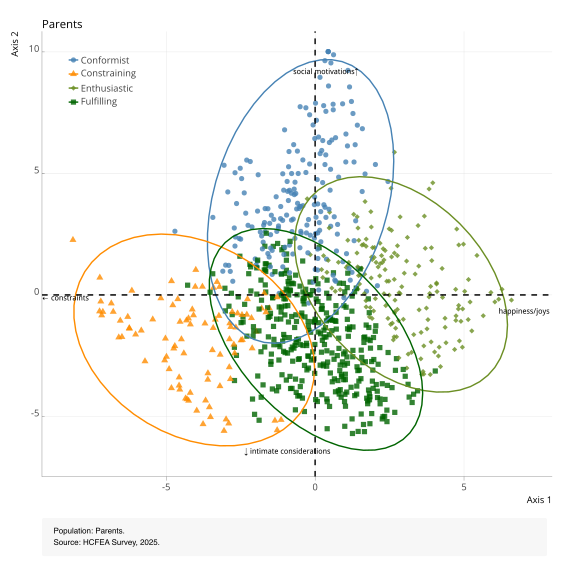
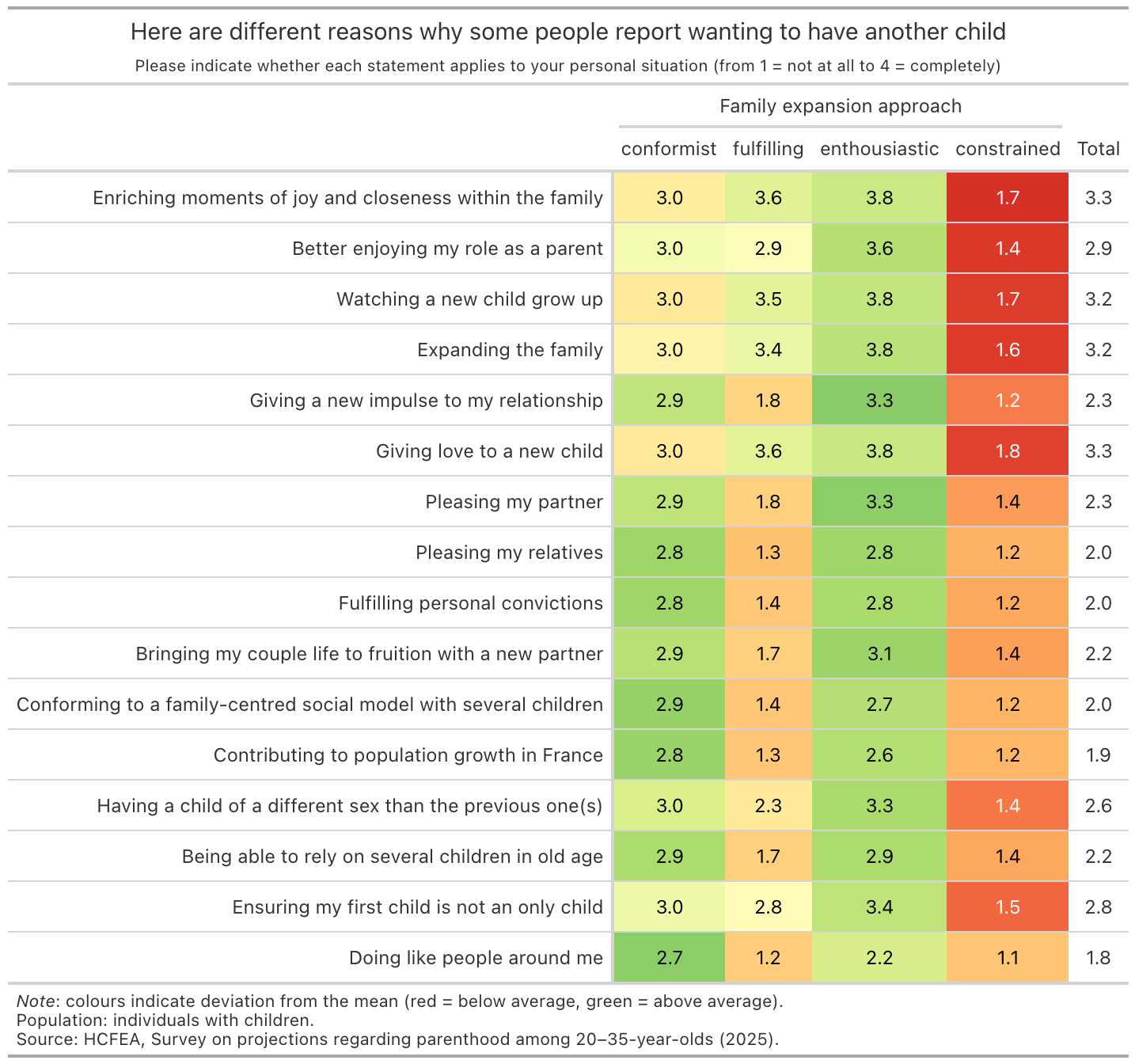
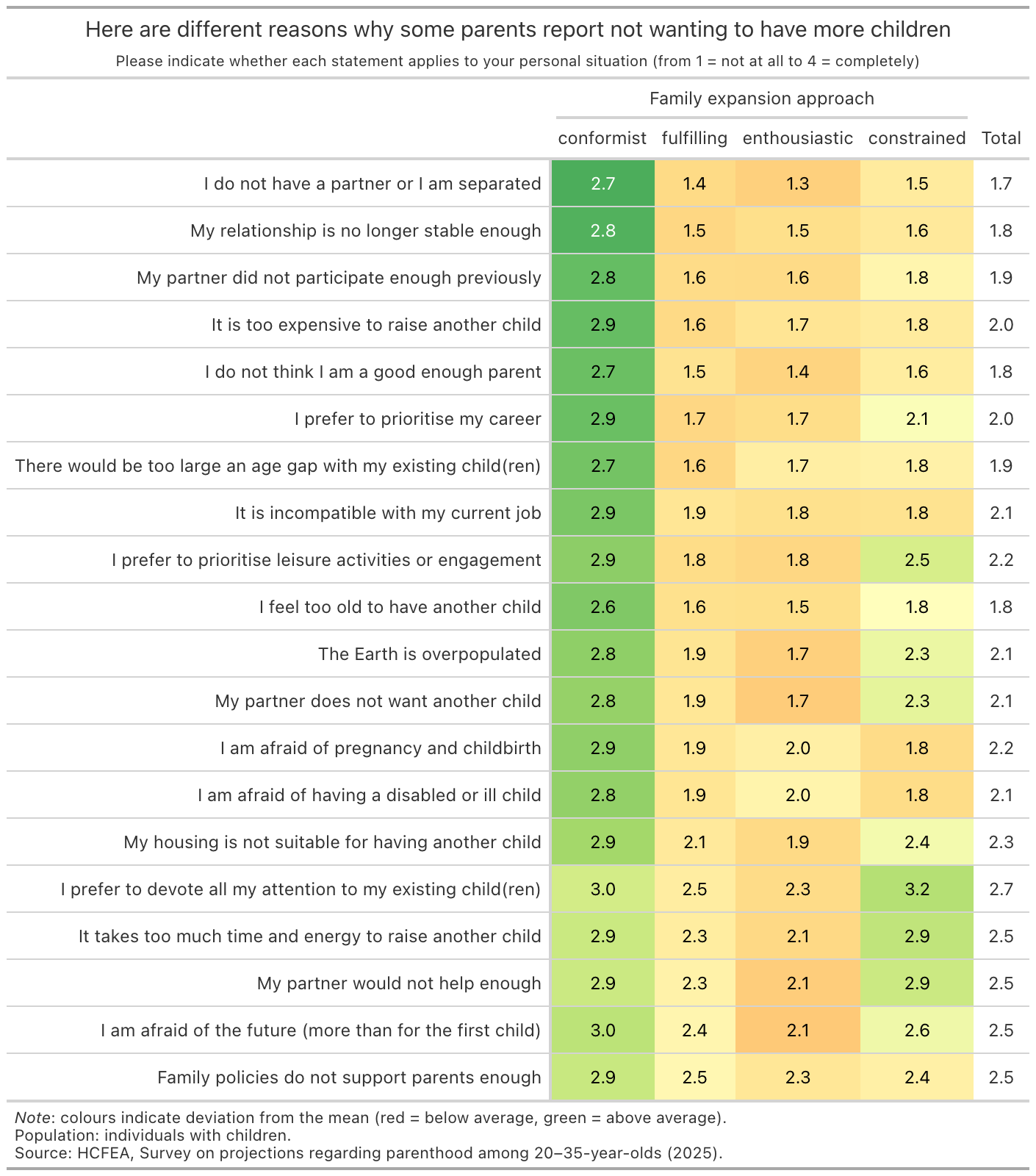
Table 4 compares responses regarding the reasons why respondents might want to have another child, while Table 5 focuses on the reasons for not wanting one. As among childless respondents, for each statement, a mean score above 2 indicates that individuals in the group consider the statement to apply to their situation, whereas a score below 2 indicates that they consider it not to apply. The mean score assigned to each statement by the different groups can also be compared with the overall mean observed across all respondents.respondents.
The respondents who adhere to a conformist approach continue the pattern observed among childless individuals. It is distinguished from other groups by the type of reasons they endorse for wanting another child. Individuals with this approach view having another child primarily as a way to conform to social expectations. They identify with items referring to following socially valued family models. Compared with other groups, they particularly endorse arguments such as “doing like the people around me” (average score 2.7/4) and “conforming to a society-centered model of a family with multiple children” (average score 2.9/4). These parents also value items like “contributing to the growth of the French population” (score 2.8) or “having a child of the opposite sex” which they consider valid reasons to expand the family. Regarding reasons for not wanting another child, this group agrees with most of the statements presented.
For respondents who adhere to a fulfilling Approach, having another child is primarily seen as a source of joy and personal fulfilment. They are particularly responsive to arguments highlighting the pleasure and bonding moments that a new child brings (average score 3/4), the enrichment of family life, or the desire to give love to another child. Conversely, these parents do not subscribe to a conformist view of parenthood: they rarely identify with motivations such as “pleasing one’s partner” “conforming to a family model with multiple children” (average score 1.8/4), or “doing like the people around me” (average score 1.3/4). Similarly, arguments such as “contributing to the growth of the French population” are not seen as reasons to have another child (average score 1.3/4).
Respondents who declare an enthusiastic approach combines both social motivations and more intimate reasons for wanting another child. These parents broadly endorse most of the arguments in favour of having another child while consistently rejecting reasons for not wanting one. In this regard, they are clearly distinct from those adhering to a fulfilling approach. Additionally, like parents with a conformist approach, these parents consider having another child of the opposite sex a valid reason (average score 3.3/4).
The constraining view of family expansion reflects the continuation of the constraining approach to parenthood observed among some childless individuals. For this group, the idea of having another child is perceived as a source of constraints, potentially reducing the quality of family life. Individuals in this group do not identify with statements such as “it enriches joyful and bonding moments in the family” (average score 1.7/4) or “it allows me to better enjoy my role as a parent” (average score 1.4/4). In contrast, they strongly endorse several reasons for not wanting another child, similarly to the conformist group: “I prefer to devote all my attention to the child or children I already have” (average score 3.2/4), “I prefer to focus on my hobbies” (2.5/4), “the Earth is overpopulated” (2.3/4), and “my partner will not help enough” (2.9/4).
5.1.1 Profiles Associated with the Four Types of Parents’ Projections
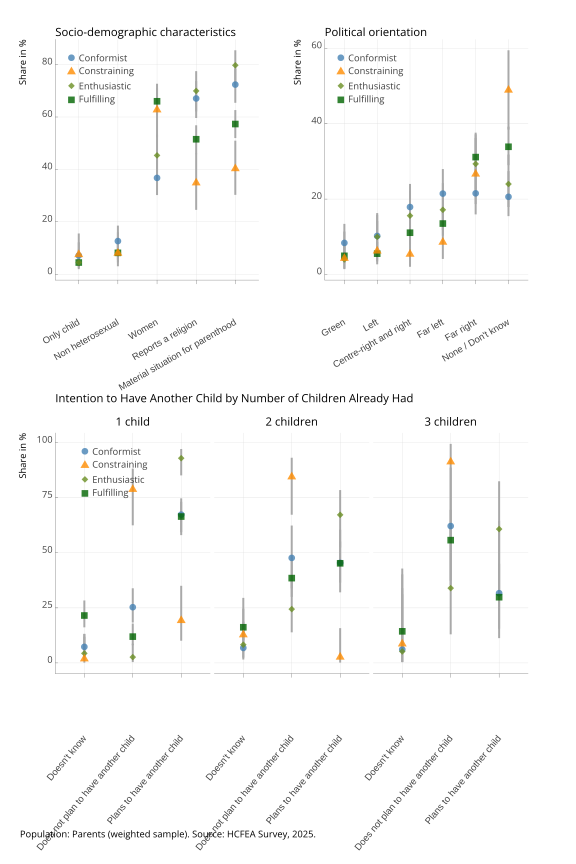
As with childless respondents, parents adhering to the four approaches to parenthood display distinct sociodemographic profiles, levels of political engagement, and childbearing intentions. Figure 7 presents the representation, expressed as percentages, of different characteristics within each parenthood approach. Beyond the presence of an additional approach to parenthood, the distribution across the groups also differs from that observed among childless respondents.
Gender remains a strong marker of these four profiles, with associations consistent with those observed among childless individuals. As for childless respondant, women are significantly less likely to adopt a conformist approach to parenthood, accounting for only 38% of this group and they are overrepresented among parents holding a constraint-oriented view of parenthood and among those adopting a fulfilling approach. Parents adhering to an enthusiastic approach are more evenly balanced in terms of gender.
Sexual orientation does not distinguish between the different approaches, unlike among childless individuals. Indeed, whereas more than 14% of childless respondents who answered the question reported being non-heterosexual, this figure is only 9% among parents. This may reflect the greater difficulties faced by non-heterosexual individuals in becoming parents.
A majority of individuals following a conformist or enthusiastic view of parenthood report a religious affiliation (67% and 70%, respectively), compared with only 51.5% of parents adhering to a fulfilling approach and 34% of those following the constraining approach.
Parents adopting an enthusiastic approach are less likely to be only children. They have an average of 3.5 siblings, significantly more than those adhering to the other approaches. By contrast, parents with a constraining approach have an average of 2.5 siblings, compared with 2.7 among parents with a conformist Approach and 2.8 among those with a fulfilling approach.
Overall, the proportion of parents reporting that they plan to have another child decreases as the number of children increases, regardless of their approach to parenthood. Among parents with one child, the proportion answering ‘yes’ is relatively high, ranging from 19.3% among those with a constraining approach to 93% among those with an enthusiastic approach. This proportion decreases among parents with two children (from 2.7% to 67.3%) and remains lower among those with three or more children (from 29.9% to 60.8%). The enthusiastic approach is consistently associated with the highest proportion of parents wishing to have another child, whereas the constraining approach is associated with the lowest.
6 External validation of the typologies
To assess the external validity of the PCA-based typology, we estimated OLS regression models predicting respondents’ ratings of the importance of becoming a parent over the life course. This outcome was not included among the variables used in the PCA and therefore provides an independent criterion for assessing the coherence and substantive validity of the identified profiles. If the typology captures meaningful differences in orientations towards parenthood, the identified groups should also differ significantly in their evaluation of the importance of parenthood.
The analyses were conducted separately for childless individuals and parents. In each model, the key explanatory variable is the parenthood approach to which respondents were assigned based on the PCA-derived typology. The regressions also control for a range of socio-demographic characteristics, allowing us to assess whether differences in the perceived importance of parenthood persist after accounting for compositional differences between the groups.
Table 6 presents the regression results. Overall, the model is statistically robust. All else being equal, childless men assign 0.4 points more, on a 10-point scale, to the importance of becoming a parent over the life course compared with women. The gender divide disparea for parents. Non-heterosexual respondents attribute less importance to becoming a parent than heterosexual respondents (-1.2 points for childless respondents and -0.5 point for parents). Individuals who report being in a material situation that allows them to have children assign greater importance to becoming a parent than those who report that their material situation does not allow it (+0.5 points among childless respondents and +0.4 points among parents).
Those who report a religious affiliation assign 0.9 points more importance to becoming a parent than those without a religious affiliation. Respondents who identify as close to the far right also assign a higher score compared with individuals who do not declare any political opinion. Among parents, consistently, those with two or more children assign 0.3 points more importance to becoming a parent than those with one child, while age is not a significant predictor of the score. Among childless individuals, by contrast, the importance attributed to becoming a parent over the life course tends to decrease with age. Individuals aged 30–35 assign a significantly lower score—approximately 0.5 points lower—than those aged 20–25. This may reflect both an individual choice not to have children because they do not consider parenthood to be important, and the increasing difficulties that individuals may face after the age of 30 in eventually having children, such as not having a partner.
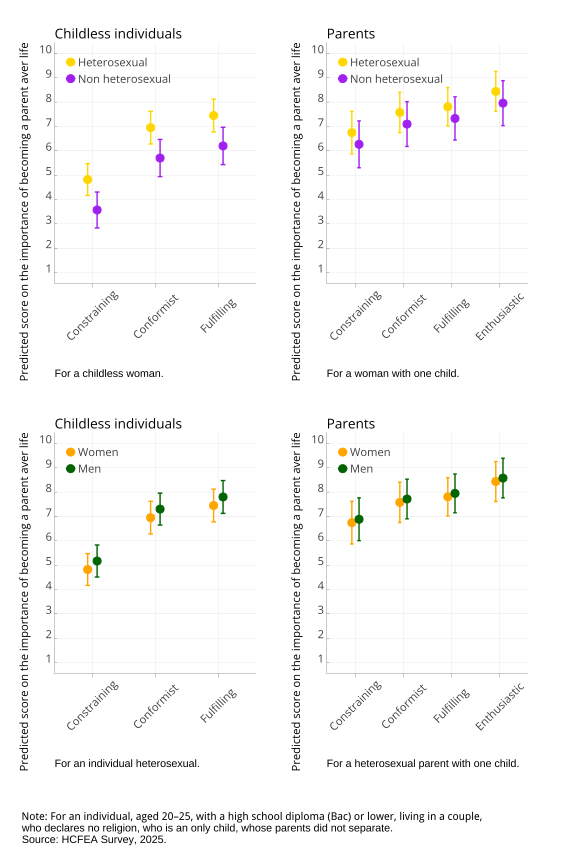
Finally, as expected, childless individuals adhering to a conformist approach assign, on average, a score 2.1 points higher to the importance of becoming a parent than those with a constraining approach. Among parents, the difference is smaller but significant, at 0.8 point. The gap is larger for individuals with a fulfilling approach, reaching 2.6 points among childless individuals and 1.1 points among parents. Finally, parents adopting an enthusiastic approach assign 1.7 points more importance to becoming a parent than those adopting a constraining approach.
Figure 8 describe the score predicted by the model for the case of woman aged 20–25, with a high school diploma (Bac) or lower, living in a couple, who declares no religion, who is an only child, whose parents did not separate. In the case of parent, she already has one child.
| Childless individuals | Parents | |
|---|---|---|
| Gender (ref. women) | 0,4* | 0,1 |
| (0,1) | (0,1) | |
| 25-29 years (ref. 20-24 years) | -0,0 | 0,1 |
| (0,2) | (0,2) | |
| 30-35 years (ref. 20-24 years) | -0,5** | 0,1 |
| (0,2) | (0,2) | |
| Bachelor’s degree (ref. Bac or less) | 0,2 | -0,1 |
| (0,2) | (0,2) | |
| Master’s degree or higher (ref. Bac or less) | 0,5* | -0,1 |
| (0,2) | (0,2) | |
| Currently a student (ref. Bac or less) | 0,5* | -0,6 |
| (0,2) | (0,8) | |
| Complex household (ref. couple) | -0,1 | -1,3** |
| (0,2) | (0,5) | |
| Lives alone (ref. couple) | -0,1 | -0,1 |
| (0,2) | (0,2) | |
| Non-heterosexual (ref. heterosexual) | -1,2*** | -0,5* |
| (0,2) | (0,2) | |
| Parental separation (ref. no) | 0,0 | -0,0 |
| (0,1) | (0,1) | |
| One sibling (ref. only child) | -0,2 | 0,2 |
| (0,2) | (0,3) | |
| Two siblings or more (ref. only child) | 0,2 | 0,3 |
| (0,2) | (0,3) | |
| Religious affiliation (ref. none) | 0,9*** | 0,3+ |
| (0,1) | (0,1) | |
| Far-left (ref. no response / none) | 0,0 | -0,2 |
| (0,2) | (0,2) | |
| Left (ref. no response / none) | 0,3 | -0,2 |
| (0,3) | (0,3) | |
| Greens / Ecologists (ref. no resp./none) | -0,2 | -0,2 |
| (0,3) | (0,3) | |
| Right / Center-right (ref. no resp./none) | 0,4 | 0,0 |
| (0,2) | (0,2) | |
| Far-right (ref. no response / none) | 0,4* | 0,3+ |
| (0,2) | (0,2) | |
| Material situation allows parenthood (ref. no) | 0,5** | 0,4* |
| (0,1) | (0,2) | |
| 2 children or more (ref. one child) | 0,3* | |
| (0,1) | ||
| Conformist (ref. Constraining) | 2,1*** | 0,8** |
| (0,2) | (0,3) | |
| Fulfilling (ref. Constraining) | 2,6*** | 1,1*** |
| (0,2) | (0,2) | |
| Enthusiastic (ref. Constraining) | 1,7*** | |
| (0,3) | ||
| Num.Obs. | 1059 | 733 |
| R2 | 0,376 | 0,134 |
| R2 Adj. | 0,363 | 0,106 |
| + p < 0,1, * p < 0,05, ** p < 0,01, *** p < 0,001 | ||
| Source: HCFEA Survey, 2025. | ||
7 Concluding remarks
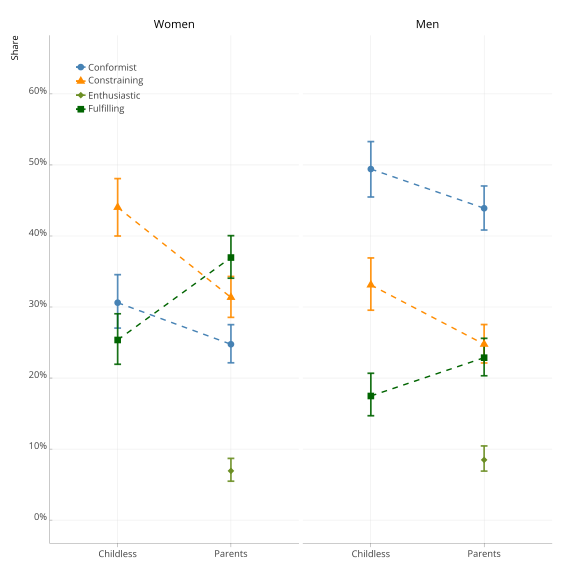
The survey provides important insights into young adults’ intentions toward parenthood in France in 2025, summarised in Figure 9. The comparison between childless respondents and parents highlights both a strong gender dimension and a marked recomposition of parenthood approaches associated with parenthood status. Among childless respondents, men are substantially more likely than women to adopt a conformist approach (49.4% vs. 30.6%), whereas women are more strongly represented in the constraint-oriented approach (44.0% vs. 33.1%) and in the fulfilling approach (25.4% vs. 17.5%). Among parents, these gender differences persist but are partly reshaped. The fulfilling approach becomes the most prevalent profile among women (37.0%), while the conformist approach remains dominant among men (43.9%). The constraint-oriented approach decreases substantially among both women and men, while the newly identified enthusiastic approach accounts for a small but non-negligible share of parents. Overall, these differences should be interpreted in light of self-selection into parenthood: parents are not a random subset of the childless population, but individuals who have entered parenthood and may therefore hold different perceptions and experiences of parenthood. The observed differences between parents and childless respondents may thus partly reflect this self-selection process, suggesting that entering parenthood is associated with a reconfiguration of attitudes and perceptions of parenthood, while gender remains an important dimension structuring these profiles.
From a demographic perspective, these findings suggest that men may be more strongly aligned with prevailing social norms surrounding parenthood, whereas young women appear more aware of the constraints and costs associated with motherhood. In a context where the normative ideal of the three-child family has increasingly given way to a two-child ideal, these patterns may point towards a continued decline in fertility in France. More broadly, they suggest that the decline in fertility observed since 2021 may not simply reflect temporary changes in childbearing behaviour, but may also be rooted in deeper transformations in young adults’ aspirations and perceptions of parenthood.
8 Appendix
8.1 Explained variance of PCA dimensions among parents and childless individuals
| Axis |
Childless
|
Parents
|
||||
|---|---|---|---|---|---|---|
| % | Cum. % | Eigenvalue | % | Cum. % | Eigenvalue | |
| 1 | 21.3 | 21.3 | 8.7 | 26.0 | 26.0 | 9.4 |
| 2 | 16.6 | 37.8 | 6.8 | 15.9 | 41.9 | 5.7 |
| 3 | 6.8 | 44.6 | 2.8 | 6.9 | 48.7 | 2.5 |
| 4 | 3.2 | 47.8 | 1.3 | 3.7 | 52.5 | 1.3 |
| 5 | 2.8 | 50.6 | 1.1 | 2.8 | 55.3 | 1.0 |
| 6 | 2.7 | 53.4 | 1.1 | 2.5 | 57.7 | 0.9 |
| 7 | 2.4 | 55.8 | 1.0 | 2.4 | 60.1 | 0.9 |
| 8 | 2.2 | 58.0 | 0.9 | 2.2 | 62.3 | 0.8 |
| 9 | 2.2 | 60.2 | 0.9 | 2.1 | 64.4 | 0.8 |
| 10 | 2.0 | 62.2 | 0.8 | 2.0 | 66.5 | 0.7 |
| 11 | 1.9 | 64.1 | 0.8 | 2.0 | 68.5 | 0.7 |
| 12 | 1.8 | 66.0 | 0.7 | 1.9 | 70.3 | 0.7 |
| 13 | 1.8 | 67.7 | 0.7 | 1.8 | 72.1 | 0.6 |
| 14 | 1.7 | 69.5 | 0.7 | 1.7 | 73.8 | 0.6 |
| 15 | 1.6 | 71.1 | 0.7 | 1.7 | 75.5 | 0.6 |
| 16 | 1.6 | 72.7 | 0.7 | 1.6 | 77.1 | 0.6 |
| 17 | 1.5 | 74.3 | 0.6 | 1.5 | 78.6 | 0.5 |
| 18 | 1.5 | 75.7 | 0.6 | 1.5 | 80.1 | 0.5 |
| 19 | 1.4 | 77.2 | 0.6 | 1.5 | 81.6 | 0.5 |
| 20 | 1.4 | 78.6 | 0.6 | 1.4 | 83.0 | 0.5 |
| 21 | 1.4 | 80.0 | 0.6 | 1.4 | 84.4 | 0.5 |
| 22 | 1.3 | 81.3 | 0.5 | 1.4 | 85.8 | 0.5 |
| 23 | 1.3 | 82.6 | 0.5 | 1.3 | 87.1 | 0.5 |
| 24 | 1.2 | 83.8 | 0.5 | 1.3 | 88.3 | 0.5 |
| 25 | 1.2 | 85.0 | 0.5 | 1.2 | 89.5 | 0.4 |
| 26 | 1.1 | 86.2 | 0.5 | 1.2 | 90.7 | 0.4 |
| 27 | 1.1 | 87.3 | 0.5 | 1.1 | 91.8 | 0.4 |
| 28 | 1.1 | 88.4 | 0.5 | 1.1 | 92.9 | 0.4 |
| 29 | 1.1 | 89.4 | 0.5 | 1.0 | 93.9 | 0.4 |
| 30 | 1.0 | 90.5 | 0.4 | 1.0 | 94.9 | 0.4 |
| 31 | 1.0 | 91.5 | 0.4 | 1.0 | 95.9 | 0.4 |
| 32 | 1.0 | 92.4 | 0.4 | 0.9 | 96.9 | 0.3 |
| 33 | 1.0 | 93.4 | 0.4 | 0.9 | 97.7 | 0.3 |
| 34 | 1.0 | 94.4 | 0.4 | 0.8 | 98.5 | 0.3 |
| 35 | 0.9 | 95.3 | 0.4 | 0.8 | 99.3 | 0.3 |
| 36 | 0.9 | 96.2 | 0.4 | 0.7 | 100.0 | 0.3 |
| 37 | 0.8 | 97.0 | 0.3 | - | - | - |
| 38 | 0.8 | 97.9 | 0.3 | - | - | - |
| 39 | 0.8 | 98.7 | 0.3 | - | - | - |
| 40 | 0.7 | 99.3 | 0.3 | - | - | - |
| 41 | 0.7 | 100.0 | 0.3 | - | - | - |
9 References
Baiocco R., Laghi F. (2013). “Sexual orientation and the desires and intentions to become parents,” Journal of Family Studies, 19, n° 1, pp. 90–98.
Balbo N., Billari F.C., Mills M. (2012). “Fertility in advanced societies: A review of research,” European Journal of Population / Revue européenne de Démographie, 29, n° 1, pp. 1–38.
Barker R., Buber-Ennser I. (2024). “Uncertainty and flexibility of fertility intentions,” Advances in Life Course Research, 61, p. 100618.
Beaujouan E., Berghammer C. (2019). “The gap between lifetime fertility intentions and completed fertility in europe and the united states: A cohort approach,” Population Research and Policy Review, 38, n° 4, pp. 507–535.
Bergström M., Maillochon F. (2024). “Couples, histoires d’un soir, « sexfriends » : Diversité des relations intimes des moins de 30 ans,” Population & Sociétés, N° 623, n° 6, pp. 1–4.
Billari F., Kohler H.-P. (2004). “Patterns of low and lowest-low fertility in europe,” Population Studies, 58, n° 2, pp. 161–176.
Bouchet-Valat M., Toulemon L. (2025). “Les français·es veulent moins d’enfants,” Population & Sociétés, n° 635, n° 7, pp. 1–4.
Buchmann M.C., Kriesi I. (2011). “Transition to adulthood in europe,” Annual Review of Sociology, 37, n° 1, pp. 481–503.
Doepke M., Kindermann F. (2019). “Bargaining over babies: Theory, evidence, and policy implications,” American Economic Review, 109, n° 9, pp. 3264–3306.
Fahlén S., Oláh L.Sz. (2018). “Economic uncertainty and first-birth intentions in europe,” Demographic Research, 39, pp. 795–834.
Fang H., Liu C. (2026). “The confucian fertility paradox: Education competition and ultra-low fertility in east asia,” Working paper NBER, n° 35532.
Fernández R., Berniell I., Onofri M. (2026). “Falling fertility: The changing value of freedom, fulfillment, and family,” Working paper NBER, n° 35651.
Gauthier A.H., Gietel-Basten S. (2024). “Family policies in low fertility countries: Evidence and reflections,” Population and Development Review, 51, n° 1, pp. 125–161.
Goldin C. (2026). “The rise of female autonomy and the decline of fertility: The role of mismatch,” Working paper NBER, n° 35425.
Hagewen K.J., Morgan S.P. (2005). “Intended and ideal family size in the united states, 19702002,” Population and Development Review, 31, n° 3, pp. 507–527.
Hair J.F., Black W.C., Babin B.J., Anderson R.E. (2019). Multivariate data analysis, Eighth edition, Cengage, Australia Brazil Mexico South Africa Singapore United Kingdom United States.
Hoem J.M. (2008). “Overview chapter 8: The impact of public policies on european fertility,” Demographic Research, 19, pp. 249–260.
Jolliffe I.T., Cadima J. (2016). “Principal component analysis: A review and recent developments,” Philosophical Transactions of the Royal Society A: Mathematical, Physical and Engineering Sciences, 374, n° 2065, p. 20150202.
Kapitány B., Spéder Z. (2012). “Realization, postponement or abandonment of childbearing intentions in four european countries,” Population, Vol. 67, n° 4, pp. 711–744.
Morgan S.P., Rackin H. (2010). “The correspondence between fertility intentions and behavior in the united states,” Population and Development Review, 36, n° 1, pp. 91–118.
Philipov D., Spéder Z., Billari F.C. (2006). “Soon, later, or ever? The impact of anomie and social capital on fertility intentions in bulgaria (2002) and hungary (2001),” Population Studies, 60, n° 3, pp. 289–308.
Rault W. (2023). “Les couples de même sexe dans les pays occidentaux : Mieux reconnus et plus nombreux,” Population & Sociétés, N° 607, n° 1, pp. 1–4.
Régnier-Loilier A., Vignoli D. (2011). “Intentions de fécondité et obstacles à leur réalisation en france et en italie,” Population, Vol. 66, n° 2, pp. 401–431.
Riskind R.G., Patterson C.J. (2010). “Parenting intentions and desires among childless lesbian, gay, and heterosexual individuals.” Journal of Family Psychology, 24, n° 1, pp. 78–81.
Schoen R., Astone N.M., Kim Y.J., Nathanson C.A., Fields J.M. (1999). “Do fertility intentions affect fertility behavior?” Journal of Marriage and the Family, 61, n° 3, p. 790.
Sobotka T. (2009). “Sub-replacement fertility intentions in austria,” European Journal of Population / Revue européenne de Démographie, 25, n° 4, pp. 387–412.
Spéder Z., Bálint L. (2024). “Realization of short-term fertility intentions in a comparative perspective: Which macro-level conditions matter?” Population Research and Policy Review, 43, n° 5.
Spéder Z., Kapitány B. (2009). “How are time-dependent childbearing intentions realized? Realization, postponement, abandonment, bringing forward,” European Journal of Population / Revue européenne de Démographie, 25, n° 4, pp. 503–523.
Thélot H. (2025). “Bilan démographique 2024,” Insee Première, n° n° 2033.
Tornello S.L., Bos H. (2017). “Parenting intentions among transgender individuals,” LGBT Health, 4, n° 2, pp. 115–120.
Vseviov H., Puur A., Gortfelder M. (2023). “Fertility intentions and sexual orientation: Evidence from the 2020 youth survey in estonia,” Population Research and Policy Review, 42, n° 2.
Reuse
Citation
BibTeX citation:
@article{périvier2026,
  author = {Périvier, Hélène},
  title = {Gender {Differences} in {Attitudes} {Toward} {Parenthood}},
  journal = {Document de travail de l’OFCE},
  number = {2026-11},
  date = {2026-09-18},
  url = {https://www.ofce.fr/wp/2026/11/},
  langid = {en},
  abstract = {This study examines young adults’ perceptions and
    intentions regarding parenthood in France among individuals aged
    20–35, with particular attention to gender, sexual orientation,
    social norms, and socioeconomic factors. Drawing on an original
    survey, it documents how young adults perceive parenthood and
    identifies distinct approaches to parenthood using principal
    component analysis. A typology is developed separately for childless
    individuals and parents, revealing a strong gender dimension in
    perceptions of parenthood. Childless young women are more likely to
    perceive parenthood as constraining, whereas women with one or more
    children are more likely to adopt an enthusiastic or fulfilling
    approach, suggesting strong selection into motherhood. By contrast,
    men are more likely to adopt a conformist approach to parenthood,
    regardless of whether they have children, reflecting a stronger
    alignment with prevailing social expectations surrounding
    childbearing. These findings contribute to a better understanding of
    contemporary parenthood intentions and gender differences, while
    shedding light on broader transformations in family formation and
    fertility in France.}
}
For attribution, please cite this work as:
Périvier H. (2026). « Gender Differences in Attitudes
Toward Parenthood », Document de travail de l’OFCE,
n° 2026-11.