The Macroeconomic Effects of Pension Reforms
This paper studies the macroeconomic effects of pension reforms in advanced economies. We build a new narrative database of major pension reforms in 17 OECD countries over 1980-2025, recording their timing, magnitude, and phase-in across retirement ages, early-retirement rules, contribution requirements, and private pillars. A conditional factor analysis extracts two orthogonal reform dimensions: an Age factor (delayed retirement) and a Capitalisation factor (a financing-related dimension associated with funded schemes). Local projections show that retirement-age reforms are broadly expansionary: they raise older workers’ participation, actual and potential GDP, consumption, and investment, while lowering pension expenditure and public debt ratios. They act as positive labour-supply shocks rather than fiscal retrenchments. By contrast, based on fewer episodes, we find suggestive evidence that the Capitalisation factor is associated with persistent declines in GDP, consumption, investment, GDP per worker, and higher debt ratios, consistent with transition costs and demand compression outweighing capital-accumulation effects over the medium run. Overall, the instrument matters: delaying retirement can improve both growth and fiscal sustainability, whereas shifting to funded schemes does not appear to deliver macroeconomic gains within ten years.
1 Introduction
Population ageing is one of the most important structural challenges facing advanced economies. As longevity increases and the share of older individuals rises, public pension systems come under growing pressure. Governments are therefore repeatedly called upon to reform pension arrangements in order to preserve fiscal sustainability, extend working lives, and adapt retirement systems to demographic change. These reforms are politically salient and economically consequential: they affect not only public finances, but also labour supply, household income, consumption, savings, investment, and aggregate output.
Yet the macroeconomic effects of pension reforms remain difficult to assess. Pension reforms are multidimensional policy interventions. Some reforms raise statutory retirement ages or tighten early-retirement rules, thereby directly affecting the timing of labour market exit. Others modify contribution requirements, benefit formulas, indexation rules, or the balance between pay-as-you-go and funded pension pillars. These instruments are often bundled within broader reform packages, phased in over long periods, and implemented in macroeconomic environments that may themselves influence reform decisions. As a result, identifying the causal effects of pension reforms requires both detailed institutional information and an empirical strategy capable of distinguishing between different reform channels.
Most of the existing literature has focused on the labour-market effects of pension reforms, especially the response of older workers to changes in retirement incentives. A large body of evidence shows that retirement behaviour is highly responsive to institutional rules governing eligibility ages, benefit accrual, and early-retirement provisions (Gruber & Wise, 1999). More recent empirical work provides causal evidence on the effects of increasing retirement ages: Staubli & Zweimüller (2013) show that raising the early retirement age significantly increases employment among older workers.1 Recent work has also emphasised the importance of implementation lags and anticipation effects. In particular, Bi & Zubairy (2023) show that restrictive pension reforms may have very different effects depending on whether they are implemented immediately or phased in over a long horizon: while immediate reforms tend to increase labour force participation among older workers, long phase-in periods may induce early exits as workers attempt to lock in pre-reform benefits. These findings highlight that timing and design are central to understanding the effects of pension reforms.
1 The labour-supply response to retirement-age reforms is not mechanical. Empirical evidence also shows that increases in retirement ages may generate short-run adjustment costs: while some workers remain employed for longer, others who would otherwise have claimed pension benefits remain in unemployment, inactivity, or disability for longer periods (Dubois & Koubi, 2016; Le Duigou & Messe, 2016; Rabaté & Rochut, 2020). At the aggregate level, however, the evidence does not support the view that delayed retirement crowds out employment opportunities for younger workers. Cross-country and country-specific studies generally find that employment among older and younger workers tends to move together rather than in opposite directions (Ben Salem, Blanchet, Bozio, & Roger, 2010; Kalwij, Kapteyn, & Vos, 2010; Munnell & Wu, 2012; Wise, 2017). This suggests that the macroeconomic effects of retirement-age reforms depend not only on mechanical labour-force participation effects, but also on the response of aggregate demand, labour demand, and firms’ adjustment margins.
2 Macroeconomic models and institutional syntheses also emphasise that the different levers used to restore pension-system balance operate through distinct channels (Secrétariat général du Conseil d’orientation des retraites, 2026). Increases in contribution rates tend to affect the labour tax wedge, disposable income, production costs, and ultimately employment and output. Changes in pension benefits primarily affect retirees’ disposable income and aggregate consumption in the short run, but may also induce life-cycle responses through savings and labour supply. By contrast, increases in retirement ages act primarily as positive labour-supply shocks, raising employment, potential output, and fiscal space over the medium run (Hviding & Mérette, 1998; Karam, Muir, Pereira, & Tuladhar, 2010; Morgavi, 2024; Secrétariat général du Conseil d’orientation des retraites, 2026). These mechanisms call for an empirical framework that can distinguish across reform instruments rather than treating pension reforms as a single homogeneous shock.
By contrast, less is known about the broader macroeconomic consequences of pension reforms. Beyond labour supply, reforms may affect aggregate demand through changes in household income and expected pension wealth; they may influence savings and investment through intertemporal substitution and capital accumulation; and they may alter fiscal space through changes in pension expenditure and public debt. Moreover, different reform instruments may operate through opposite channels: raising the retirement age can be interpreted as a positive labour-supply shock that increases productive capacity and labour income, while shifting toward funded private pension schemes may instead compress current consumption, generate transition costs for the public sector, and only gradually affect capital accumulation.2
This paper studies the dynamic macroeconomic effects of pension reforms in advanced economies. We make three contributions. First, we construct a new narrative database of major pension reforms for 17 OECD countries over the period 1980-2025, building on the narrative approach to policy shocks and on recent pension reform datasets (Beetsma, Klaassen, Romp, & Maurik, 2020; Bi & Zubairy, 2023; Ramey, 2011; Romer & Romer, 2010; Romp, 2024). The database measures the timing, magnitude, and annual phase-in of reforms across statutory retirement ages, early-retirement rules, contribution requirements, and private pension pillars. This allows us to go beyond standard dummy-based measures of pension reforms and to capture both the magnitude and the annual phase-in of policy changes.
Second, we propose a parsimonious characterization of pension reforms using a conditional factor analysis. Pension systems are described by several policy variables, which often move together as part of broader reform packages. We summarize this information into two orthogonal dimensions, net of the business cycle. The first factor, labelled the Age factor, allows us to capture age-related reforms, most often delaying retirement by raising statutory or early-retirement ages. The second factor, labelled the Capitalisation factor, is related to shifts toward funded private pension schemes. This decomposition makes it possible to distinguish between reforms that primarily affect the timing of retirement and reforms that alter the financing structure of pension systems. Our main analysis focuses on the Age factor, while estimates for the Capitalisation factor are treated as complementary, given their more limited empirical support.
Third, we estimate the dynamic effects of these reform dimensions using local projections (Jordà, 2005). Our specification includes country and year fixed effects, lagged dependent variables, demographic controls, labour-market controls, the alternative pension reform factor, and crisis dummies. This framework allows us to trace the response of labour-market outcomes, GDP, consumption, savings, investment, public finances, external balances, and productivity over a ten-year horizon.
Our main results concern retirement-age reforms. Reforms that delay retirement generate a broad expansionary response. They significantly raise the labour force participation rate of workers aged 55-64 and increase aggregate participation. Consistent with the evidence on short-run adjustment frictions, the increase in older workers’ participation is not necessarily equivalent to a one-for-one increase in employment: some individuals may remain temporarily in unemployment or inactivity before reaching the new retirement age. Nevertheless, the aggregate response indicates that these transitional frictions do not offset the expansionary effects of delayed retirement on labour supply, output, and fiscal ratios. They also raise real GDP and potential GDP, indicating that the output gains are not purely cyclical. Consumption and investment increase in levels, while investment also rises as a share of GDP. On the fiscal side, public pension expenditure declines as a share of GDP and government debt ratios fall persistently. These results suggest that age-based reforms should not be interpreted as standard fiscal retrenchment shocks. Rather, they operate as positive labour-supply shocks that also generate demand effects through higher labour income: workers who remain employed longer receive wages that typically exceed pension benefits, supporting household consumption and firms’ investment decisions.
The evidence on capitalisation reforms is more suggestive, as it is based on a smaller set of reform episodes and countries. Shifts toward funded private pension schemes are associated with persistent declines in GDP, consumption, investment, and GDP per worker over the ten-year horizon. Public pension expenditure falls in levels, while debt ratios increase, a pattern consistent with transition costs: as contributions are redirected toward private accounts, governments must continue financing existing pay-as-you-go obligations while losing contribution revenue. Contrary to the standard prediction that funded schemes should raise savings and investment through capital accumulation, we find no evidence that this channel dominates over the medium run. Instead, the results are consistent with a demand-compression mechanism and fiscal transition costs potentially outweighing any positive capital-accumulation effect over the horizon considered.
The paper therefore shows that the macroeconomic effects of pension reforms depend crucially on the instrument used. Delaying retirement can simultaneously support growth and improve fiscal sustainability, provided that the labour-income and labour-supply channels dominate anticipation effects. By contrast, reforms that shift pension financing toward funded schemes may entail substantial transition costs and contractionary effects, at least over the medium run.
The rest of the paper is organised as follows. Section 2 discusses the theoretical and empirical literature on public spending, pension systems, and macroeconomic transmission channels. Section 3 presents the pension reform database. Section 4 describes the factor analysis and empirical strategy. Section 5 reports the dynamic effects of retirement-age reforms on GDP and productive capacity, labour-market outcomes, consumption, savings, investment, public finances, the external sector, and productivity. Section 6 provides suggestive evidence on the effects of capitalisation reforms, as well as various robustness checks. Section 7 concludes.
3 Pension Reforms Database
We construct a new database documenting pension reforms across 17 OECD countries over the 1980-2025 period. Following the literature on macroeconomic fiscal policy shocks, we adopt a narrative approach (Ramey, 2011; Romer & Romer, 2010) to identify pension policy changes (Beetsma et al., 2020; Bi & Zubairy, 2023; Romp, 2024). This approach helps distinguish structural pension reforms from policy changes driven by contemporaneous macroeconomic conditions, and provides the basis for constructing reform measures that are less directly contaminated by the business cycle.
The construction of systematic data on pension reforms is itself an important research contribution. Beetsma et al. (2020) build a comprehensive narrative dataset of pension reform measures for OECD countries over the period 1970-2017, documenting whether reforms expand or contract pension arrangements and which population groups they affect. They show that the timing of pension reforms is strongly related to business-cycle conditions, with retrenchment measures more likely during downturns, while demographic pressures mainly account for the long-run reform trend rather than short-run reform timing. A similar identification challenge arises in the broader structural reform literature: Duval & Furceri (2018) use a narrative dataset of major labour and product market reforms in advanced economies to address the endogeneity of reform timing to macroeconomic conditions. Our database builds on this narrative tradition while adding two dimensions that are especially important for pension reforms: the magnitude of policy changes and their annual implementation schedule.
The main contribution of our database lies in its ability to capture the dynamic, year-by-year trajectory of pension reform implementation. This addresses two major limitations of existing pension reform datasets. First, while many existing datasets are event-based and focus primarily on the year in which reforms are voted or announced, they provide less systematic information on the annual path of implementation. In practice, pension reforms can be subject to substantial delays, as structural reforms often entail extended phase-in periods. In line with the growing emphasis in recent literature on the importance of these phase-in periods (Bi & Zubairy, 2023; Romp, 2024), tracking gradual reform timelines is central to our database design. Second, the widespread reliance on dummy variables in the literature fails to capture the magnitude of pension policy changes. A binary indicator cannot differentiate between a major structural shock, such as a five-year increase in the retirement age, and a more limited adjustment, such as an additional quarter of required contributions to access early retirement. To better reflect real-world institutional modifications, our database records the precise annual changes implemented across five core policy instruments: statutory normal retirement age, statutory retirement age for women when distinct from men, required contribution periods, early retirement age limits, and private pension contribution rates. Combined with information on the voting year, this granular approach provides a precise measurement of both the timing and magnitude of pension shocks.
3.1 Sample
The present database covers 17 OECD countries from 1980 to 2025: Australia, Austria, Belgium, Canada, Denmark, Finland, France, Germany, Italy, Japan, the Netherlands, New Zealand, Portugal, Spain, Sweden, the UK, and the US. This sample provides substantial institutional diversity and encompasses a wide range of pension systems—from traditional pay-as-you-go schemes to systems with a sizeable mandatory or strongly incentivized funded pillar. This institutional variety is reflected in the different policy levers countries choose to activate. While some governments primarily rely on raising the statutory retirement age, others focus on extending required contribution periods, tightening early retirement schemes, or strengthening funded pension arrangements. By capturing these dimensions simultaneously, our database offers a comprehensive view of how advanced economies restructure their pension systems.
3.2 Sources
Our dataset compiles and extends data from two main sources: Bi & Zubairy (2023) and Romp (2024), supplemented by country-specific official documents.
The first dataset, from Bi & Zubairy (2023), documents public pension reforms across ten OECD countries over the 1962–2017 period: Australia, Belgium, Denmark, Finland, France, Italy, Japan, New Zealand, Spain, and the United Kingdom. Their framework relies primarily on country-specific annual and biennial OECD Economic Surveys. They categorize pension changes along four main dimensions: (i) the sign of the reform, distinguishing generous policy changes from restrictive measures; (ii) the policy tools used, such as benefit formulas, coverage, indexation, or retirement ages; (iii) the underlying motivation, distinguishing short-run cyclical or purchasing-power considerations from long-run structural drivers; and (iv) the implementation lag between the initial reform year and full implementation. This level of detail allows us to trace reform events with precision. In particular, by separating long-run structural reforms from short-run adjustments, their framework provides a useful narrative foundation for isolating the policy shocks that we quantify in our own dataset.
Their empirical analysis also highlights why implementation timing matters. Focusing on structural reforms, Bi & Zubairy (2023) show that reforms implemented immediately and reforms phased in over long horizons can generate very different behavioural responses among older workers. In particular, long phase-in periods may weaken the intended fiscal effects of restrictive reforms, as workers close to retirement may exit the labour force early in order to secure benefits under the pre-reform rules. This evidence motivates our decision to record not only the reform year, but also the annual implementation path.
The second dataset, constructed by Romp (2024), covers pension reforms in 23 OECD countries over the 1970-2023 period. It extends the dataset developed by Beetsma et al. (2020) and expands its scope to include adjustments to occupational funded schemes. The database combines information from Bi & Zubairy (2023) with material from various institutional sources, including NATLEX, ISSA, LABREF, the OECD, and ad-hoc reports. By combining narrative identification with automated text filters, the dataset identifies 1,828 reform packages and provides information on: (i) the direction of the reform, distinguishing expanding, contracting, and unclear adjustments; (ii) age-related criteria and, where available, the length of phase-in periods; and (iii) qualitative details on the specific provisions of each reform. This dataset is particularly valuable for our analysis because it brings together a wide range of institutional sources and provides the qualitative information needed to map reform provisions into our quantitative variables.
Using this dataset, Romp (2024) investigates the determinants of pension reform phase-in periods. The study finds that the direction of the reform is the key factor: contracting reforms, which reduce pension generosity, are associated with significantly longer transition periods—about 4.8 additional years on average—consistent with the idea that gradual implementation facilitates political acceptability. By contrast, the study finds no statistically significant relationship between population ageing or the economic cycle and the length of implementation phases.
3.3 Methodology
Our database focuses on major pension reforms, defined as policy changes that are structural in nature, affect a broad segment of the population, or have a substantial influence on public old-age expenditure. This approach ensures that the dataset captures policy changes that are macroeconomically relevant and suitable for local-projection analysis. The dataset organises these reforms into two broad categories.
The first category includes time-varying quantitative structural indicators that track the year-by-year implementation of reforms across four instruments, each expressed in years: (i) the statutory normal retirement age, (ii) the statutory retirement age for women when distinct from men, (iii) the earliest eligibility age for the main early retirement scheme, and (iv) the mandatory contribution period required for a full pension. The second category consists of a private pillar variable that captures mandatory or strongly incentivised contribution rates to private pension funds, expressed as a percentage of gross earnings. This variable concerns five countries—Australia, Germany, New Zealand, Sweden, and the UK—where the state directly mandates, legislates, or subsidizes these target contribution rates. Together, these five quantitative metrics define the core structural pension policy variables in our sample.
Each quantitative policy shift is labelled with the official name of the reform or reform package in its first year of implementation, accompanied by an accurate description of the measures drawn from the underlying source. For reforms sourced from Romp (2024), the original primary source is explicitly cited whenever available. Furthermore, all methodological choices are documented to justify each change recorded across our core pension policy variables. By design, our dataset tracks the actual trajectory of implementation schedules. However, when granular details regarding the transition timeline are missing—for instance, if a reform stipulates a three-year age increase over a six-year period without further information—we apply a linear interpolation approach to compute annual adjustments toward the final policy target.
4 Empirics
This section describes the empirical strategy used to estimate the dynamic macroeconomic effects of pension reforms. We proceed in two steps. First, we use a conditional factor-analysis approach to summarize the multidimensional information contained in our pension reform database into two orthogonal reform dimensions: an Age factor, capturing reforms that delay retirement, and a Capitalisation factor, capturing shifts toward funded private pension schemes. Second, we estimate the dynamic effects of changes in these two factors using local projections. This empirical strategy allows us to connect the institutional detail of the reform database to the testable implications derived in Section 2.4.
4.1 Characterizing Pension Reforms: A Factor Analysis Approach
Pension systems are inherently multidimensional. Key policy parameters—such as statutory retirement age, early retirement provisions, contribution duration, or the balance between public and private financing—tend to be highly correlated and often evolve jointly as part of broader reform packages. This creates two main challenges for empirical analysis. On the one hand, including multiple indicators simultaneously in regression models may lead to multicollinearity, making coefficient estimates unstable and difficult to interpret. On the other hand, focusing on individual indicators risks overlooking the fact that important reforms are typically bundled, reflecting underlying policy orientations rather than isolated changes.
To address these issues, we rely on a principal-component factor analysis (PCFA), a dimensionality reduction technique that summarizes the common variation across variables into a smaller set of orthogonal factors. The key idea is to extract latent dimensions that capture the main lines along which pension systems differ. This approach offers two main advantages: (i) it reduces the dimensionality of the problem while preserving most of the information in the data, and (ii) it yields composite indicators that can be interpreted as underlying reform dimensions rather than isolated policy changes. In the context of pension reforms, the PCFA allows us to move from a set of fragmented policy measures to a more structural characterization of reforms, such as changes in the timing of retirement or shifts in the financing structure of pension systems.
While the set of variables presented in Section 3.3 cannot be considered highly endogenous —as they relate to structural, long-term features of pension systems—, they cannot be regarded as fully exogenous to macroeconomic conditions either. One cannot rule out that, over longer time horizons, pension reforms are influenced by macroeconomic developments, in particular GDP growth and fiscal stress. Pension reforms are often state-dependent, with periods of low growth or deteriorating public finances triggering parametric adjustments, such as increases in retirement ages or contribution requirements, while periods of stronger growth may relax reform pressures. As a result, the variables may exhibit co-movement driven not only by underlying institutional similarities, but also by their shared exposure to the business cycle. Applying a standard PCFA directly to these variables would therefore risk identifying components that partly capture macroeconomic fluctuations rather than the structural reform dimensions that are of primary interest in this paper.
To tackle this challenge, we implement a conditional PCFA—also known as partial PCA or PCA on residuals (Boone & Staver, 2020)—whereby the effect of a third variable is first removed from each variable of interest prior to dimensionality reduction. We orthogonalise the pension variables with respect to real GDP growth by removing its linear effect. This approach reduces the extent to which the extracted factors reflect common variation driven by the business cycle . In addition to mitigating the risk of spurious correlations arising from a common macroeconomic driver, this approach prevents the first factor from being dominated by a single aggregate component such as GDP growth. It should therefore be interpreted as a way to purge the reform variables of GDP-growth variation .
The results are reported in Table 2 to Table 4. The two retained factors have eigenvalues of 2.017 and 1.640 and explain approximately 73% of the total variance jointly (Table 3). The likelihood ratio test strongly rejects the null hypothesis of independence (\chi^2(10) = 1029.48, p < 0.001), supporting the presence of a non-trivial factor structure in the data.
| Factor | Eigenvalue | Difference | Proportion | Cumulative |
|---|---|---|---|---|
| Factor 1 | 2.073 | 0.488 | 0.415 | 0.415 |
| Factor 2 | 1.584 | 0.949 | 0.317 | 0.731 |
| Factor 3 | 0.635 | 0.224 | 0.127 | 0.859 |
| Factor 4 | 0.412 | 0.116 | 0.082 | 0.941 |
| Factor 5 | 0.296 | — | 0.059 | 1.000 |
LR test (independent vs. saturated): \chi^2(10) = 1029.48, p < 0.001
| Factor | Eigenvalue | Difference | Proportion | Cumulative |
|---|---|---|---|---|
| Factor 1 | 2.017 | 0.378 | 0.404 | 0.404 |
| Factor 2 | 1.640 | — | 0.328 | 0.731 |
LR test (independent vs. saturated): \chi^2(10) = 1029.48, p < 0.001
| Variable | Factor 1 | Factor 2 | Uniqueness |
|---|---|---|---|
| Statutory retirement age | 0.902 | -0.024 | 0.186 |
| Retirement age (women) | 0.902 | -0.043 | 0.185 |
| Early retirement age | 0.573 | 0.630 | 0.275 |
| Contribution duration | 0.062 | 0.770 | 0.403 |
| Private pension contribution | 0.241 | -0.804 | 0.295 |
The first factor displays strong and positive loadings on the statutory retirement age (0.902) and the retirement age for women (0.902), and to a lesser extent on the early retirement age (0.573). Private pension contributions play a more moderate role (0.241), while contribution duration has virtually no influence on this dimension. This pattern clearly identifies the first factor as capturing a retirement timing dimension. It reflects the overall level at which individuals exit the labour market, encompassing both standard and early retirement pathways. Countries or periods with higher values of this factor are characterized by systematically later retirement ages, and changes in this factor over time correspond to pension reforms that delay retirement.
The second factor exhibits a markedly different structure. It loads strongly and negatively on private pension contributions (-0.804) and positively on contribution duration (0.770) and early retirement age (0.630), while the statutory retirement age variables play virtually no role. This configuration captures an institutional financing structure dimension, opposing systems that rely more heavily on private, funded schemes to those characterized by longer mandatory contribution periods within public, pay-as-you-go systems. Because the raw rotated factor loads negatively on private pension contributions, we reverse its sign for ease of interpretation. The resulting Capitalisation factor is therefore increasing in the importance of funded private pension schemes.4
4 After sign reversal, a higher Capitalisation factor could in principle also reflect a lower contribution duration. In practice, our data contain no episode that would link a decline in public system contribution duration to greater capitalisation — that is, an increase in the Capitalisation factor score driven by a fall in public contribution duration alongside an unchanged private pillar contribution rate. The Capitalisation factor is therefore not driven by standalone reductions in contribution duration.
Building on the above, we define pension reforms as changes in countries’ factor scores over time. Pension reforms can thus be decomposed into two orthogonal reform shocks: (i) changes in the Age factor, capturing reforms that delay retirement, and (ii) changes in the Capitalisation factor, capturing reforms that increase the role of funded private pension schemes. Note that the capitalisation dimension is identified from a smaller and more geographically concentrated set of reform shocks: increases in private pension contributions occur in 25 country-year observations and concern only five countries —Australia, Germany, New Zealand, Sweden, and the United Kingdom. For this reason, the analysis below treats the estimates associated with the Age factor as the main results of the paper, presented in Section 5, while the estimates associated with the Capitalisation factor, discussed in Section 6, are presented as complementary and more suggestive evidence.
4.2 Empirical Model
We estimate the dynamic effects of pension reforms on macroeconomic outcomes using the local projections method of Jordà (2005). For each outcome variable y and horizon h = 0, 1, \ldots, H, we estimate the cumulative response between t-1 and t+h:
y_{i,t+h} - y_{i,t-1} = \alpha_{i,h} + \gamma_{t,h} + \beta^{\text{Reform}}_h \, \Delta F^{\text{Reform}}_{i,t} + \mathbf{X}_{i,t}' \boldsymbol{\delta}_h + \varepsilon_{i,t+h} \tag{1}
where y_{i,t} denotes one of the macroeconomic outcomes enumerated in the testable relationships in Section 2.4 for country i and year t. For variables expressed in logarithms, the left-hand side can be interpreted as a cumulative growth response; for ratios and rates, it corresponds to a cumulative change in percentage points. \Delta F^{\text{Reform}}_{i,t} denotes annual changes in the Age or Capitalisation factor. The associated coefficients \beta^{\text{Reform}}_h therefore trace the dynamic response of outcome y to the reform —at horizon h. Country fixed effects \alpha_{i,h} control for time-invariant cross-country heterogeneity, while year fixed effects \gamma_{t,h} absorb common shocks. The vector \mathbf{X}_{i,t} includes one lag of the dependent variable, as well as the contemporaneous values and three lags of the old-age dependency ratio, the unemployment rate, the alternative reform factor, and the crisis dummy. Inference is based on bootstrapped standard errors (1000 replications).
A key preliminary question concerns the causal interpretation of our shock variables — the Age and Capitalisation factors. First, they are constructed from structural institutional changes rather than short-run indexation rules or discretionary cyclical adjustments, which limits the risk that they merely capture contemporaneous stabilisation policies. This is consistent with the political economy of pension reforms, which are typically politically costly and driven by long-run demographic trends and fiscal sustainability concerns rather than short-run macroeconomic conditions.5 Second, although the underlying variables already capture structural changes, we additionally orthogonalise them with respect to the business cycle, further insulating the identified shocks from contemporaneous macroeconomic conditions. Together, these two features substantially mitigate endogeneity concerns and support the interpretation of our factors as exogenous sources of variation.6
5 See Bi & Zubairy (2023), who show that their structural reform measures are not predicted by lagged GDP growth, inflation, or unemployment.
6 Residual endogeneity cannot be entirely ruled out, but we consider it unlikely to materially affect our identification strategy and address remaining concerns further below. The bootstrap procedure used for inference also partially accounts for the uncertainty associated with the measurement of the shock variables.
5 Impacts of retirement-age reforms
This section focuses on the dynamic responses of macroeconomic outcomes to retirement-age reforms, as captured by changes in the Age factor identified above. We present the results in the following order: GDP and productive capacity, labour-market outcomes, consumption and savings, investment, public finances, the external sector, and productivity. Throughout the section, responses to the Age factor are interpreted as the effects of reforms that delay retirement. The factor is rescaled so that a one-unit change corresponds to a reform increasing the statutory retirement age by one year.
5.1 GDP and productive capacity
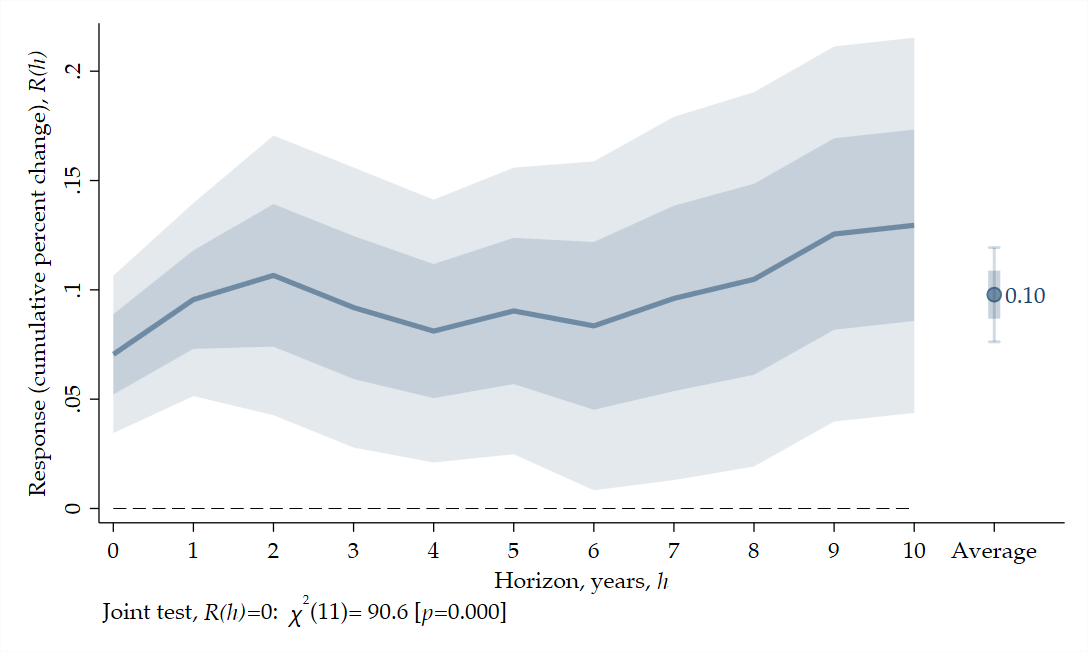
Figure 1 reports the responses of both real and potential GDP. The Age reform generates a positive and statistically significant increase in real GDP, averaging at 0.1%, remaining significant over all the ten-year window (panel a). This response is in line with Testable Implication 1 and is consistent with a positive labour-supply shock operating already in the short run, together with induced demand effects. By delaying labour-market exit, the reform increases effective labour input as workers who would otherwise have retired remain employed. At the same time, these workers continue to receive labour income that typically exceeds the pension benefits they would otherwise have obtained, thereby supporting disposable income, private consumption, and aggregate demand, as documented in Section 5.3.
Over the medium run, the supply-side component becomes more visible: higher labour input raises productive capacity and stimulates investment through capital-labour complementarity, reinforcing the output response. The positive response of potential GDP confirms this interpretation. Potential GDP follows a broadly similar profile, although with a slightly smaller magnitude of about +0.09% (panel b) on average, and +0.13% by the 10th year, indicating that the increase in real GDP is not purely cyclical but reflects an expansion of the economy’s productive capacity.
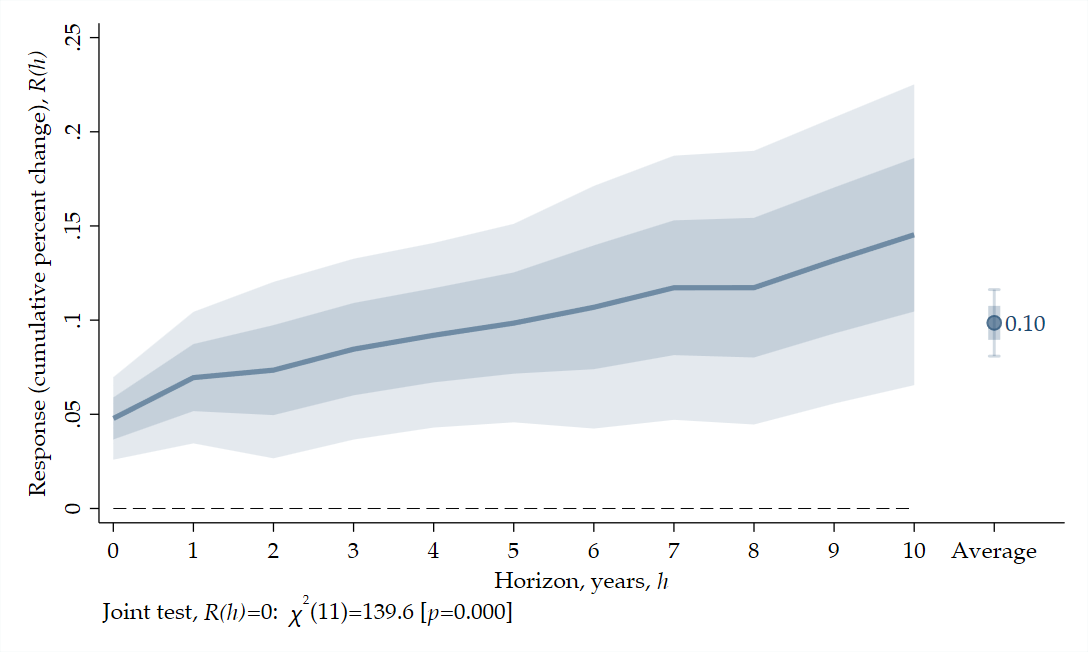
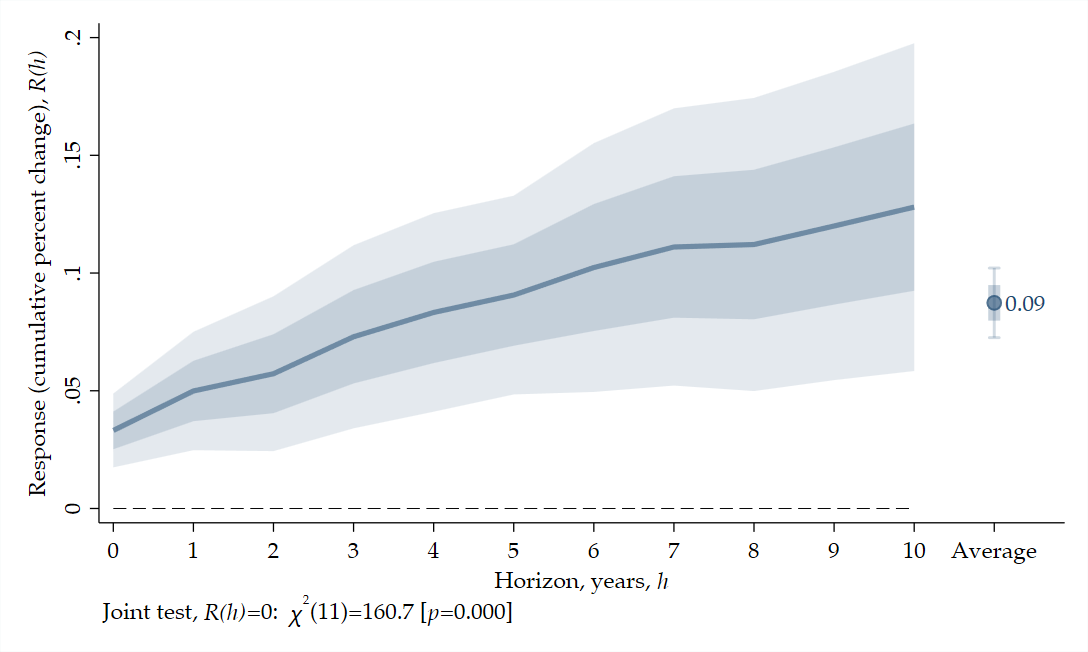
Notes: The dependent variable is the cumulative change in GDP and productive capacity—relative to t{-}1. Responses are normalized to a one-year increase in the statutory retirement age. The specification includes one lag of the dependent variable, contemporaneous values, and three lags of the old-age dependency ratio, the unemployment rate, the alternative (second) factor, and a crisis dummy, along with horizon-specific country and year fixed effects. Inferences based on bootstrapped standard errors (1000 replications). Wald test statistics for joint significance and p-values are reported below each chart. Darker (lighter) shaded areas indicate 68% (95%) pointwise confidence intervals.
5.2 Labour market outcomes
Figure 2 presents the labour market responses. The Age reform produces, as predicted, a large and statistically robust increase in the labour force participation rate of workers aged 55-64 (panel a). The response is significant within both the 68% and 95% confidence bands from horizon 1 onward, reaches a peak of +2.6 percentage points at horizons 5-6, and remains elevated throughout the ten-year window. This result aligns closely with Testable Implication 2 and is consistent with the large related literature (Gruber & Wise, 1999; Staubli & Zweimüller, 2013): by raising the statutory retirement age, the reform mechanically extends the period of labour market attachment and strengthens the income motive to remain employed. The total labour force participation rate (panel b) also rises, with a more moderate but continuous effect (significant at 68%), reaching +0.8 pp at the 10th year, consistent with the absence of crowding-out documented in the literature (Dai et al., 2022; Munnell & Wu, 2012): older workers remaining in the labour market do not displace younger cohorts. The unemployment rate response (panel c) decreases in the short run, with a trough of about -1.5 pp at horizon 3, before becoming less precisely estimated thereafter. A potential explanation is that the transition dynamics noted in Testable Implication 2 are more than offset by the expansionary impact on output previously highlighted.
A further implication of Testable Implication 2, drawing on Bi & Zubairy (2023), was that the sign of the Age reform’s effect on older workers’ participation could be ambiguous or even negative in the short run for reforms announced with long phase-in periods, due to the fiscal foresight and uncertainty channels. The finding that the LFPR response is positive from horizon 1 onward is therefore informative: it suggests that, in our sample, the labour-supply and income effects dominate any fiscal-foresight or uncertainty channel that could have induced early exits. This is consistent with the nature of the reforms contributing most to the Age factor (statutory retirement age increases applied without extended transition periods), and it corroborates the exogeneity argument developed in Section 4.1: the reforms we identify are structural in motivation and do not exhibit the very long implementation lags that Bi & Zubairy (2023) associate with LFPR declines.
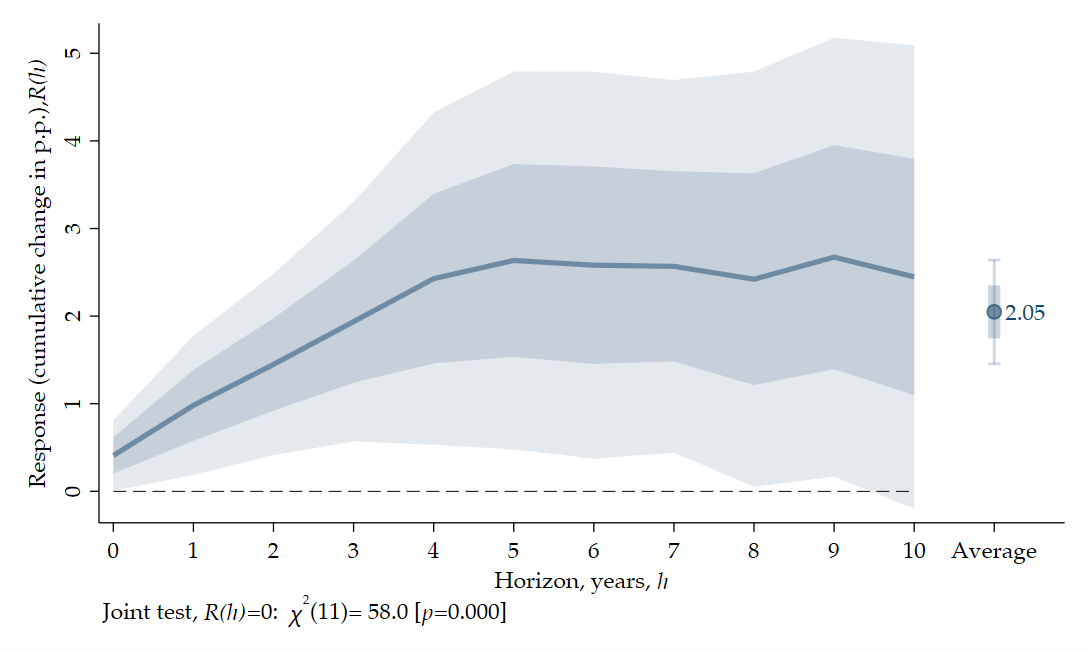
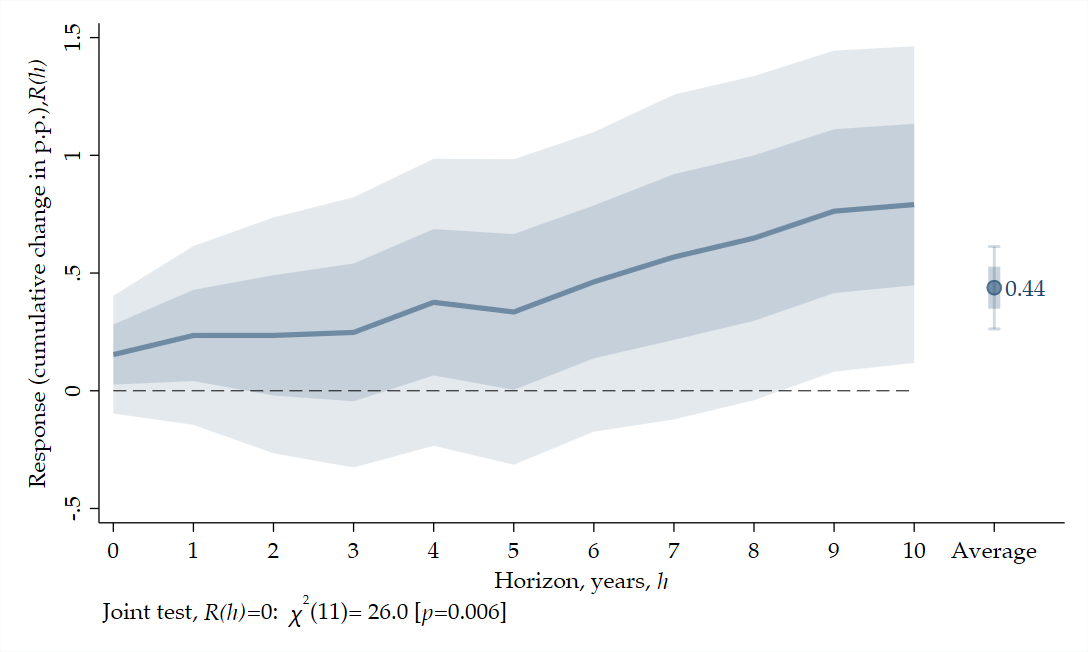
Notes: The dependent variable is the cumulative change in labour market outcomes—relative to t{-}1. Responses are normalized to a one-year increase in the statutory retirement age. The specification includes one lag of the dependent variable, contemporaneous values, and three lags of the old-age dependency ratio, the unemployment rate, the alternative (second) factor, and a crisis dummy, along with horizon-specific country and year fixed effects. For the unemployment-rate regressions, the unemployment rate is excluded from the set of controls. Inferences based on bootstrapped standard errors (1000 replications). Wald test statistics for joint significance and p-values are reported below each chart. Darker (lighter) shaded areas indicate 68% (95%) pointwise confidence intervals.
5.3 Consumption and savings
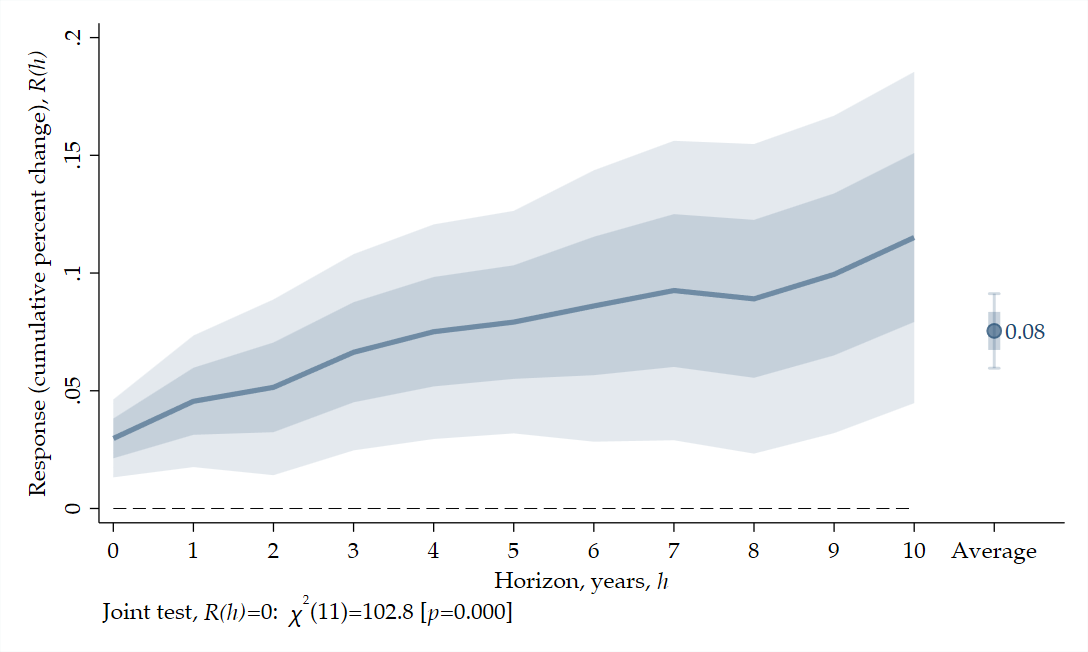
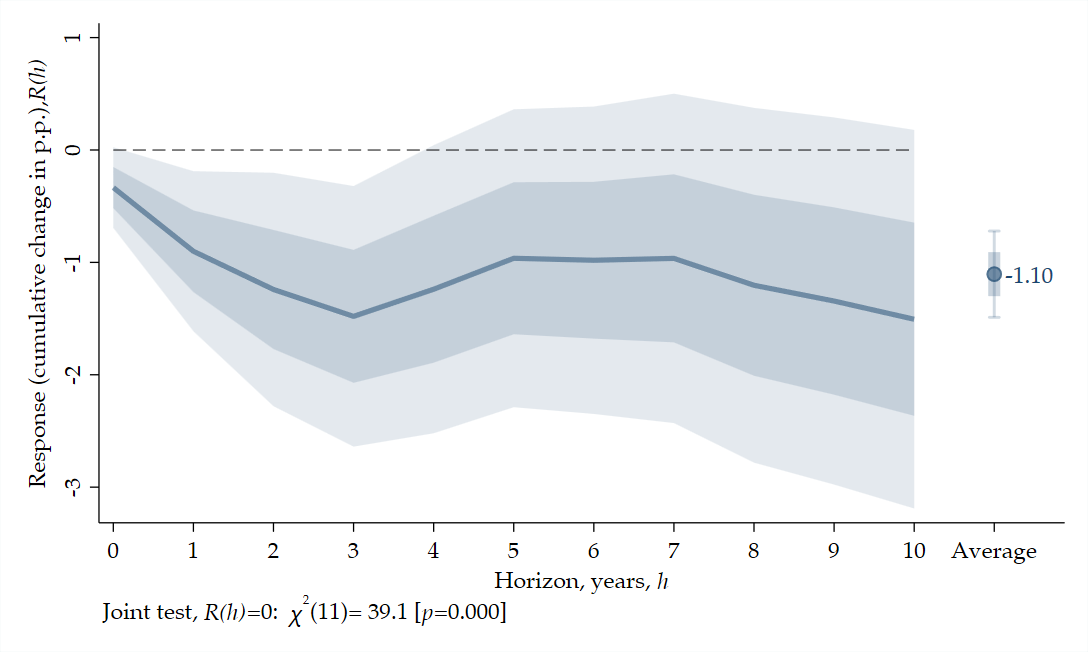
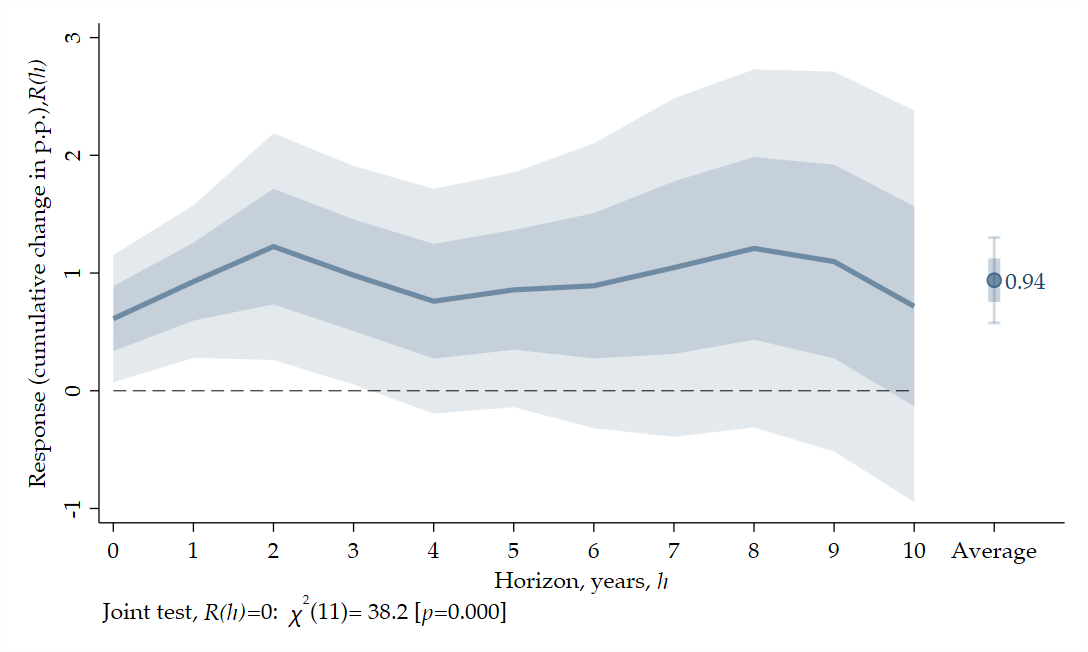
Notes: The dependent variable is the cumulative change in consumption—relative to t{-}1. Responses are normalized to a one-year increase in the statutory retirement age. The specification includes one lag of the dependent variable, contemporaneous values, and three lags of the old-age dependency ratio, the unemployment rate, the alternative factor, and a crisis dummy, along with horizon-specific country and year fixed effects. Inferences based on bootstrapped standard errors (1000 replications). Wald test statistics for joint significance and p-values are reported below each chart. Darker (lighter) shaded areas indicate 68% (95%) pointwise confidence intervals.
Figure 3 reports the consumption responses. The Age reform produces a positive and statistically significant increase in private consumption in absolute terms (panel a, average +0.08% in cumulative percent change, significant throughout). This result is in line with Testable Implication 4 and validates the labour-income channel: workers who remain in employment instead of retiring continue to earn wages that substantially exceed their pension replacement income, thereby supporting aggregate consumption. As a share of GDP, however, consumption declines significantly (panel b, average -1.4 pp, -1.7 pp at the 10th horizon), reflecting the fact that the reform raises GDP faster than it raises consumption — the labour supply expansion generates output growth that outpaces the demand effect, compressing the consumption-to-GDP ratio. This is consistent with the supply-side character of the Age reform documented in Section 5.1.
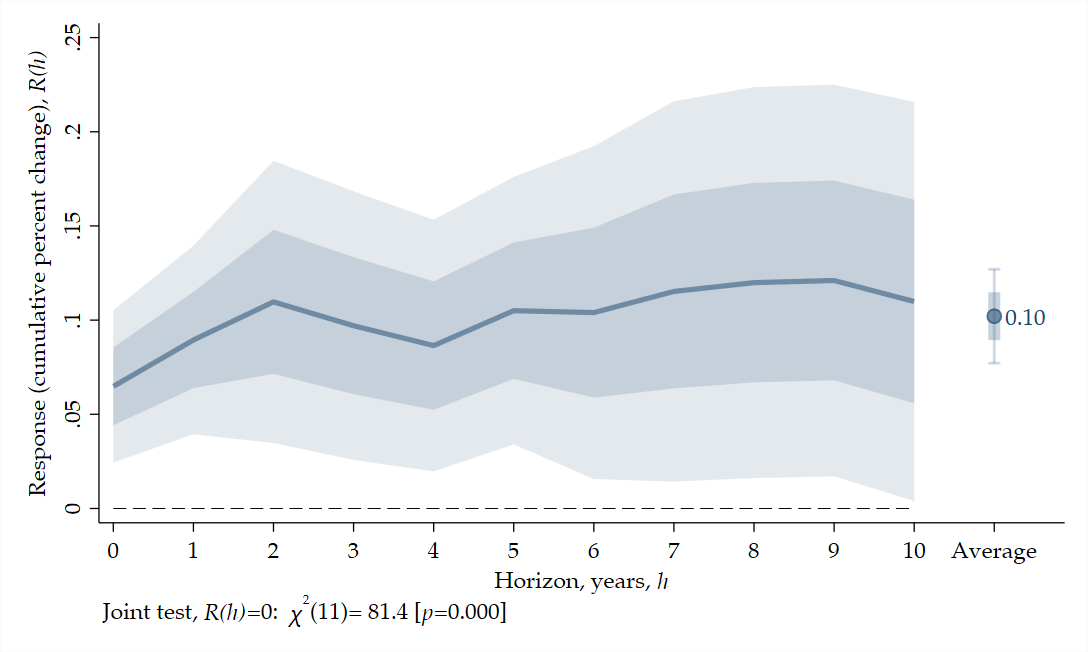
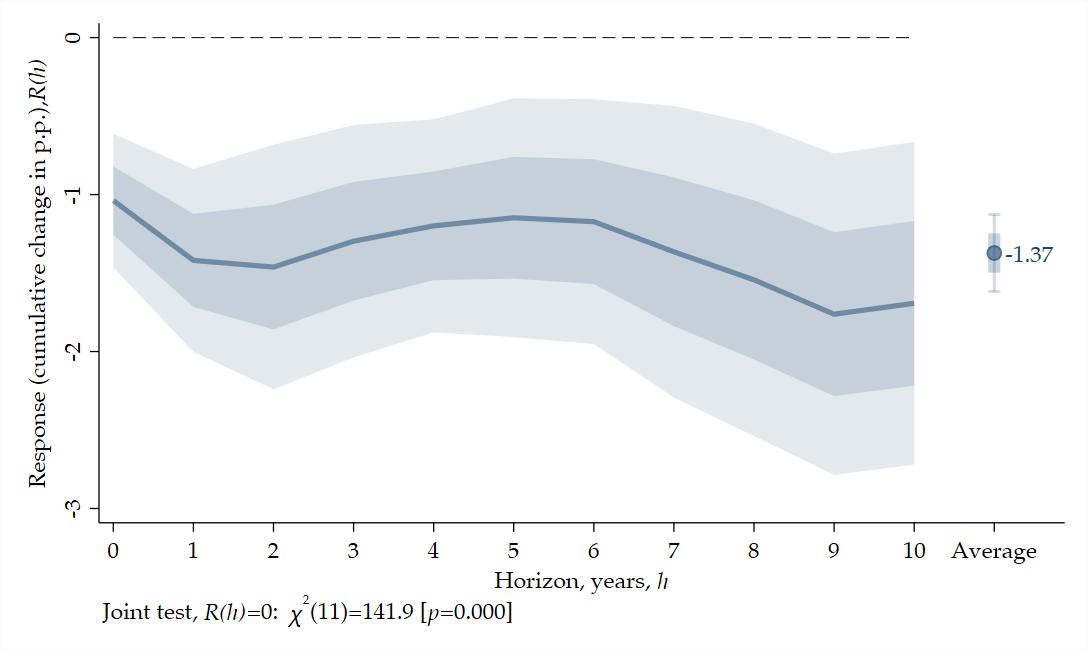
Notes: The dependent variable is the cumulative change in savings—relative to t{-}1. Responses are normalized to a one-year increase in the statutory retirement age. The specification includes one lag of the dependent variable, contemporaneous values, and three lags of the old-age dependency ratio, the unemployment rate, the alternative factor, and a crisis dummy, along with horizon-specific country and year fixed effects. Inferences based on bootstrapped standard errors (1000 replications). Wald test statistics for joint significance and p-values are reported below each chart. Darker (lighter) shaded areas indicate 68% (95%) pointwise confidence intervals.
Figure 4 reports the savings responses, which provide the natural counterpart to the consumption results. Gross domestic savings rise clearly both in levels and as a share of GDP, with slightly weaker significance in the latter case. In levels (panel b), the response is positive, growing, and significant throughout the window, with an average of +0.10%. As a share of GDP (panel a), savings also rise, with an average of +1 pp. Gross savings tell a very similar story (panels c–d): significant positive response in levels (average +0.10%) and as a share of GDP (average +0.9 pp). Overall, the medium-to-long-run increase in savings as a share of GDP (mirroring the decrease of consumption as a share of GDP) is consistent with a life-cycle smoothing response.
5.4 Investment
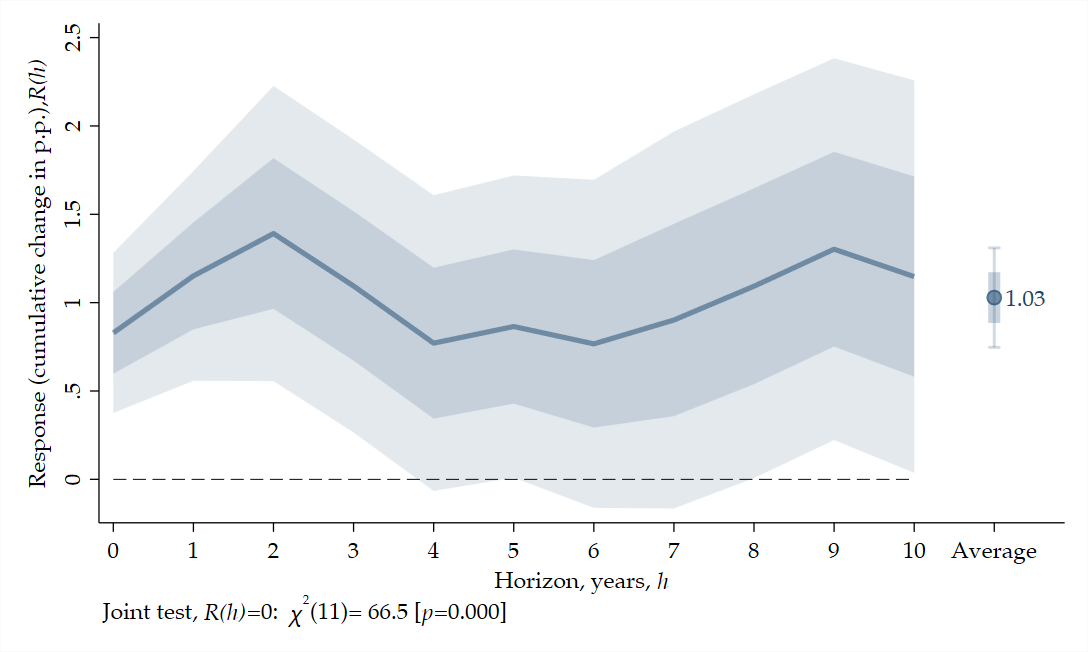
Figure 5 reports the investment responses. Consistently with Testable Implication 6, the Age reform produces a positive and growing response throughout the window. In levels (panel a), investment rises from impact and is significant throughout, with an average of +0.11%. As a share of GDP (panel b), the response is also positive and significant, averaging +1.02 pp. Fixed investment (panels c–d) tells the same story: average +0.11% in levels and +0.88 pp as a share of GDP, both significant throughout the window. Notably, the positive response materialises from impact, without any short-run contraction. The profile is consistent with two medium-run channels. First, the labour-supply expansion raises the marginal product of capital and stimulates capital formation through capital-labour complementarity. Second, the improvement in fiscal ratios documented in Section 5.5 may reduce expected public financing pressures and support private investment. Both channels build gradually, which helps explain the growing profile of the response.
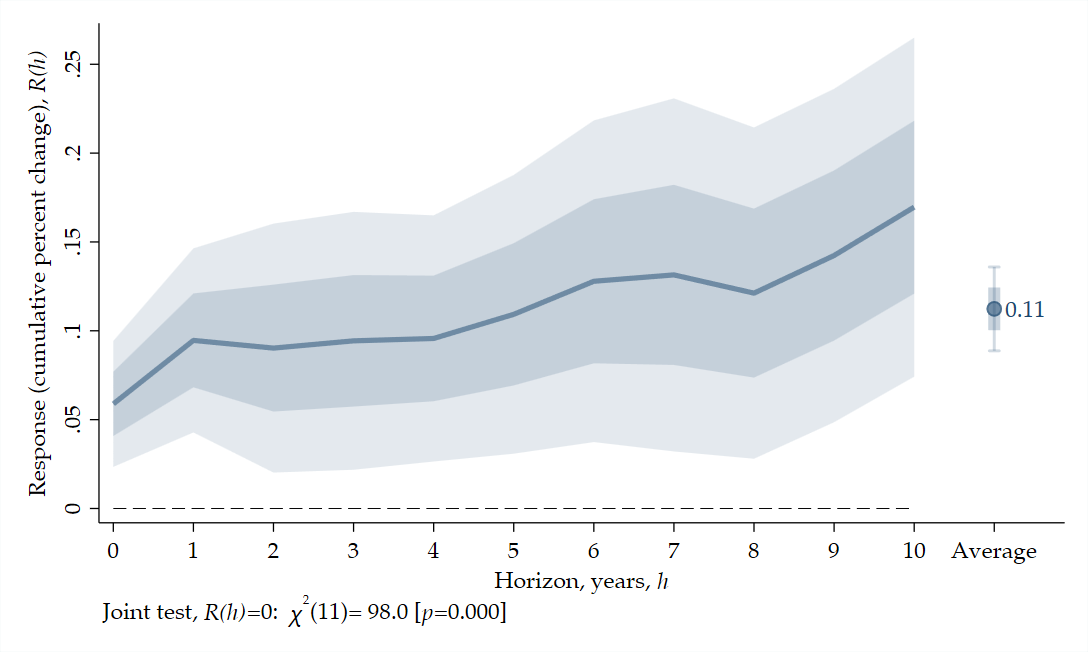
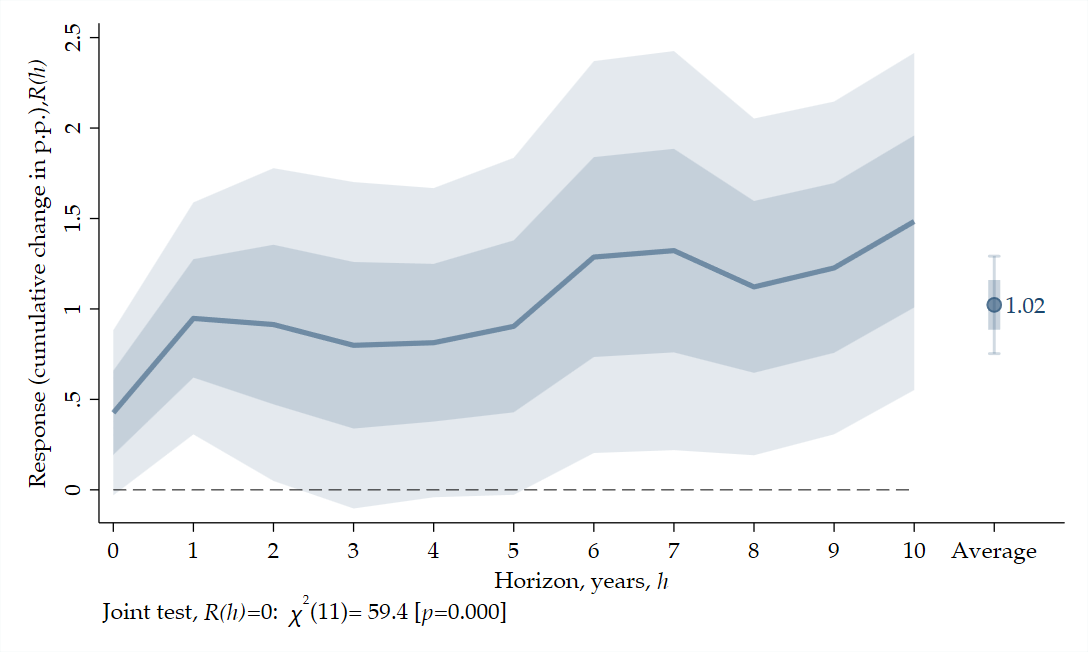
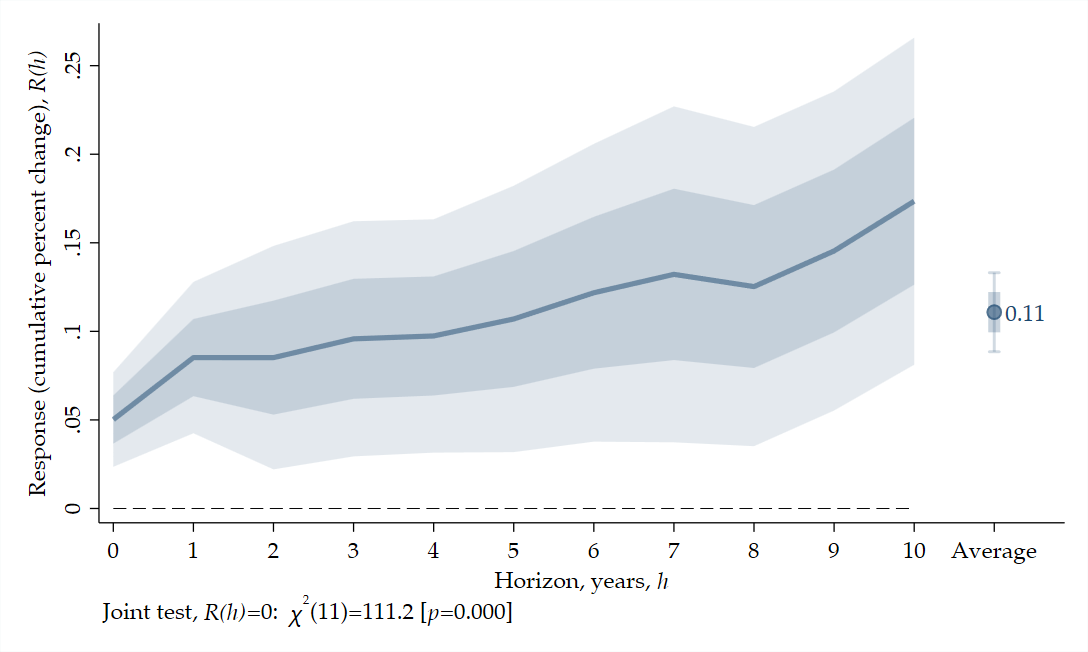
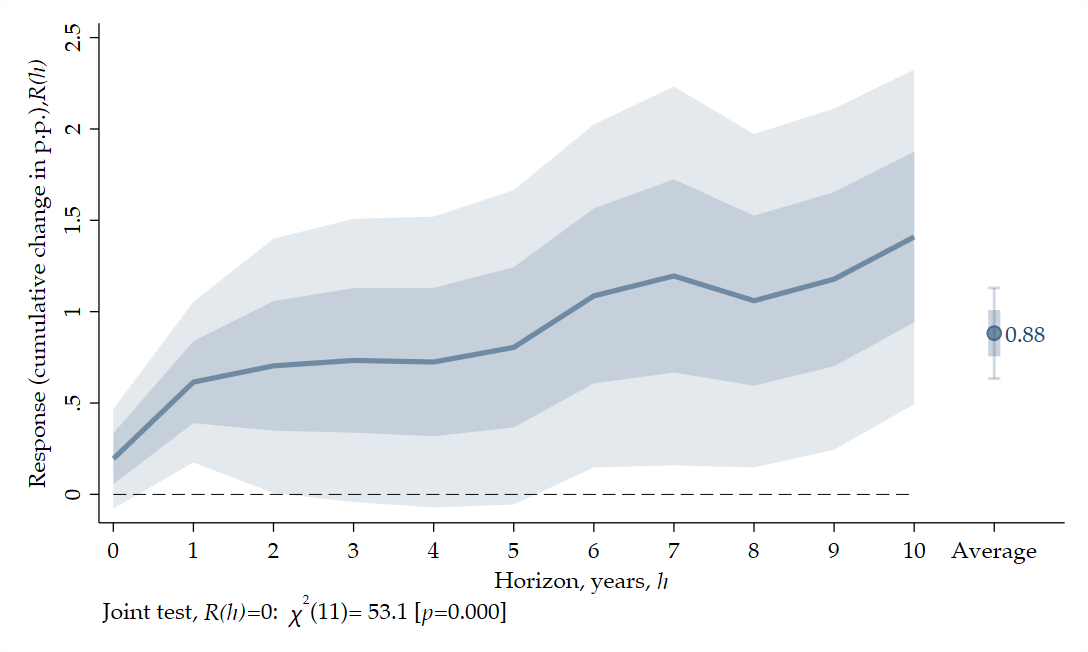
Notes: The dependent variable is the cumulative change in investment—relative to t{-}1. Responses are normalized to a one-year increase in the statutory retirement age. The specification includes one lag of the dependent variable, contemporaneous values, and three lags of the old-age dependency ratio, the unemployment rate, the alternative factor, and a crisis dummy, along with horizon-specific country and year fixed effects. Inferences based on bootstrapped standard errors (1000 replications). Wald test statistics for joint significance and p-values are reported below each chart. Darker (lighter) shaded areas indicate 68% (95%) pointwise confidence intervals.
5.5 Government debt and fiscal space
Figure 6 reports the responses of pension and government expenditure, and Figure 7 the debt responses .
The Age reform presents a striking fiscal picture. Public pension expenditure as a share of GDP declines significantly throughout the window (panel a of Figure 6, average −0.46 pp), consistent with delayed benefit eligibility and with the denominator effect generated by higher GDP. In constant USD, however, public pension expenditure is essentially unaffected — the response is quasi-zero and non-significant (panel b), suggesting that real pension spending is broadly unchanged while GDP rises, compressing the ratio. Central government expenditure in levels (panel d) rises modestly throughout (average +0.05%, weakly significant), consistent with the broader economic expansion documented in Section 5.1, and the same pattern holds for general government expenditure (panel f, average +0.05%, significant throughout). As a share of GDP, however, central government expenditure is not significantly affected (panel c): the expansion in spending and the expansion in GDP broadly offset each other, leaving the expenditure ratio unchanged. General government expenditure (panel e) as a share of GDP delivers a message broadly similar, but with a more marked and significant decline (−0.58 pp).
Government debt tells a clear story (Figure 7): both central government debt (panel a, average −4.57 pp of GDP, significant at 68% throughout) and general government debt (panel b, average −5.46 pp of GDP, significant at 68% and 95% throughout) decline significantly and persistently. In constant USD, general government debt is non-significant (panel d), again reflecting the mechanical effect of GDP growth on the denominator: the debt ratio improves primarily because the economy grows, not because debt falls in absolute terms.
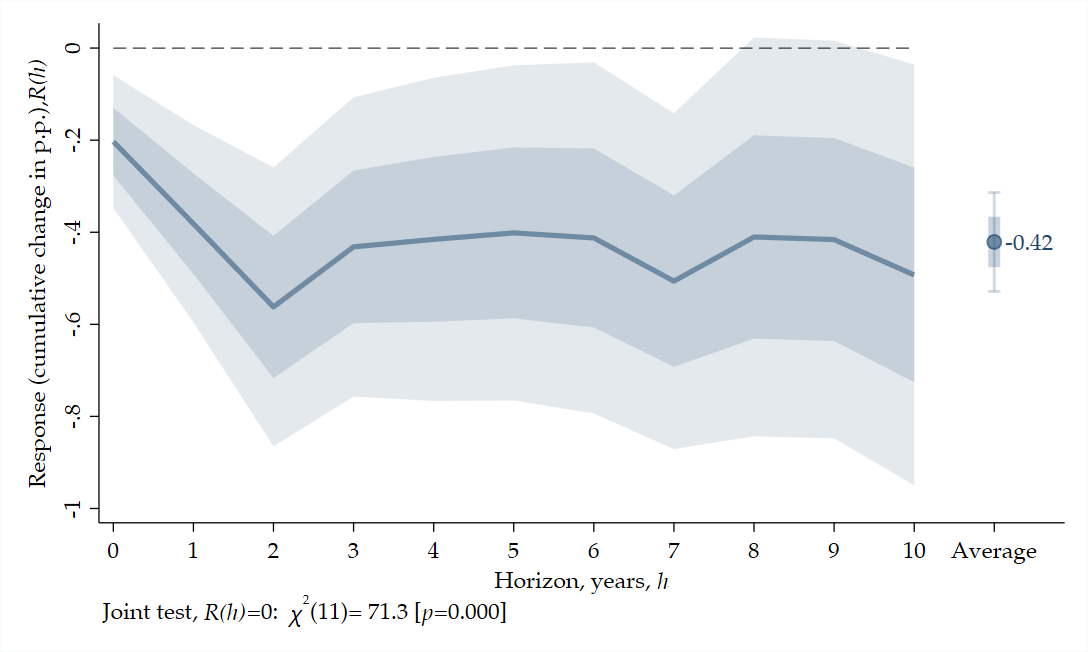
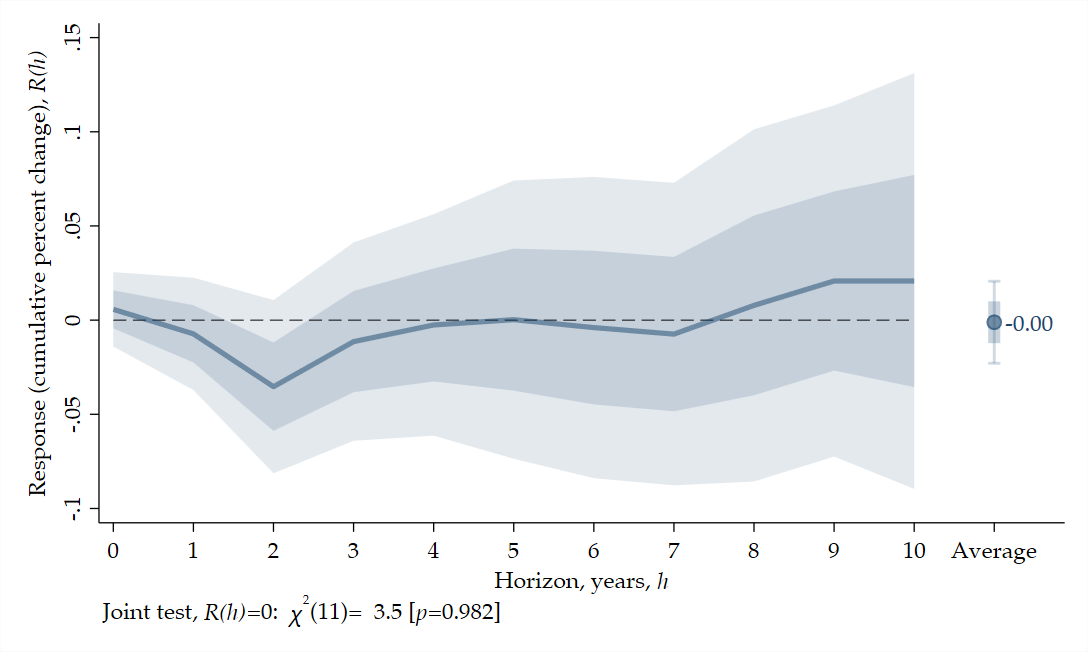
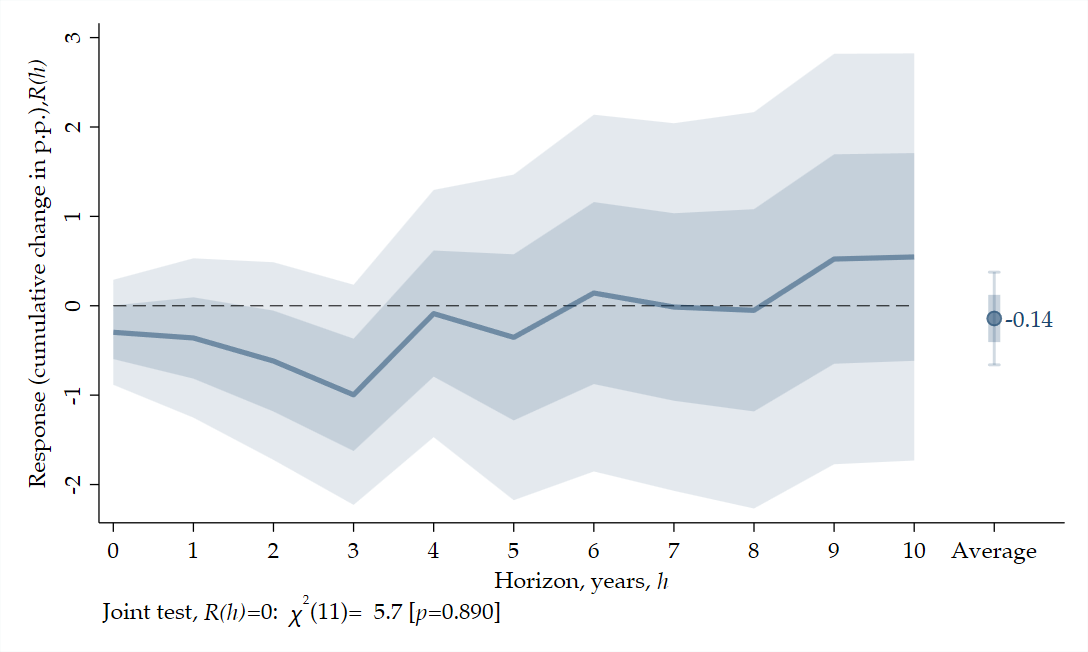
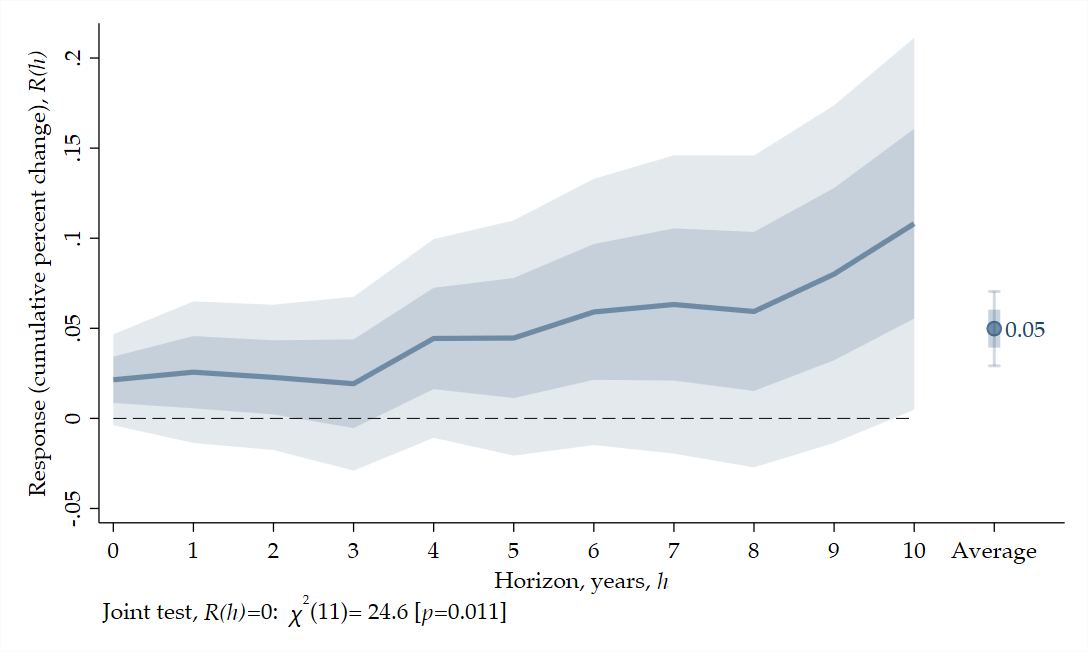
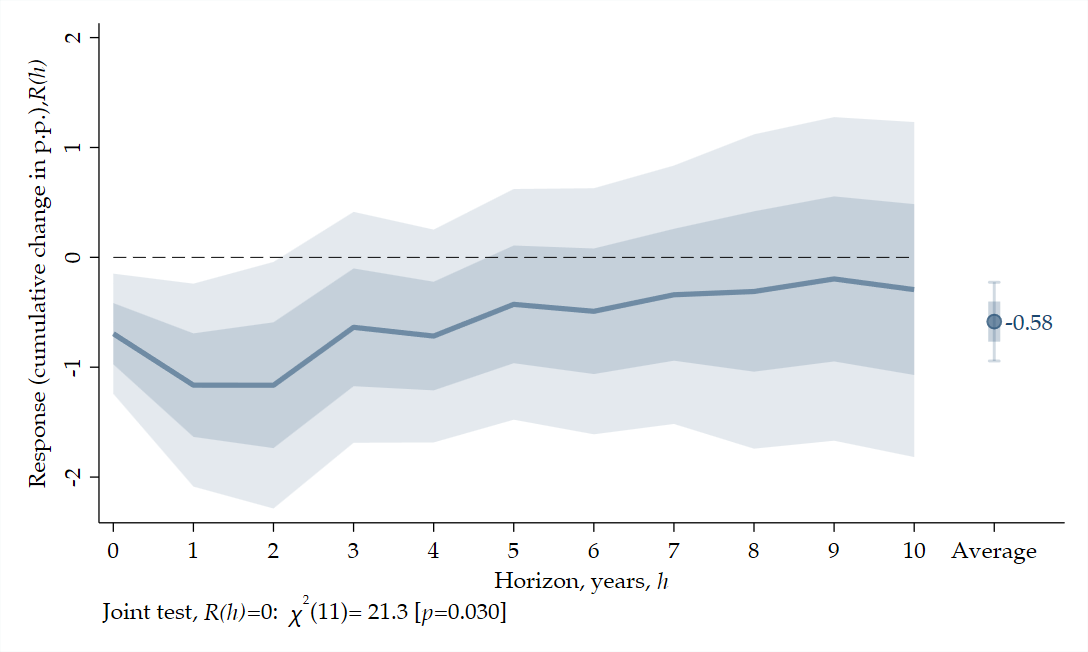
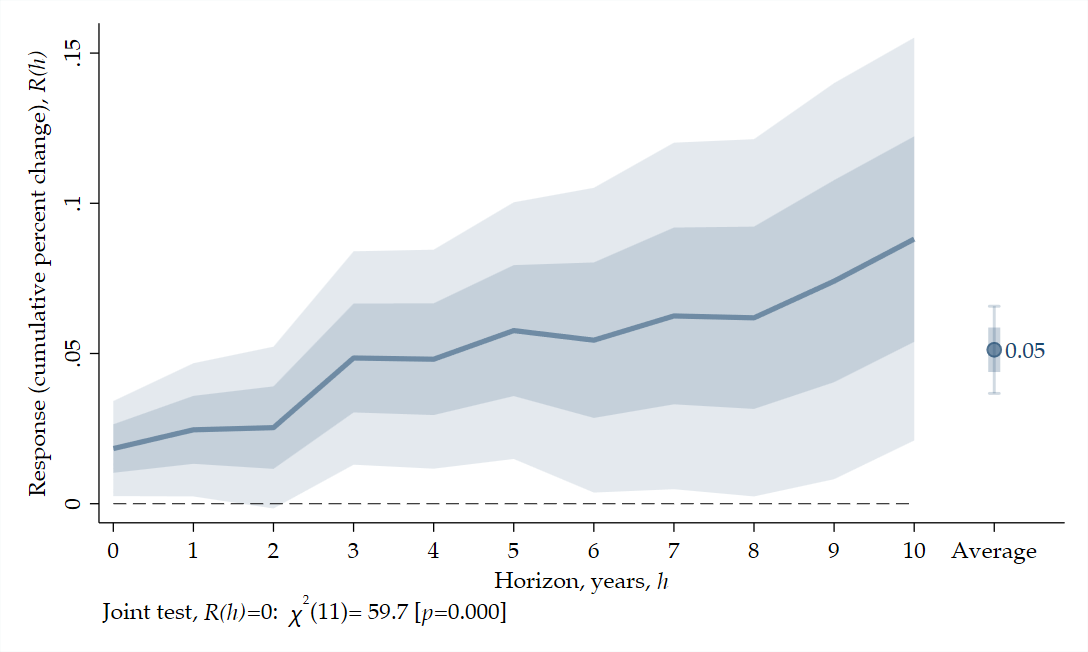
Notes: The dependent variable is the cumulative change in pension and government expenditure—relative to t{-}1. Responses are normalized to a one-year increase in the statutory retirement age. The specification includes one lag of the dependent variable, contemporaneous values, and three lags of the old-age dependency ratio, the unemployment rate, the alternative factor, and a crisis dummy, along with horizon-specific country and year fixed effects. Inferences based on bootstrapped standard errors (1000 replications). Wald test statistics for joint significance and p-values are reported below each chart. Darker (lighter) shaded areas indicate 68% (95%) pointwise confidence intervals.
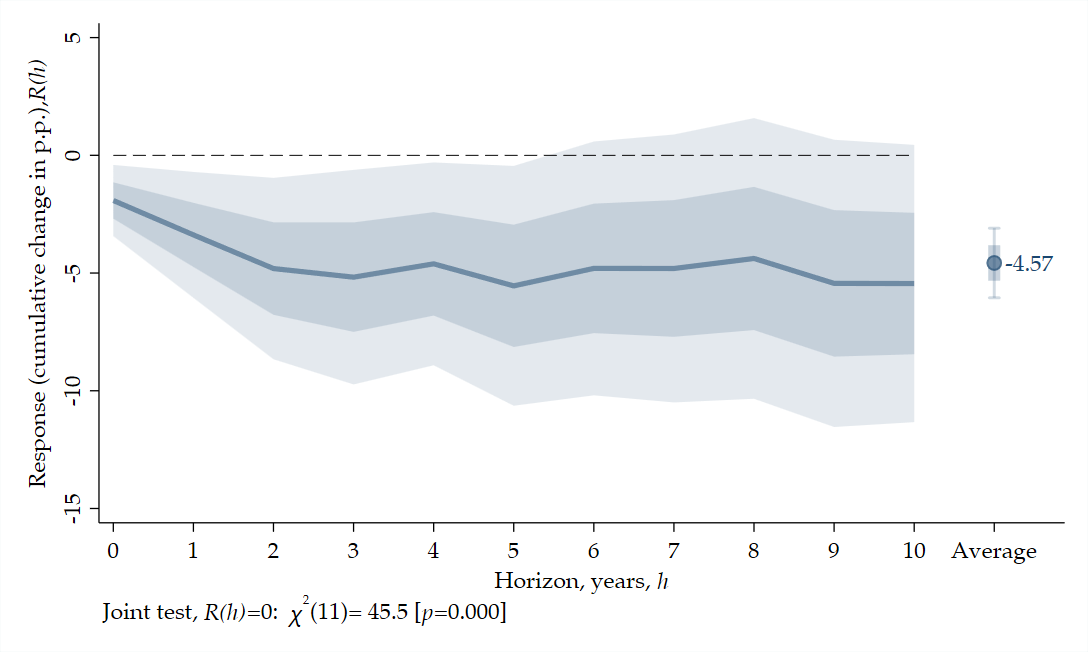
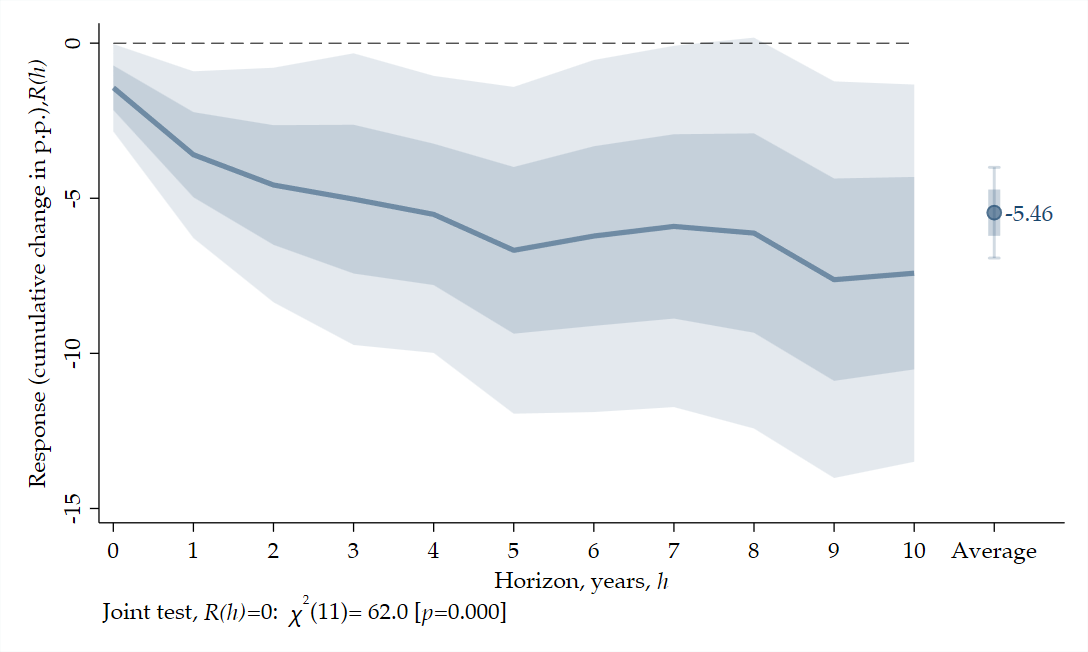
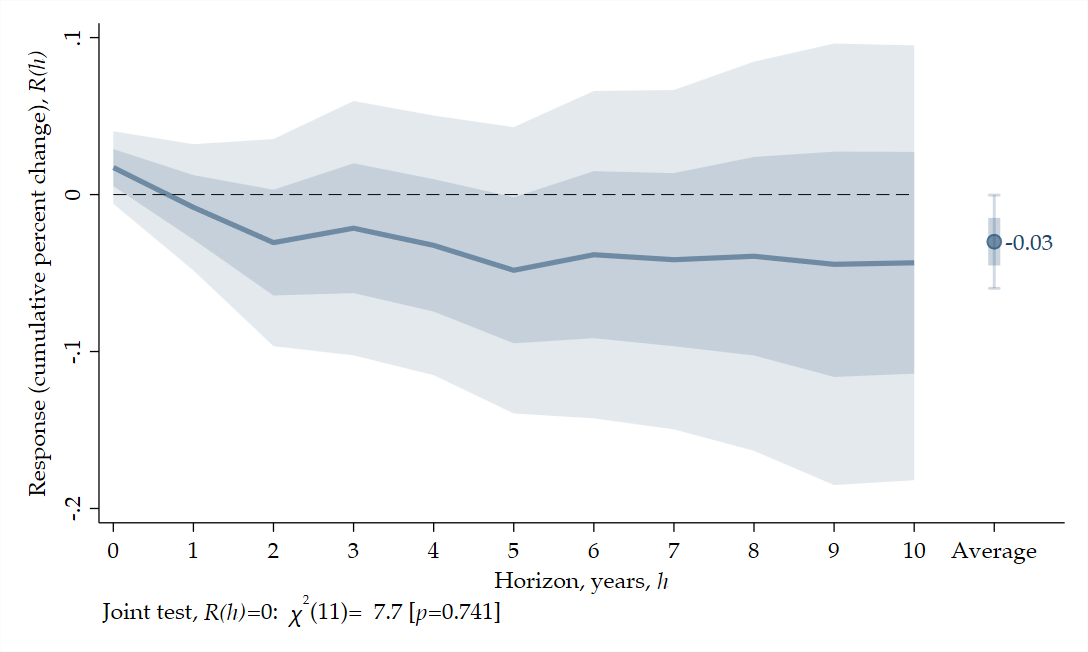
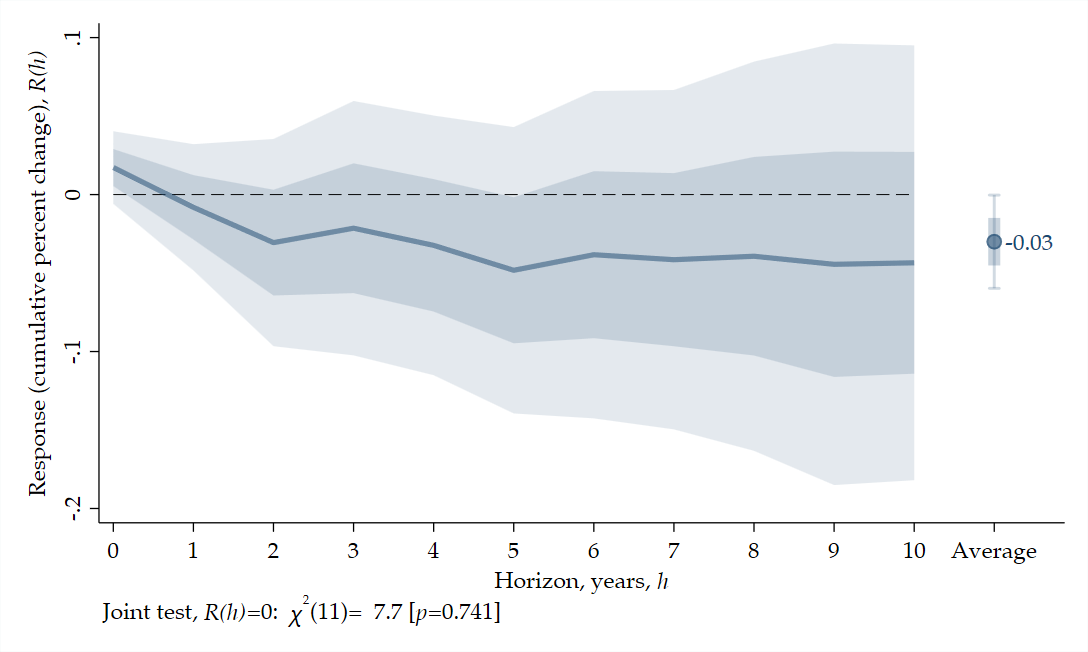
Notes: The dependent variable is the cumulative change in government debt—relative to t{-}1. Responses are normalized to a one-year increase in the statutory retirement age. The specification includes one lag of the dependent variable, contemporaneous values, and three lags of the old-age dependency ratio, the unemployment rate, the alternative factor, and a crisis dummy, along with horizon-specific country and year fixed effects. Inferences based on bootstrapped standard errors (1000 replications). Wald test statistics for joint significance and p-values are reported below each chart. Darker (lighter) shaded areas indicate 68% (95%) pointwise confidence intervals.
5.6 External sector
Figure 8 and Figure 9 report the external sector responses, which we connect to Testable Implication 8.
The Age reform produces an expansion of trade volumes in levels: both exports and imports rise over the estimation window (Figure 8, panels a and c, average +0.04% for each), while their shares of GDP remain essentially unchanged (panels b and d). This pattern is consistent with the broad GDP expansion documented in Section 5.1: the reform raises aggregate activity, increasing both export capacity and import demand in proportion to output. Consistently, neither the trade balance nor the current account balance shows a statistically significant response (Figure 9, panels a–b). This result is in line with Testable Implication 8: retirement-age reforms may raise trade volumes without necessarily altering the external balance when exports and imports move broadly together.
Overall, the external-sector results reinforce the broader pattern. The Age reform is associated with a balanced expansion of domestic activity and trade volumes, without significant external rebalancing.
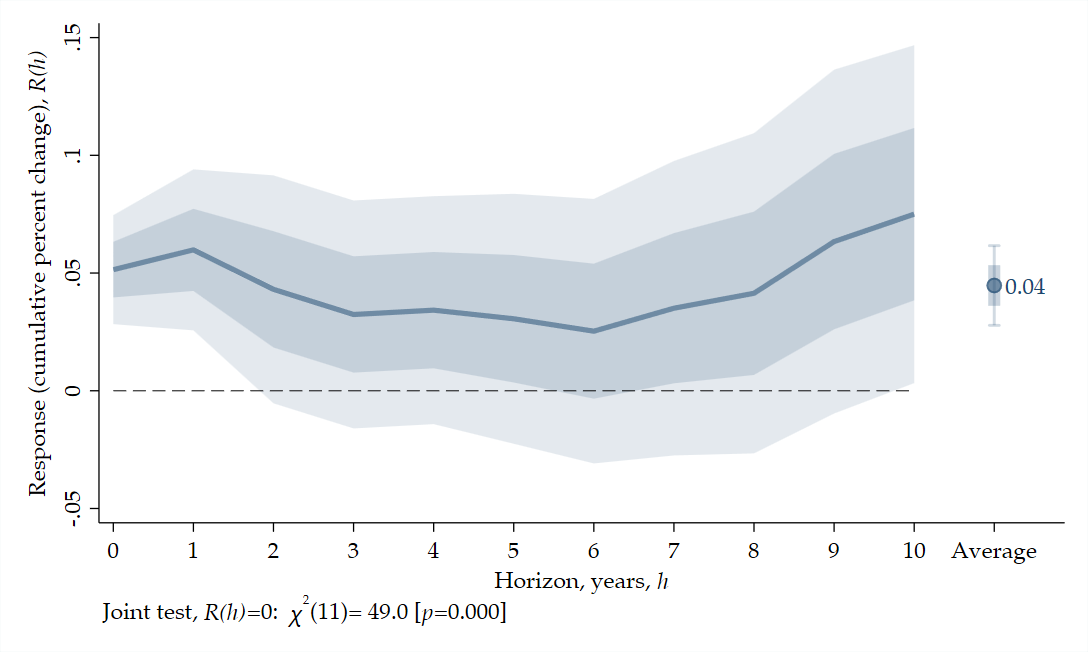
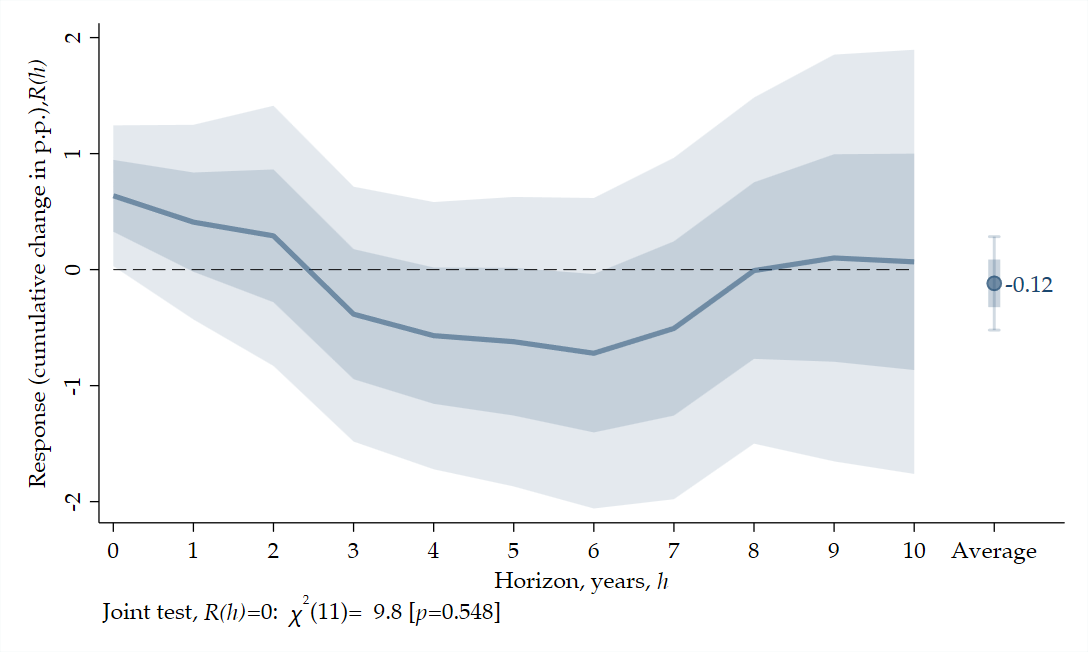
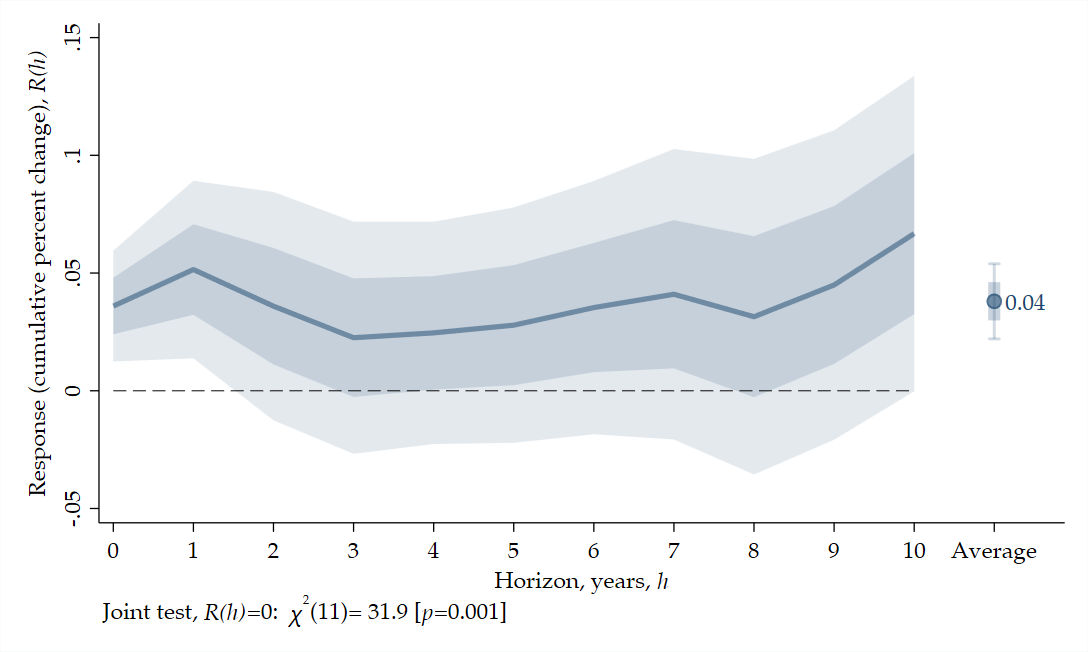
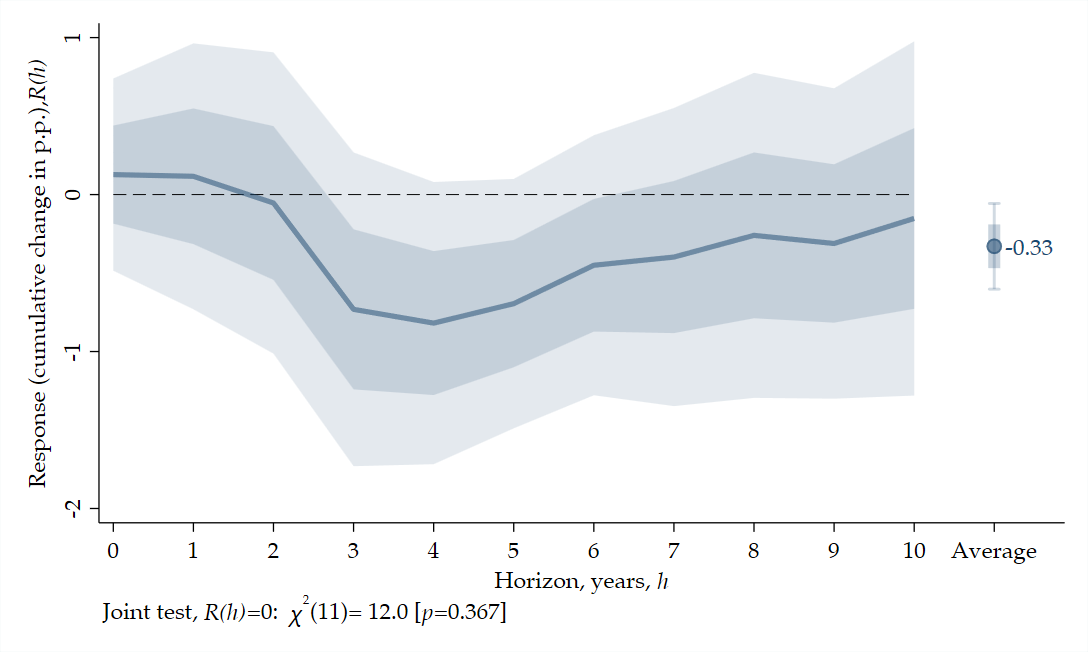
Notes: The dependent variable is the cumulative change in trade flows—relative to t{-}1. Responses are normalized to a one-year increase in the statutory retirement age. The specification includes one lag of the dependent variable, contemporaneous values, and three lags of the old-age dependency ratio, the unemployment rate, the alternative factor, and a crisis dummy, along with horizon-specific country and year fixed effects. Inferences based on bootstrapped standard errors (1000 replications). Wald test statistics for joint significance and p-values are reported below each chart. Darker (lighter) shaded areas indicate 68% (95%) pointwise confidence intervals.
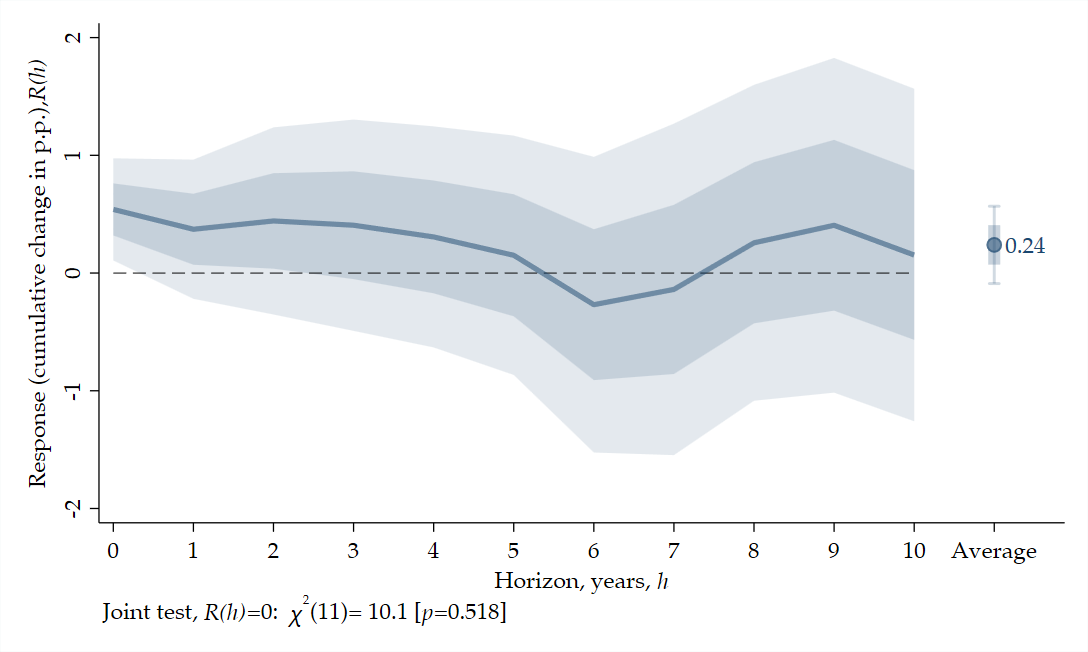
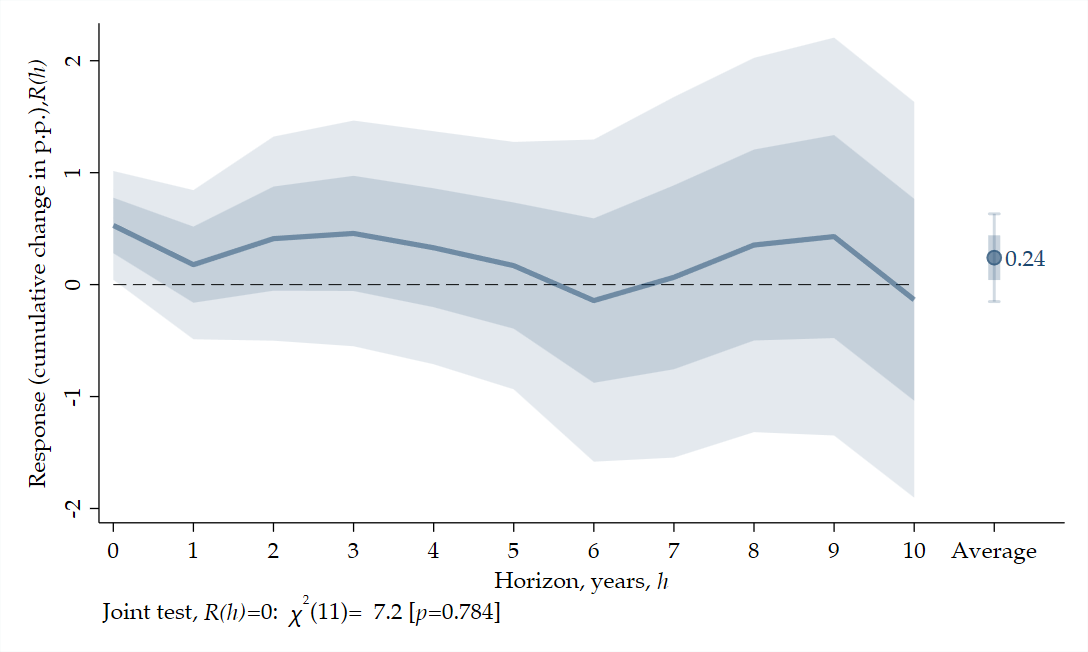
Notes: The dependent variable is the cumulative change in external balances—relative to t{-}1. Responses are normalized to a one-year increase in the statutory retirement age. The specification includes one lag of the dependent variable, contemporaneous values, and three lags of the old-age dependency ratio, the unemployment rate, the alternative factor, and a crisis dummy, along with horizon-specific country and year fixed effects. Inferences based on bootstrapped standard errors (1000 replications). Wald test statistics for joint significance and p-values are reported below each chart. Darker (lighter) shaded areas indicate 68% (95%) pointwise confidence intervals.
5.7 Productivity
Figure 10 reports the response of productivity, measured by TFP in panel (a) and GDP per worker in panel (b).
The Age reform is associated with a positive and jointly significant increase in TFP throughout the ten-year horizon (panel a). The response is positive on impact, at around +0.01%, builds gradually to approximately +0.02% at horizons 7-8, and remains above zero across the full window. GDP per worker also rises, with an average response of +0.03% (panel b), although significance quickly disappears (at h=2). Taken together, these results are broadly in line with the neutral-to-mildly-positive prediction of Testable Implication 9. A plausible interpretation is that delayed retirement does not reduce average productivity and may instead generate complementarities through experience, firm-specific knowledge, and induced investment. This interpretation is consistent with the capital-skill complementarity channel highlighted by Dai et al. (2022), but the aggregate TFP response should be interpreted cautiously, since it may also reflect broader general-equilibrium effects rather than the direct productivity effect of older workers alone.
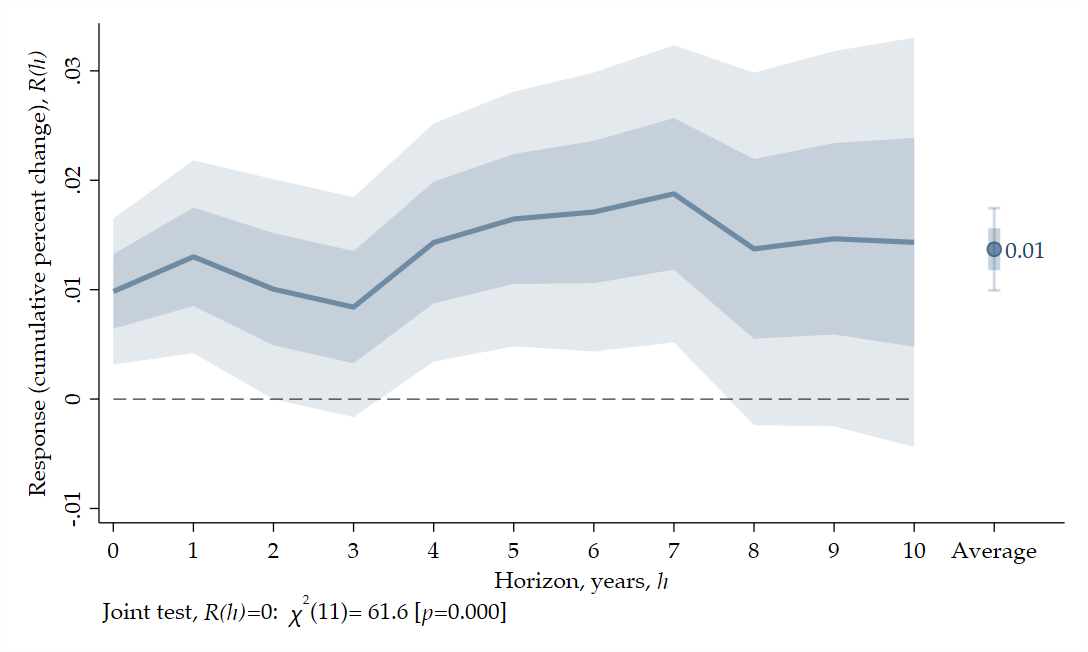
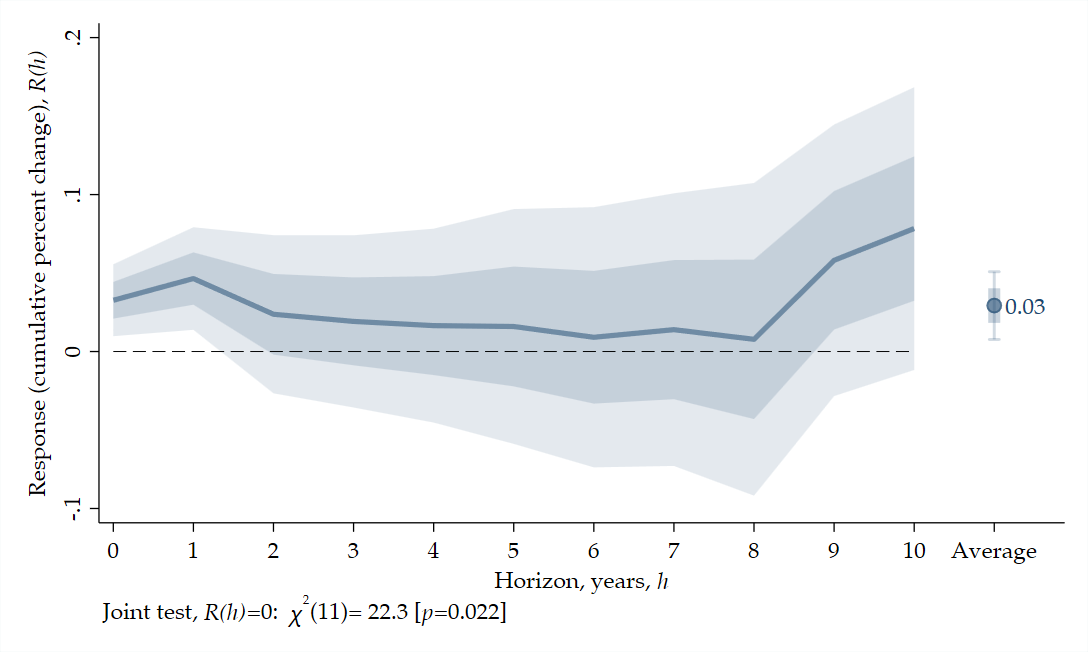
Notes: The dependent variable is the cumulative change in total factor productivity (TFP) or GDP per worker —relative to t{-}1. Responses are normalized to a one-year increase in the statutory retirement age. The specification includes one lag of the dependent variable, contemporaneous values, and three lags of the old-age dependency ratio, the unemployment rate, the alternative factor, and a crisis dummy, along with horizon-specific country and year fixed effects. Inferences based on bootstrapped standard errors (1000 replications). Wald test statistics for joint significance and p-values are reported below each chart. Darker (lighter) shaded areas indicate 68% (95%) pointwise confidence intervals.
6 Additional results
This section first presents suggestive results on the macro impacts of capitalisation reforms, then provides evidence on the savings outflow channel as a possible mechanism to rationalise their effects. Finally, we report several robustness checks, including a placebo analysis and controls for potentially omitted factors.
6.1 Suggestive evidence on “capitalisation” reforms
GDP and productive capacity. Figure 11 shows that the Capitalisation factor is associated with a contractionary GDP profile. Real GDP responds negatively on impact and remains significantly negative throughout the entire ten-year window (panel a), with the response averaging -0.06%. There is no recovery within the estimation horizon. Potential GDP exhibits the same persistent contractionary pattern (panel b), with an average response of −0.04% and similarly strong significance. These results are consistent with the possibility that the diversion of contributions from consumption to private saving generates a demand contraction (as documented below in the consumption results) that depresses both actual and potential output persistently, with no sign of the capital accumulation channel reversing the effect within ten years. Although based on a limited number of reforms and countries, this pattern suggests that the standard prediction that pension privatization eventually raises productive capacity through higher savings and investment does not appear to materialise within the horizon covered by our analysis. This may reflect a longer transmission lag, a weak or incomplete capital market channel in our sample of countries, or structural features of the privatization reforms captured by the Capitalisation factor.
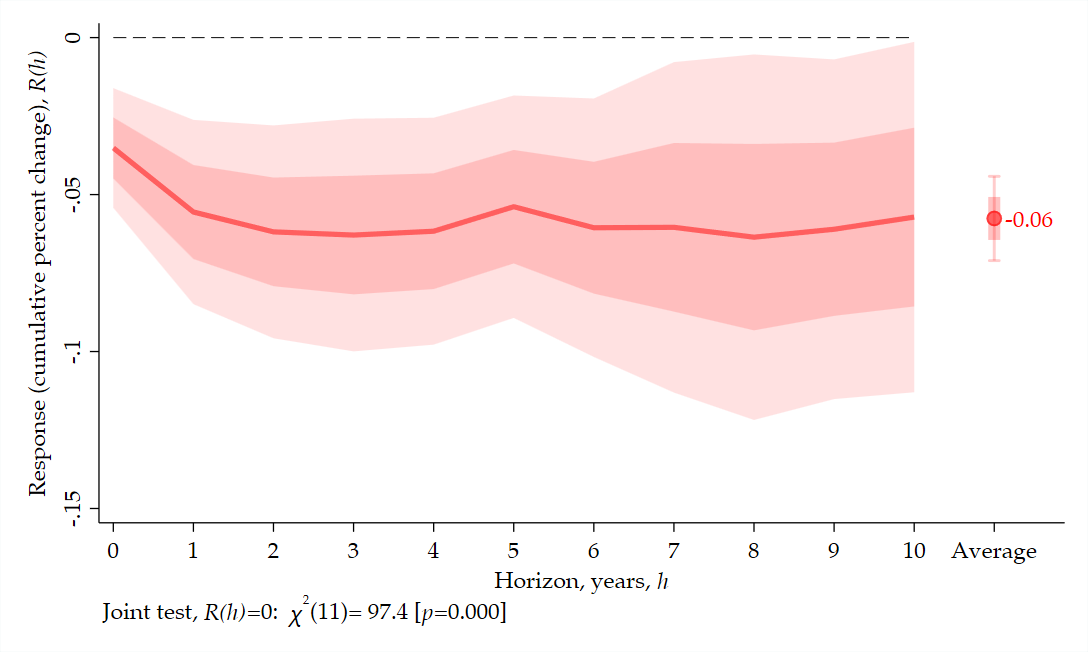
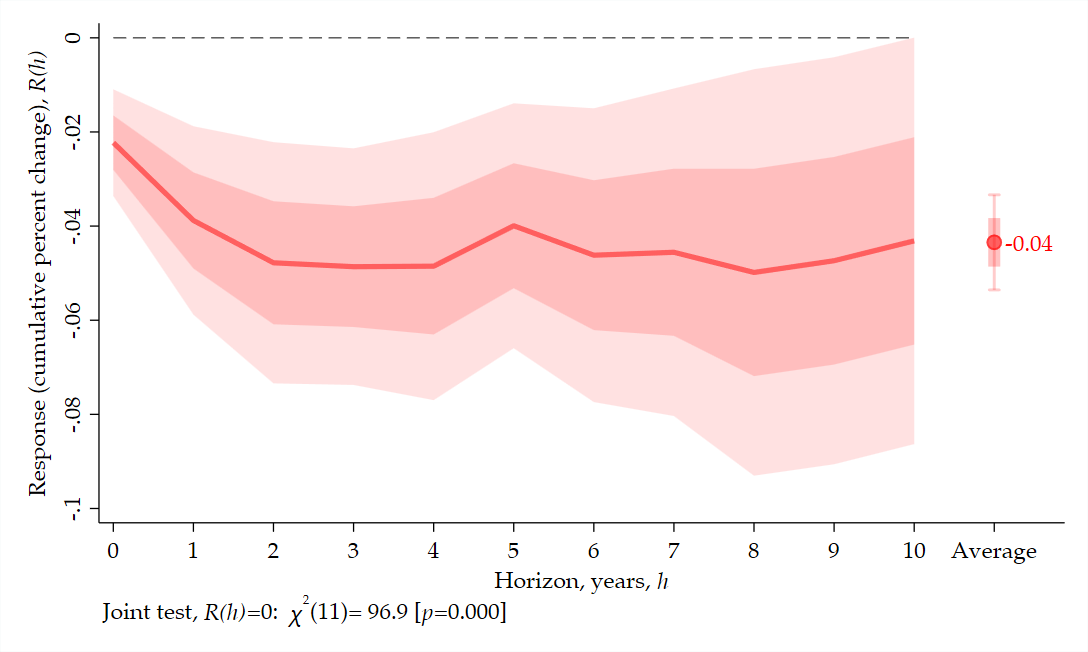
Notes: The dependent variable is the cumulative change in GDP and productive capacity—relative to t{-}1. Responses are normalized to a one-percentage-point increase in the contribution rate to private pension pillars. The specification includes one lag of the dependent variable, contemporaneous values, and three lags of the old-age dependency ratio, the unemployment rate, the age (first) factor, and a crisis dummy, along with horizon-specific country and year fixed effects. Inferences based on bootstrapped standard errors (1000 replications). Wald test statistics for joint significance and p-values are reported below each chart. Darker (lighter) shaded areas indicate 68% (95%) pointwise confidence intervals.
Labour market outcomes. As shown in Figure 12, the labour-market effects of the Capitalisation factor differ markedly from those associated with retirement-age reforms. The LFPR of older workers shows no significant response (panel a), consistent with Testable Implication 2, which anticipated a weak and ambiguous effect of financing-structure reforms on retirement timing. Similarly, the aggregate participation rate is essentially unaffected (panel b). The unemployment rate, however, rises in a non-negligible manner in the short run (panel c). The response averages +0.37 pp over the estimation window, reaches a peak of +0.80 pp at horizon 3, and then gradually fades. This increase was not explicitly predicted for the Capitalisation reform, which was expected to have limited direct labour-market effects. A plausible interpretation is that the transition toward funded private accounts generates uncertainty and short-run adjustment costs, while the associated demand contraction may temporarily weaken labour demand. This can raise unemployment even if the reform has no direct effect on statutory retirement incentives. This interpretation is consistent with the broader uncertainty channel emphasised by Bi & Zubairy (2023), although their mechanism was originally developed in the context of retirement-age reforms with long implementation lags. Overall, the labour-market results provide suggestive evidence that the Capitalisation factor has limited effects on participation, while potentially generating temporary unemployment through demand-compression and adjustment channels.
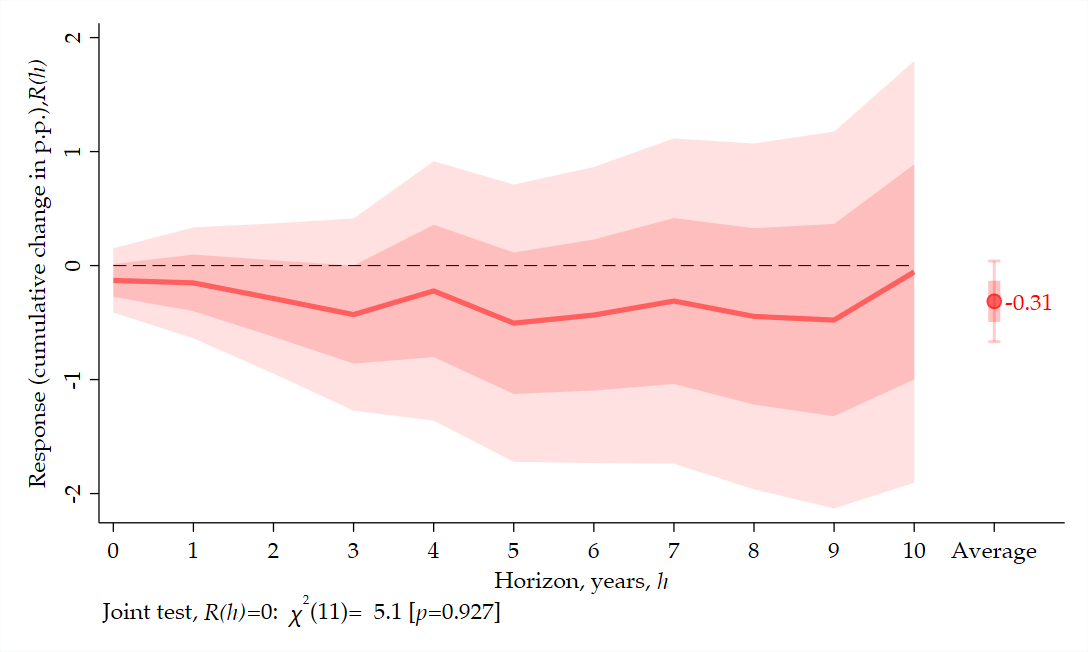
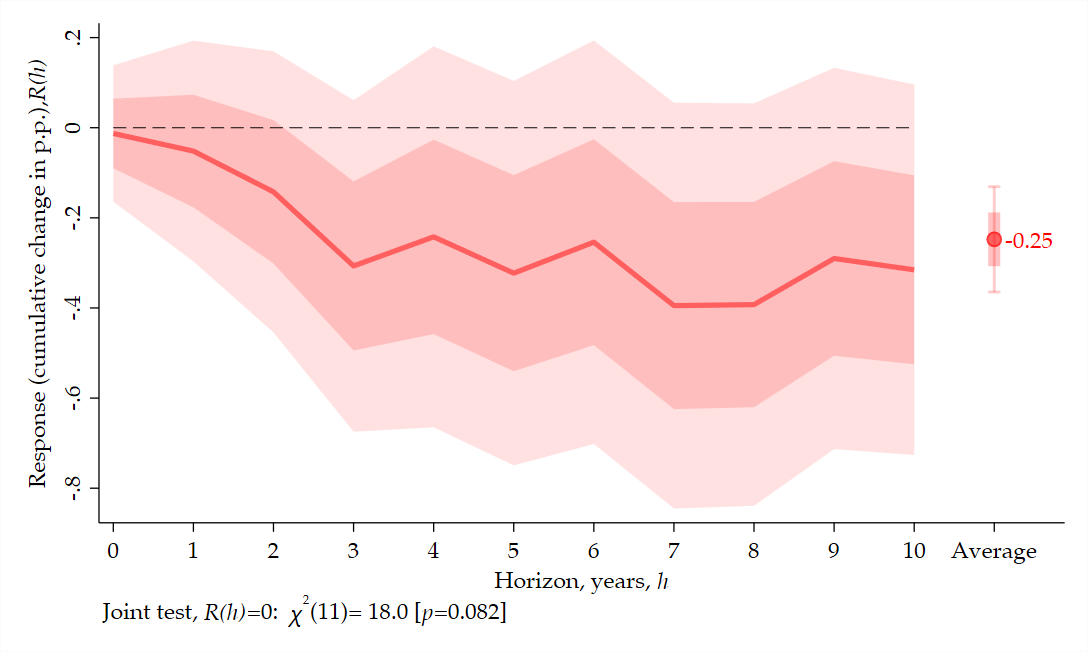
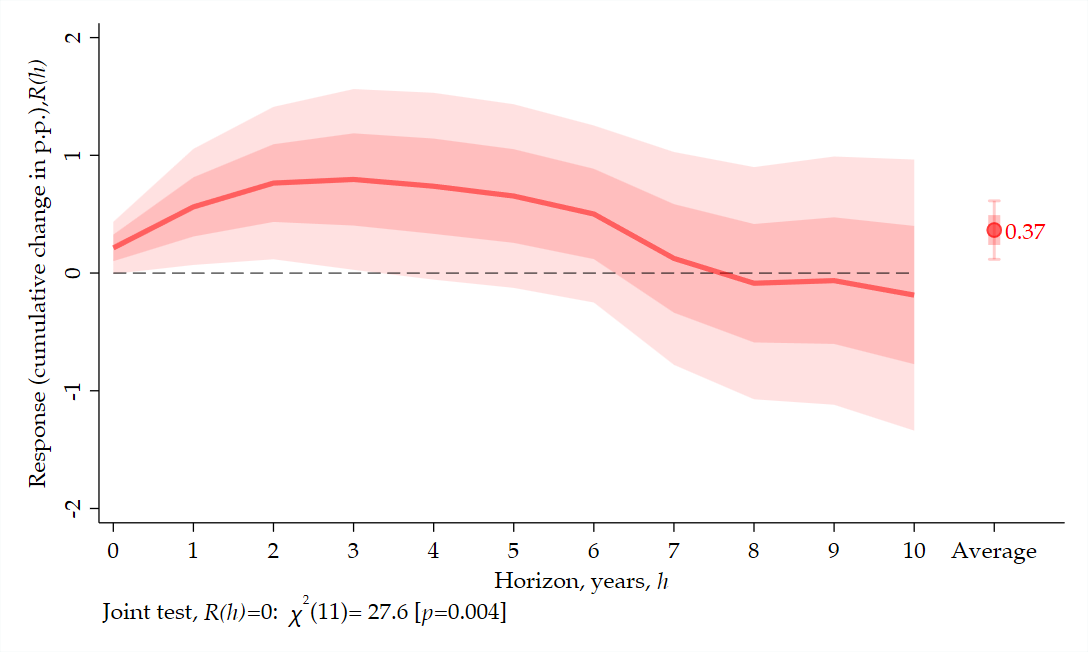
Notes: The dependent variable is the cumulative change in labour market outcomes—relative to t{-}1. Responses are normalized to a one-percentage-point increase in the contribution rate to private pension pillars. The specification includes one lag of the dependent variable, contemporaneous values, and three lags of the old-age dependency ratio, the unemployment rate, the age (first) factor, and a crisis dummy, along with horizon-specific country and year fixed effects. For the unemployment-rate regressions, the unemployment rate is excluded from the set of controls. Inferences based on bootstrapped standard errors (1000 replications). Wald test statistics for joint significance and p-values are reported below each chart. Darker (lighter) shaded areas indicate 68% (95%) pointwise confidence intervals.
Consumption and savings. Figure 13 shows that the Capitalisation factor is associated with a markedly different consumption pattern from that observed for retirement-age reforms. Private consumption falls significantly in absolute terms across the entire ten-year window (panel a, average −0.05%, significant throughout), with no sign of recovery. As a share of GDP, however, consumption is positive up to horizon 3–4 before reverting toward zero (panel b, average +0.26 pp). This apparently paradoxical combination — consumption falling in levels but rising as a share of GDP — reflects the fact that the Capitalisation reform compresses GDP proportionally more than it compresses consumption (as documented previously in the paragraph “GDP and productive capacity”), raising the consumption share mechanically. This pattern is consistent with a current-demand compression channel: the redirection of contributions toward private funded accounts may reduce consumption in levels, while the associated GDP contraction mechanically raises the consumption-to-GDP ratio.
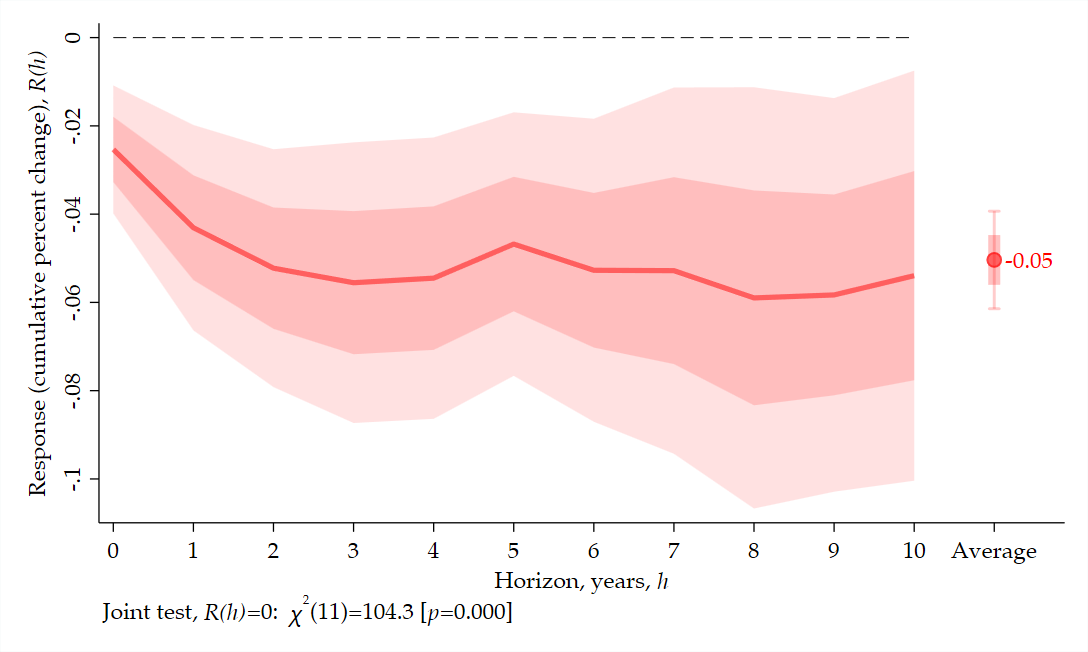
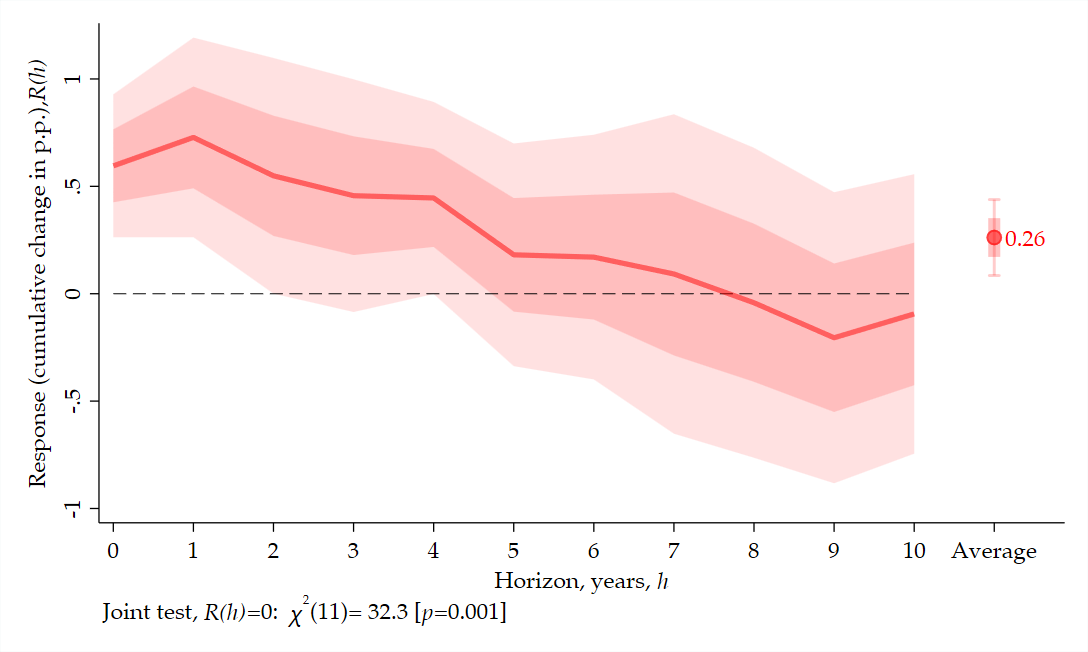
Notes: The dependent variable is the cumulative change in consumption—relative to t{-}1. Responses are normalized to a one-percentage-point increase in the contribution rate to private pension pillars. The specification includes one lag of the dependent variable, contemporaneous values, and three lags of the old-age dependency ratio, the unemployment rate, the age (first) factor, and a crisis dummy, along with horizon-specific country and year fixed effects. Inferences based on bootstrapped standard errors (1000 replications). Wald test statistics for joint significance and p-values are reported below each chart. Darker (lighter) shaded areas indicate 68% (95%) pointwise confidence intervals.
Figure 14 reports the corresponding savings responses. For the Capitalisation factor, the savings picture is contrasted. In levels, gross domestic savings fall significantly throughout the window (panel b, average −0.06%), mirroring the GDP contraction documented above in the paragraph on GDP and productive capacity: lower output mechanically reduces aggregate savings in levels. As a share of GDP, gross domestic savings also decline over horizons 0–4 before reverting toward zero (panel a, average −0.34 pp). Gross savings in levels display a similar pattern (panel d, average −0.06%), while gross savings as a share of GDP are not jointly significant (panel c). Taken together, these results suggest that the Capitalisation factor is not associated with an increase in aggregate saving rates. A standard argument in favour of funded pension schemes holds that mandatory private pension contributions should raise saving and, eventually, investment. Our results are instead consistent with a demand-compression mechanism: higher contributions may increase saving at the household level, but the associated contraction in aggregate demand and output may compress household incomes broadly, offsetting the saving gains of contributors and preventing any increase in aggregate saving at the macroeconomic level. This interpretation remains suggestive, however, since our aggregate saving measures do not separately identify mandatory private pension contributions from other forms of saving.
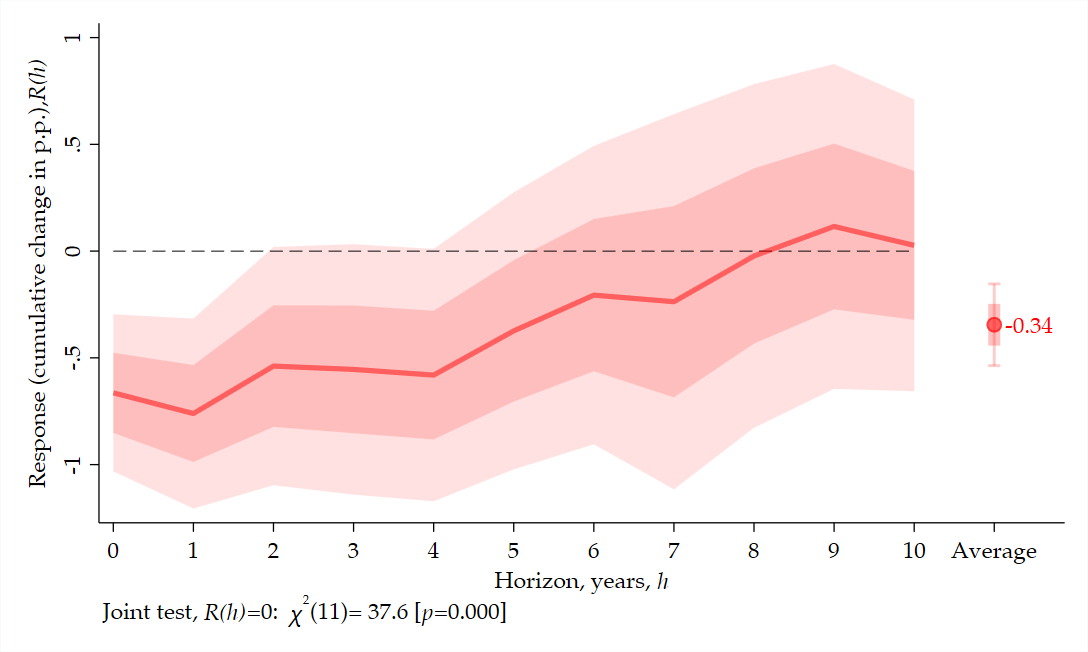
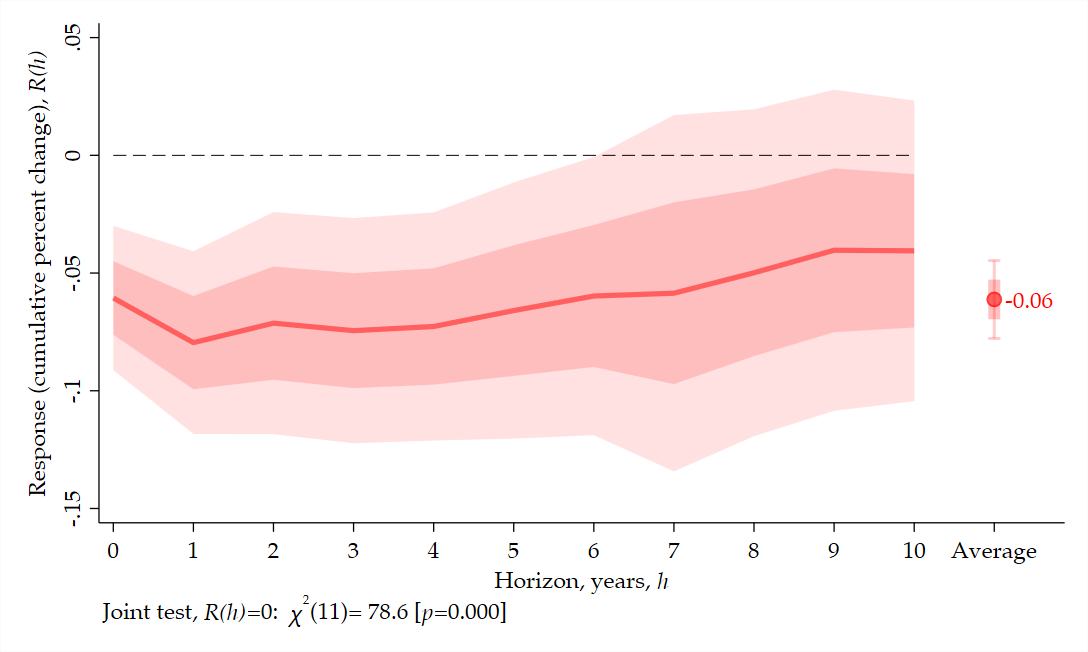
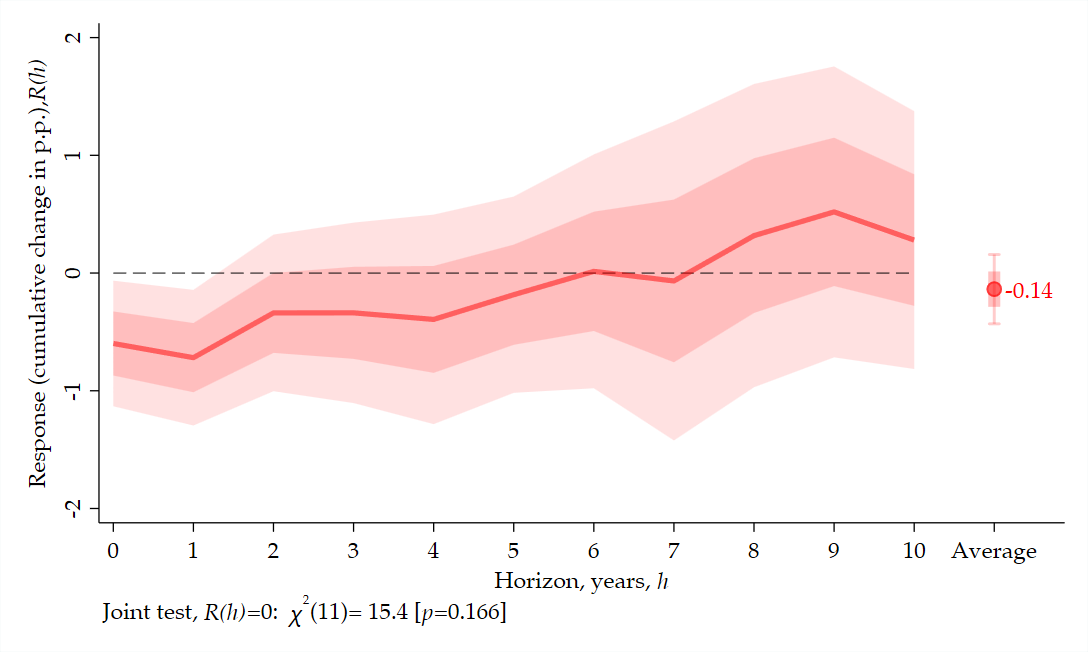
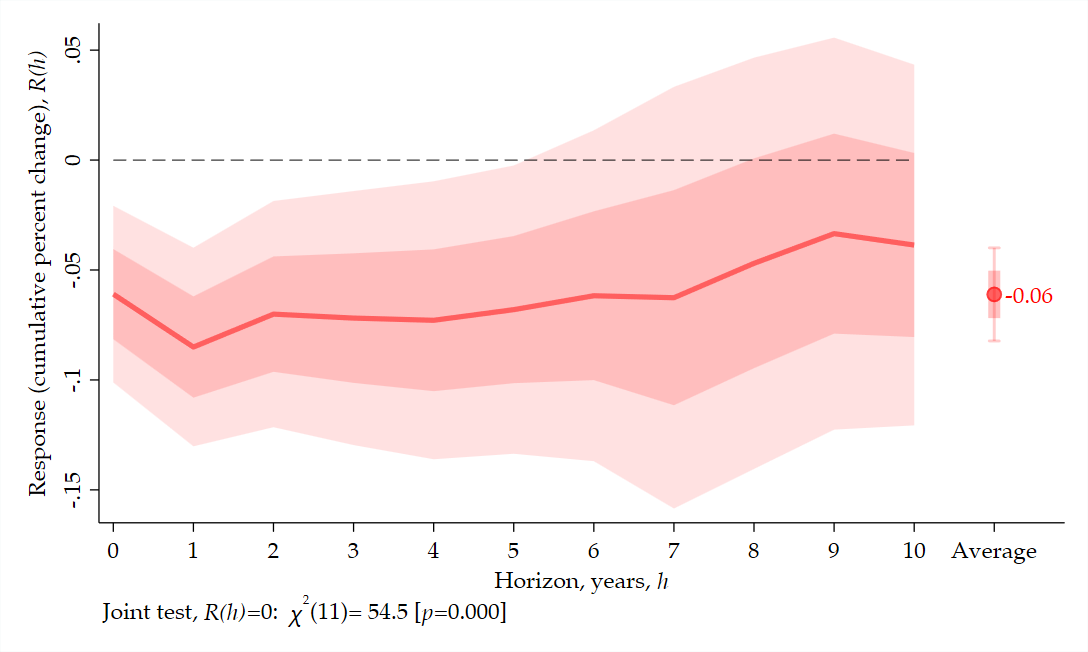
Notes: The dependent variable is the cumulative change in savings—relative to t{-}1. Responses are normalized to a one-percentage-point increase in the contribution rate to private pension pillars. The specification includes one lag of the dependent variable, contemporaneous values, and three lags of the old-age dependency ratio, the unemployment rate, the age (first) factor, and a crisis dummy, along with horizon-specific country and year fixed effects. Inferences based on bootstrapped standard errors (1000 replications). Wald test statistics for joint significance and p-values are reported below each chart. Darker (lighter) shaded areas indicate 68% (95%) pointwise confidence intervals.
Investment. The Capitalisation factor is associated with a long-lasting negative investment response (Figure 15) — a result that contrasts with the theoretical prediction of a positive capital market channel. In levels (panel a), investment falls throughout the window, with an average of −0.06%, significant on most horizons. As a share of GDP (panel b), the response is negative and significant over horizons 0–7, before reverting toward zero, with an average of −0.42 pp. Fixed investment mirrors this pattern (panels c–d): average −0.06% in levels and −0.23 pp as a share of GDP, with a trough around h=4–5 before partial recovery. Testable Implication 6 had left open the possibility of a neutral or negative short-run response if demand contracted before the fiscal consolidation channel took hold. However, the standard prediction — that private pension contributions flow into capital markets and stimulate investment over the medium-to-long run — does not materialise within our estimation window. Instead, the demand contraction associated with the Capitalisation factor appears to dominate, depressing investment through a standard accelerator mechanism. Whether the capital market channel eventually prevails beyond the ten-year horizon covered here remains an open question, but within this window the Capitalisation factor is associated with persistently negative investment responses.
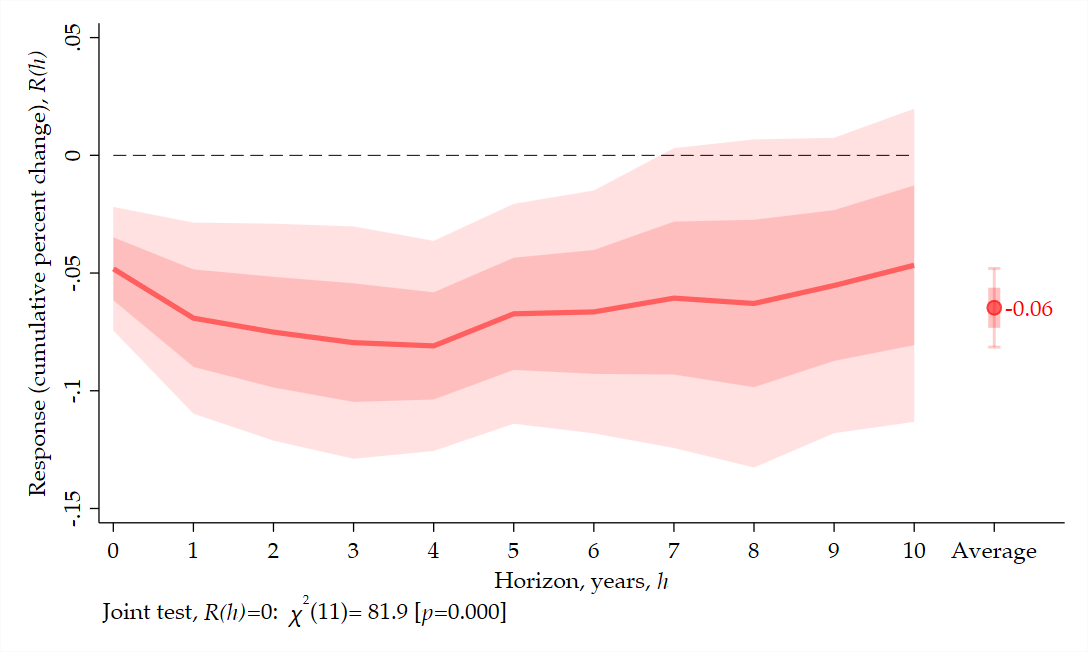
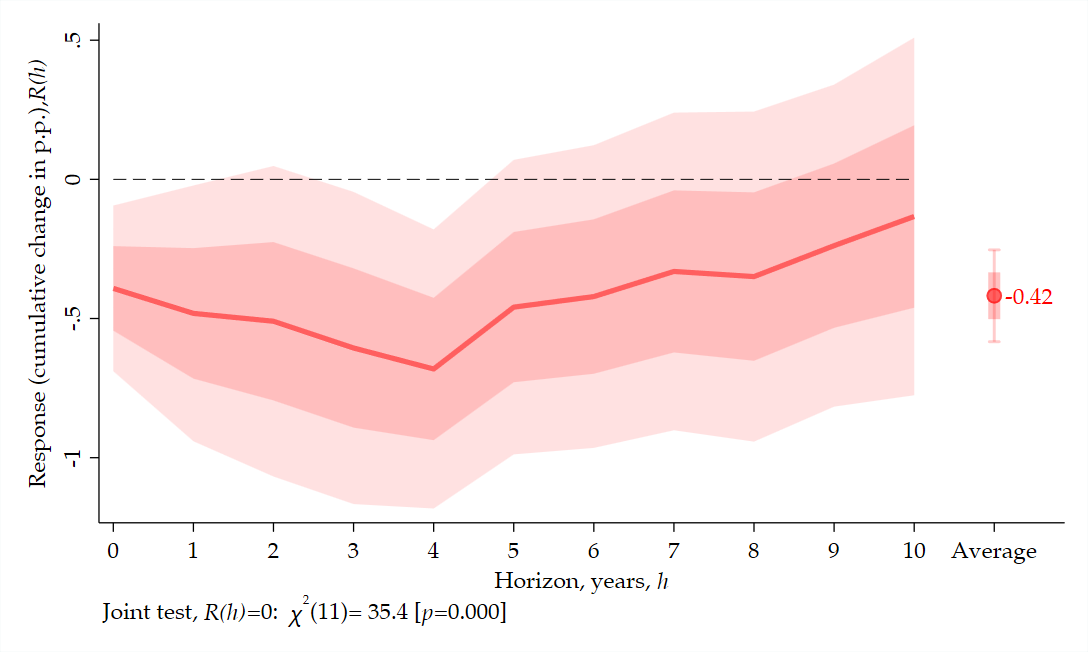
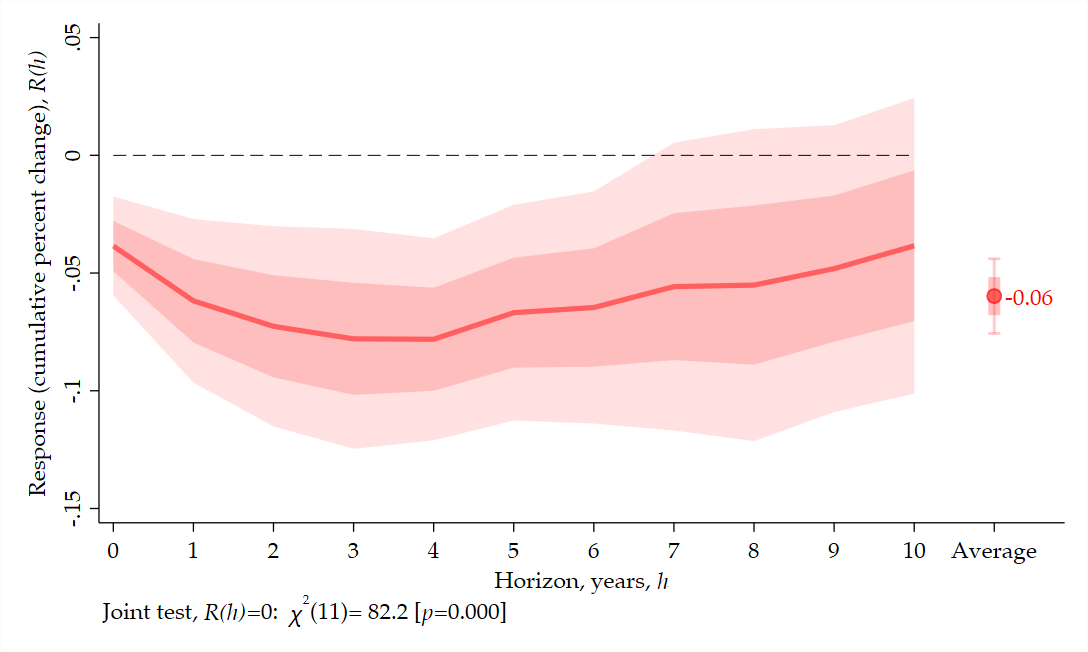
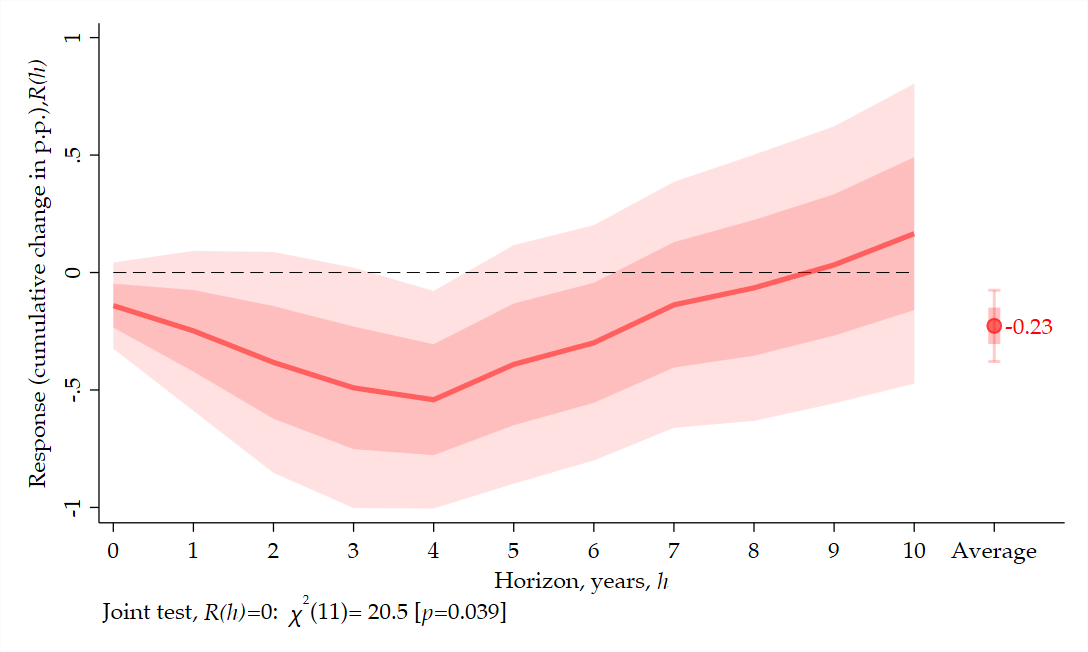
Notes: The dependent variable is the cumulative change in investment—relative to t{-}1. Responses are normalized to a one-percentage-point increase in the contribution rate to private pension pillars. The specification includes one lag of the dependent variable, contemporaneous values, and three lags of the old-age dependency ratio, the unemployment rate, the age (first) factor, and a crisis dummy, along with horizon-specific country and year fixed effects. Inferences based on bootstrapped standard errors (1000 replications). Wald test statistics for joint significance and p-values are reported below each chart. Darker (lighter) shaded areas indicate 68% (95%) pointwise confidence intervals.
Government debt and fiscal space. Figure 16 reveals a consistent pattern for the Capitalisation reform: expenditure falls in levels but expenditure ratios do not. In constant USD, public pension expenditure declines significantly throughout the window (panel b, average −0.04%), and central and general government expenditure follow the same pattern (panels d and f, average −0.03%). As shares of GDP, however, none of these series decline: the pension-to-GDP ratio is essentially unchanged (panel a, not jointly significant), while central and general government expenditure ratios actually rise (panels c and e, average +0.54 pp and +0.71 pp). This apparent paradox reflects the sharp GDP contraction documented above: as the denominator shrinks, expenditure ratios rise mechanically even as spending falls in levels.
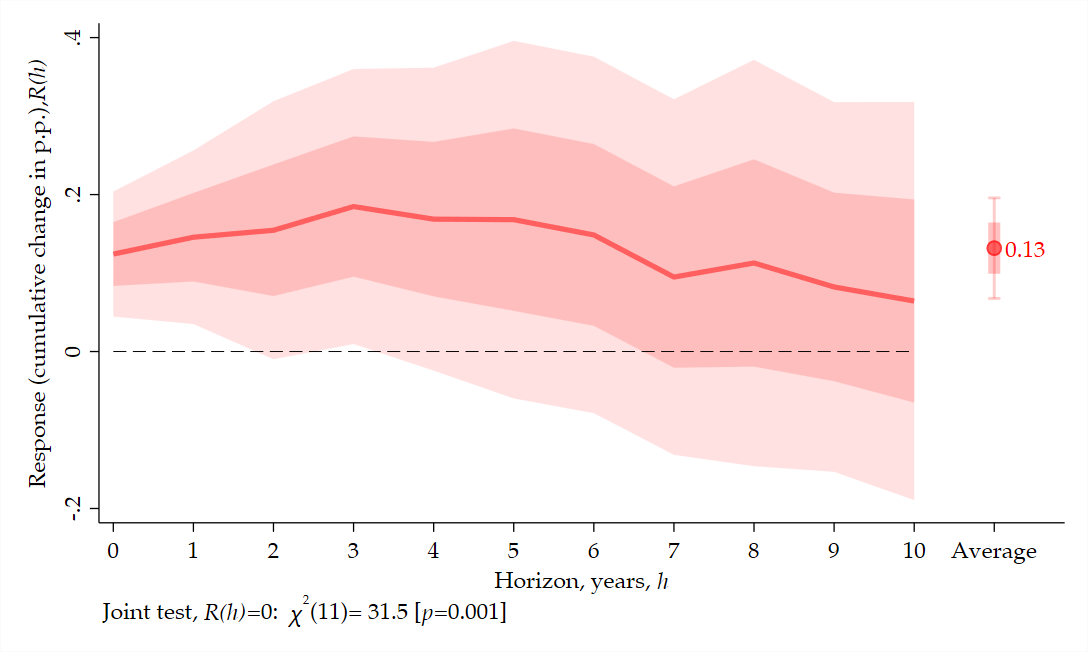
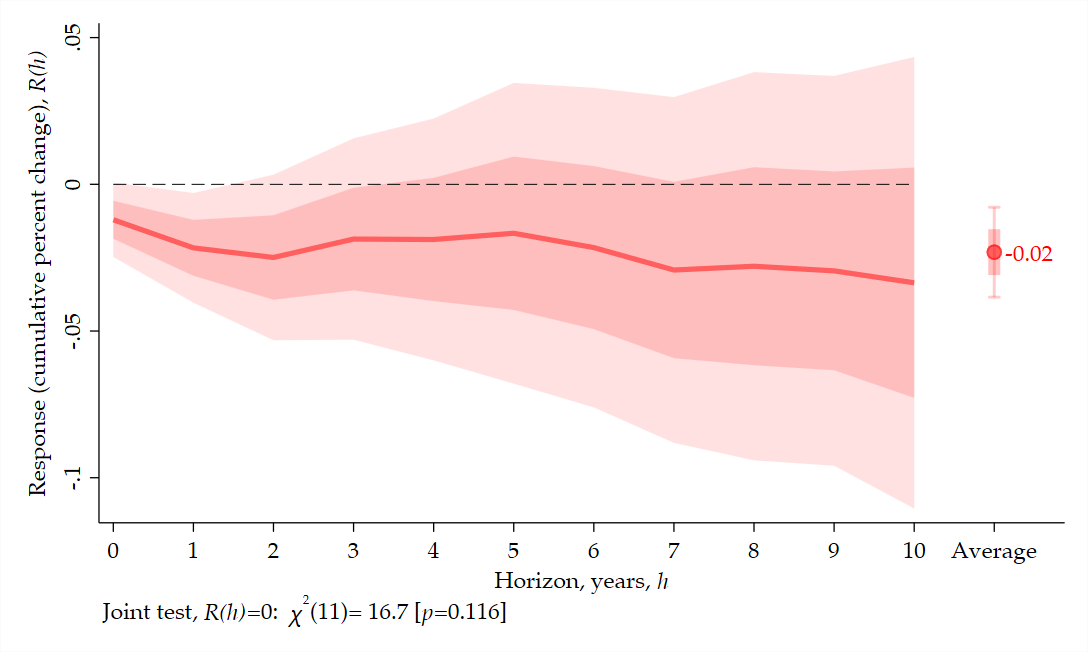
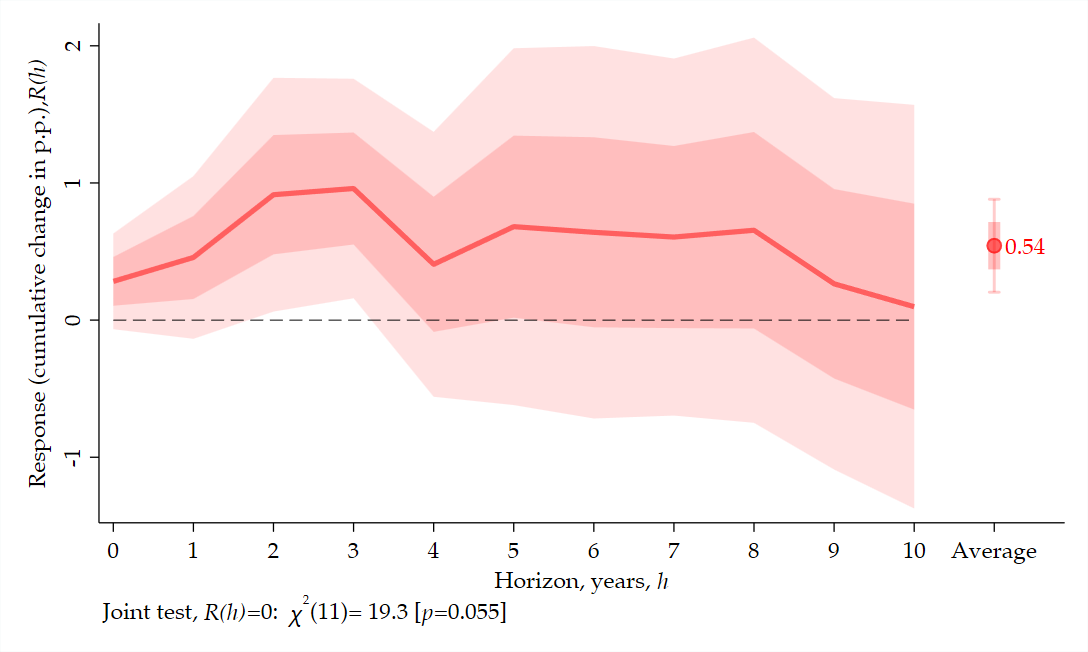
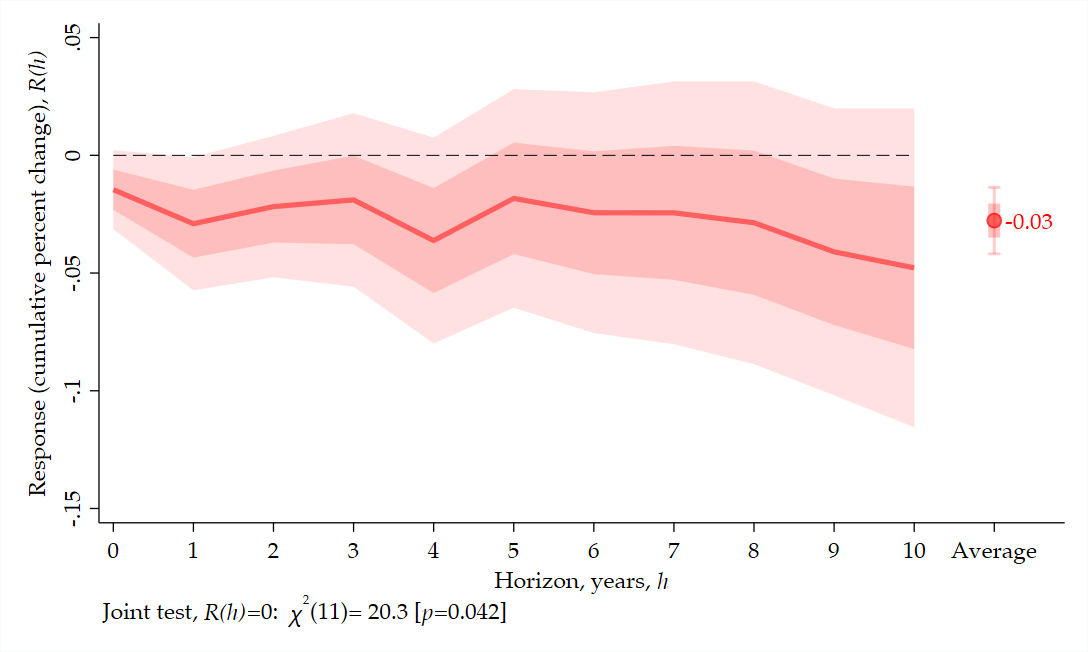
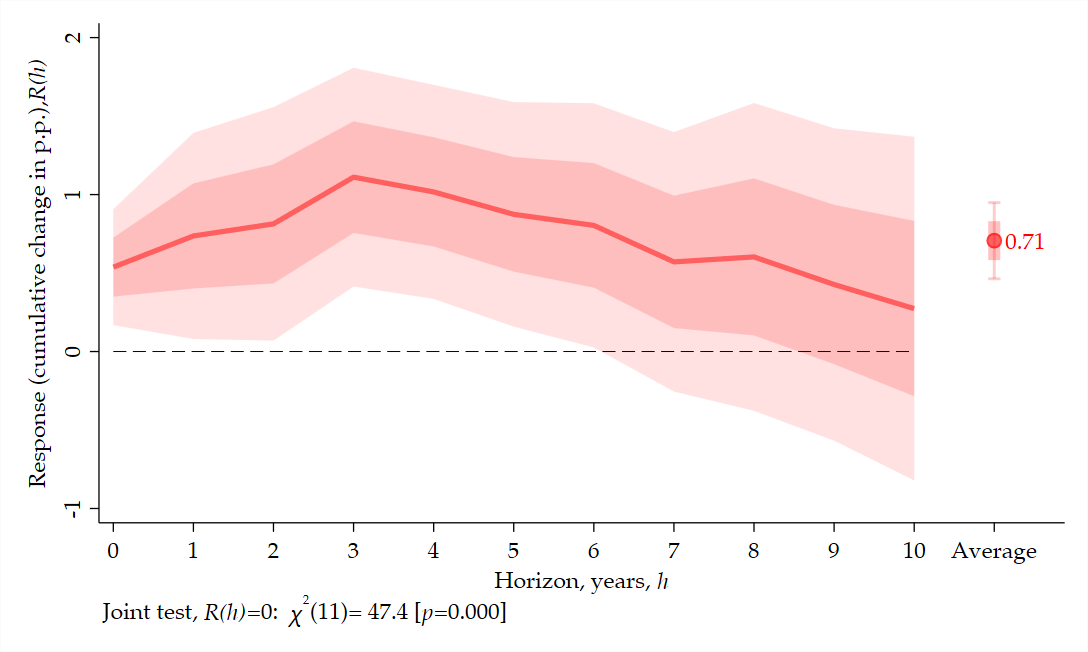
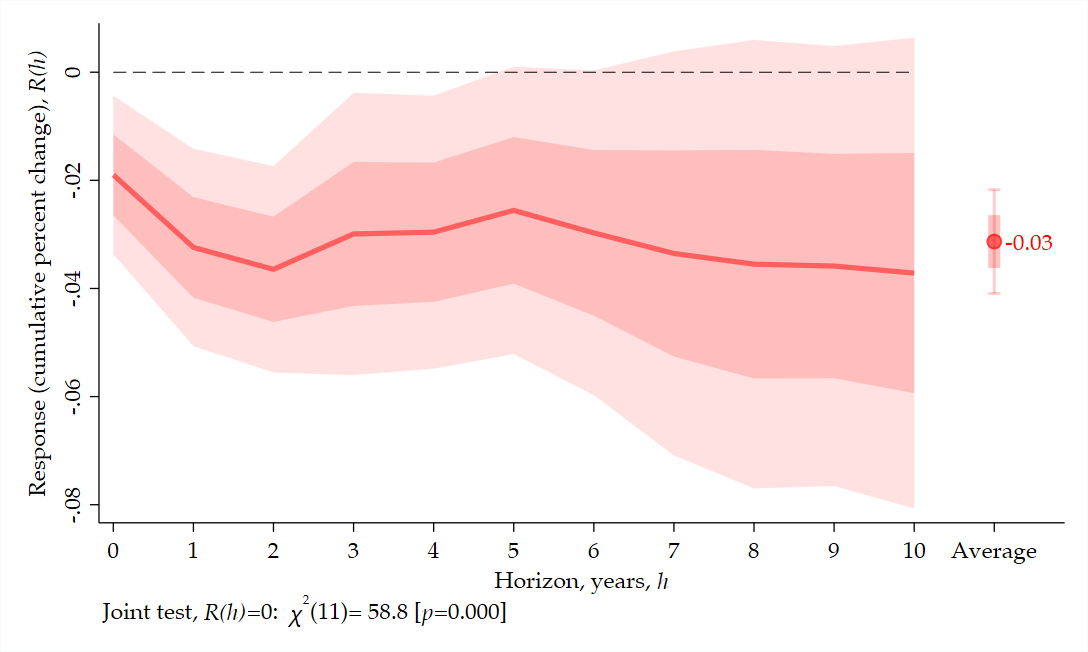
Notes: The dependent variable is the cumulative change in pension and government expenditure—relative to t{-}1. Responses are normalized to a one-percentage-point increase in the contribution rate to private pension pillars. The specification includes one lag of the dependent variable, contemporaneous values, and three lags of the old-age dependency ratio, the unemployment rate, the age (first) factor, and a crisis dummy, along with horizon-specific country and year fixed effects. Inferences based on bootstrapped standard errors (1000 replications). Wald test statistics for joint significance and p-values are reported below each chart. Darker (lighter) shaded areas indicate 68% (95%) pointwise confidence intervals.
Government debt presents a contrasting picture (Figure 17): both central government debt (panel a, average +2.42 pp of GDP) and general government debt (panel b, average +3.72 pp of GDP) increase and are statistically different from zero at the 68% confidence level. This pattern is consistent with the transition-cost channel associated with pension privatization: as contributions are redirected toward private accounts, governments may need to continue financing existing pay-as-you-go obligations while part of the contribution base is shifted away from the public system, generating additional borrowing needs in the short to medium run. In constant USD, general and central government debts are not statistically significant (panels c–d), suggesting that the increase in debt ratios partly reflects the adverse denominator effect of the GDP contraction previously documented.
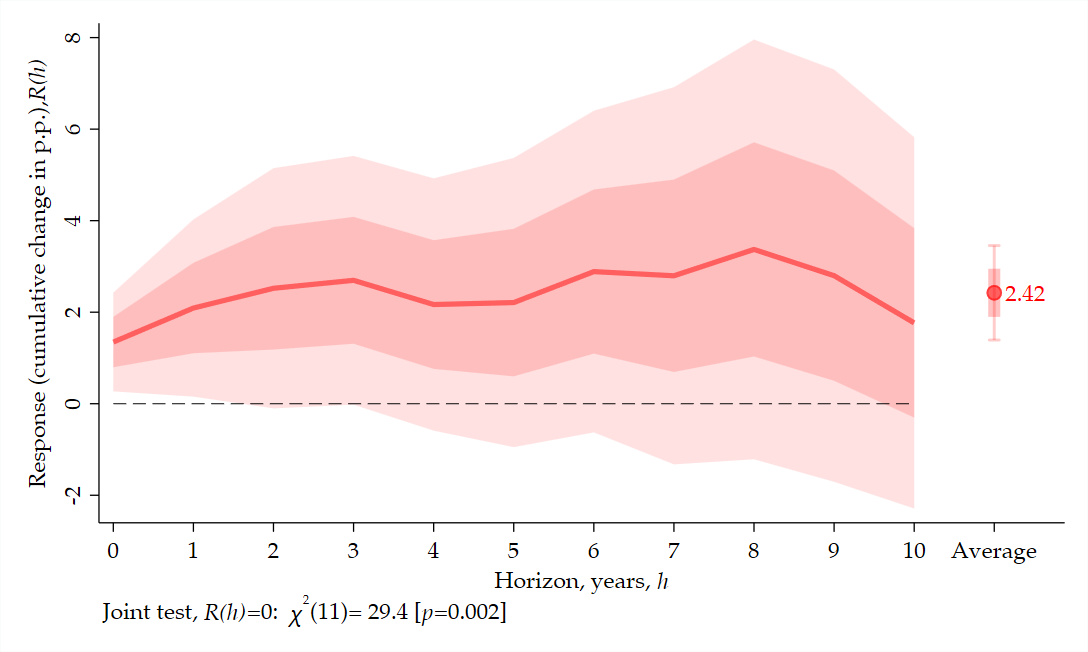
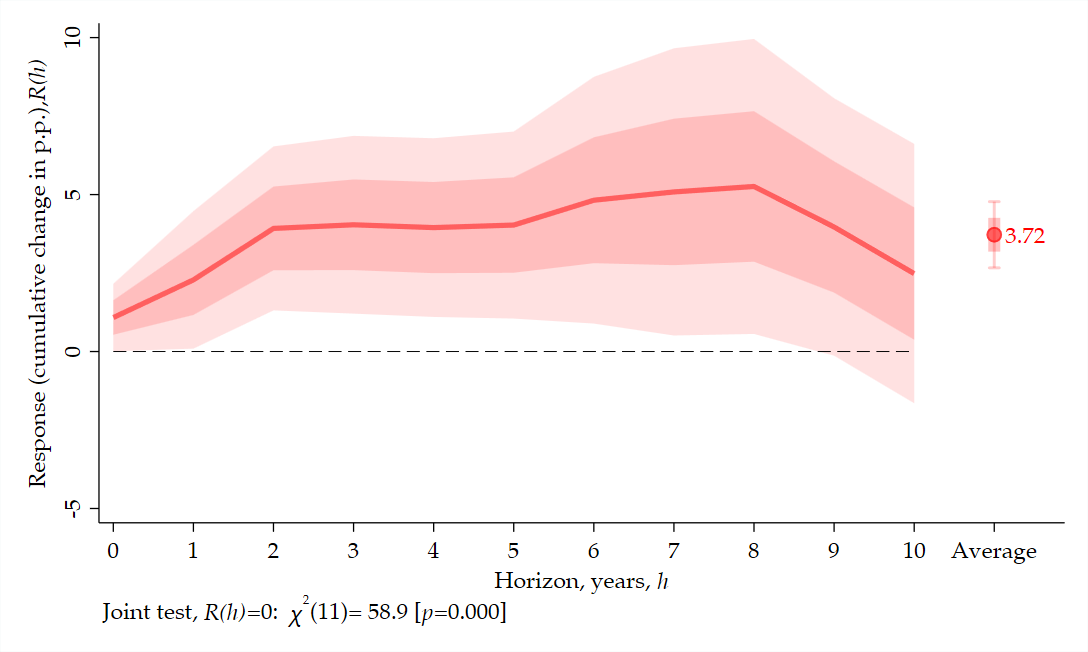
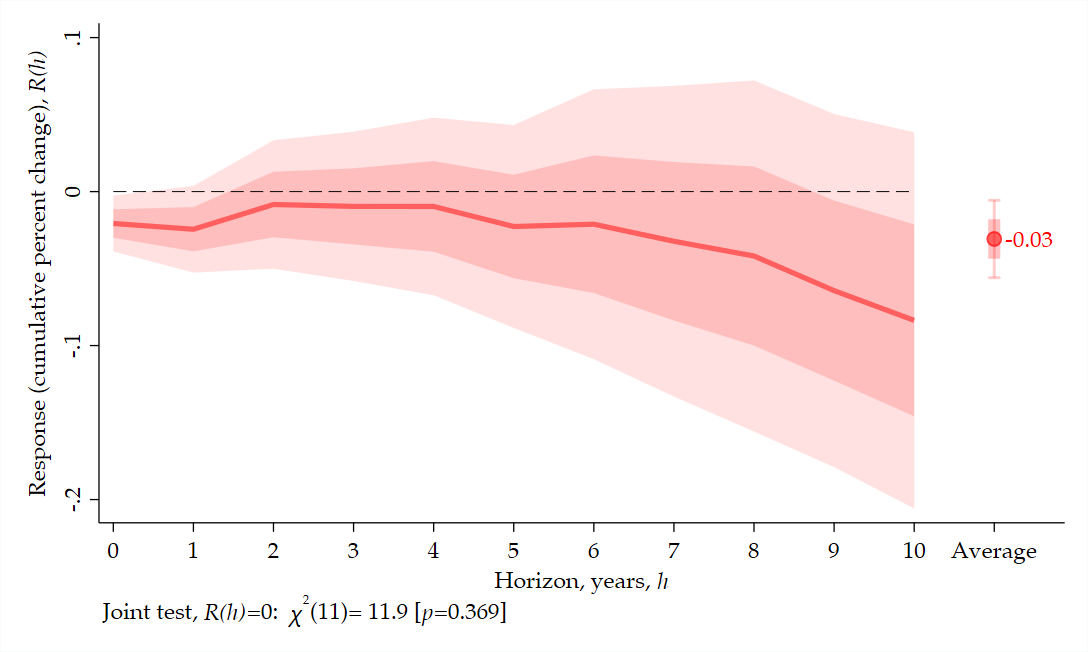
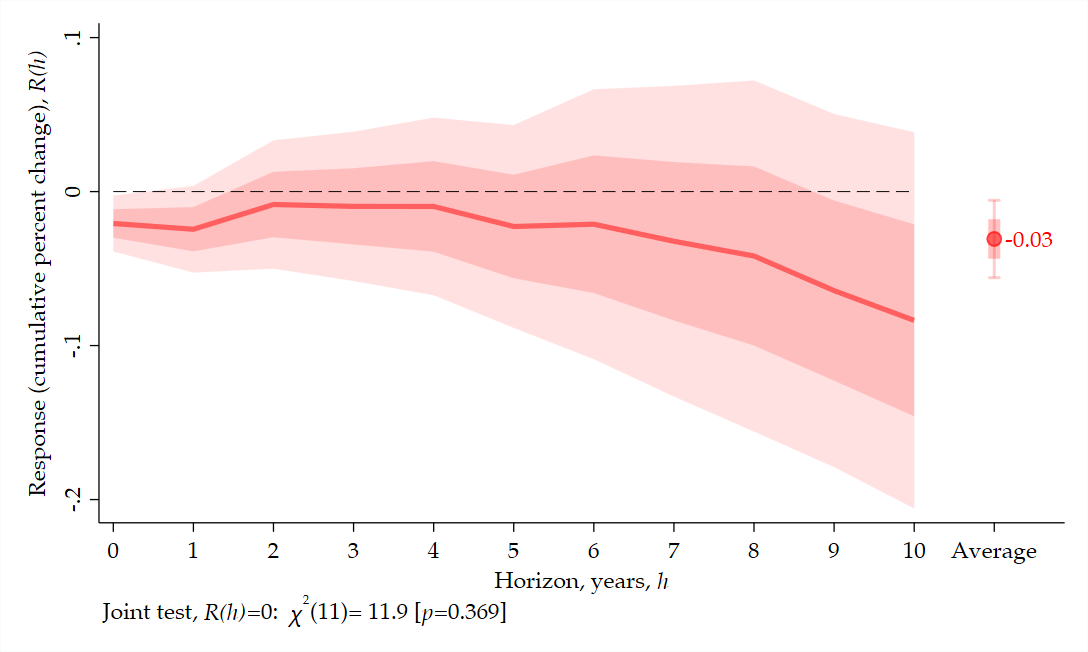
Notes: The dependent variable is the cumulative change in government debt—relative to t{-}1. Responses are normalized to a one-percentage-point increase in the contribution rate to private pension pillars. The specification includes one lag of the dependent variable, contemporaneous values, and three lags of the old-age dependency ratio, the unemployment rate, the age (first) factor, and a crisis dummy, along with horizon-specific country and year fixed effects. Inferences based on bootstrapped standard errors (1000 replications). Wald test statistics for joint significance and p-values are reported below each chart. Darker (lighter) shaded areas indicate 68% (95%) pointwise confidence intervals.
External sector. As shown in Figure 18 and Figure 19, the Capitalisation factor is associated with a different external-sector profile. Export and import volumes decline over the estimation window (Figure 18, panels a and c, average -0.03% and -0.04%, respectively), mirroring the GDP contraction previously documented. As aggregate activity contracts, both export supply and import demand fall in level terms, while their shares of GDP remain broadly stable (panels b and d). Importantly, neither the trade balance nor the current account balance improves significantly (Figure 19, panels a–b). This contrasts with the theoretical possibility described in Testable Implication 8: funded pension reforms could improve the current account if they raised national saving relative to investment. The results suggest that this saving-investment channel does not materialise within the ten-year horizon. A plausible explanation is that the saving rate does not rise, as previously documented, so the mechanism through which the current account could improve is absent.
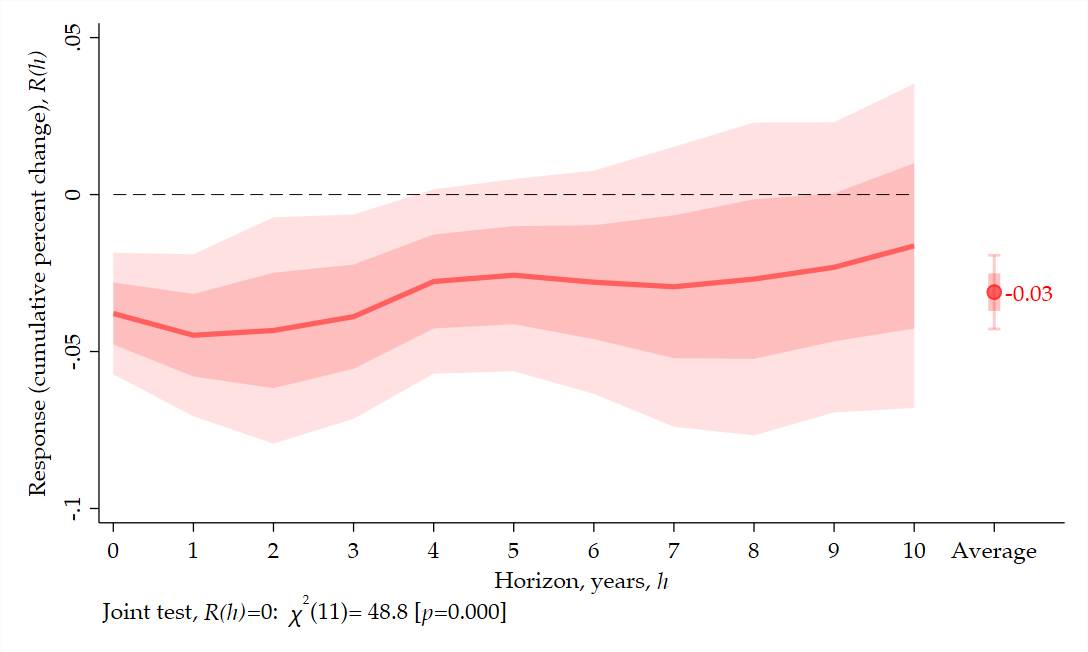
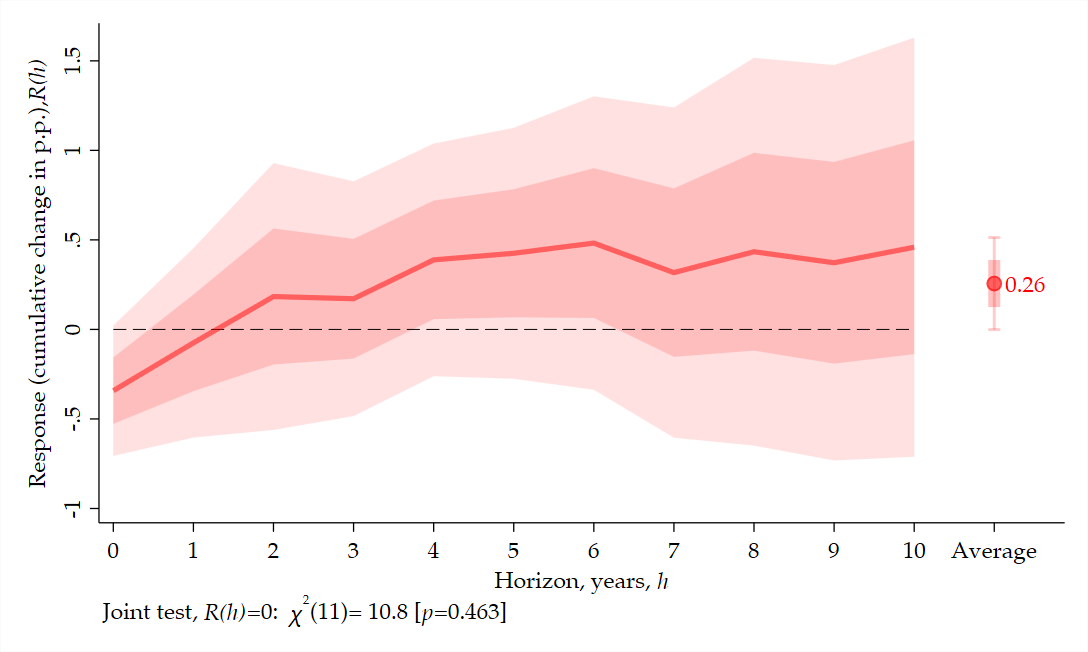
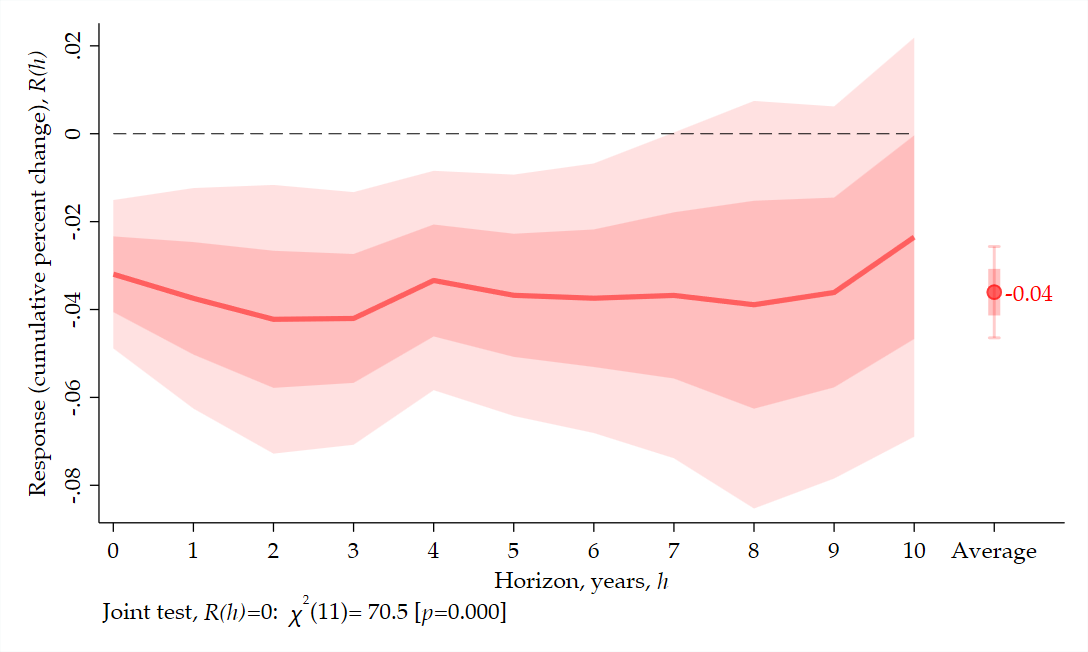
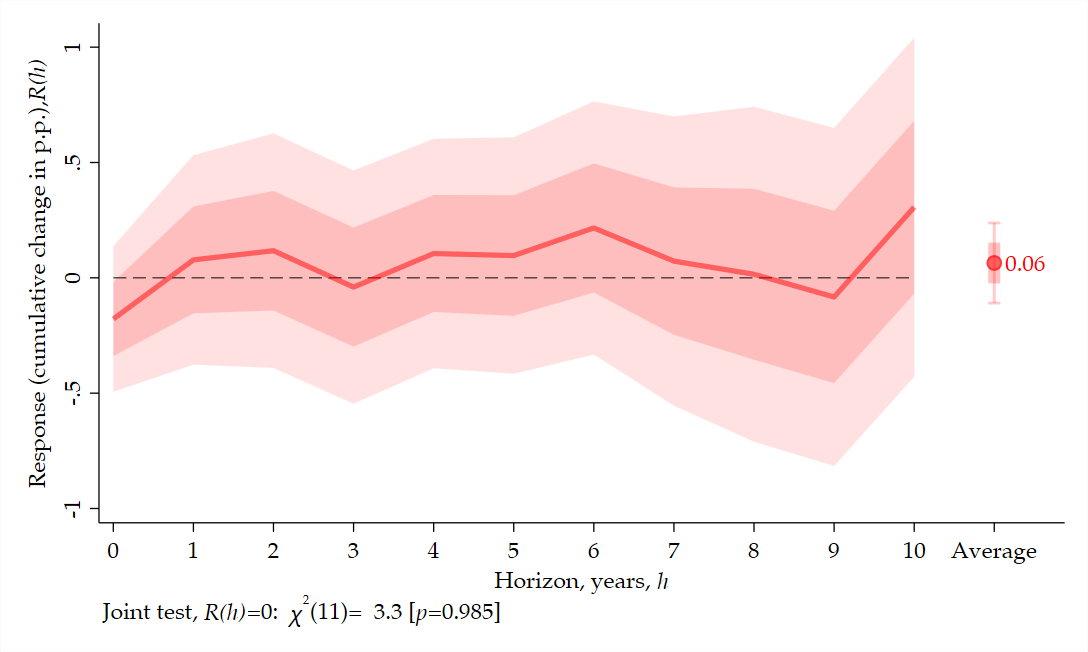
Notes: The dependent variable is the cumulative change in trade flows—relative to t{-}1. Responses are normalized to a one-percentage-point increase in the contribution rate to private pension pillars. The specification includes one lag of the dependent variable, contemporaneous values, and three lags of the old-age dependency ratio, the unemployment rate, the age (first) factor, and a crisis dummy, along with horizon-specific country and year fixed effects. Inferences based on bootstrapped standard errors (1000 replications). Wald test statistics for joint significance and p-values are reported below each chart. Darker (lighter) shaded areas indicate 68% (95%) pointwise confidence intervals.
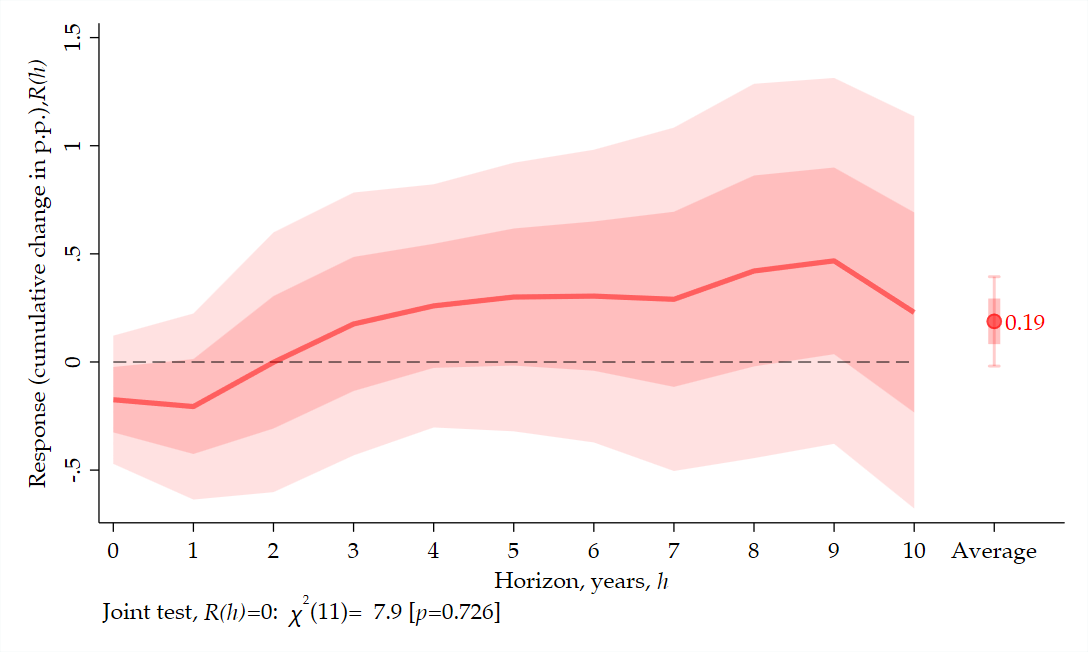
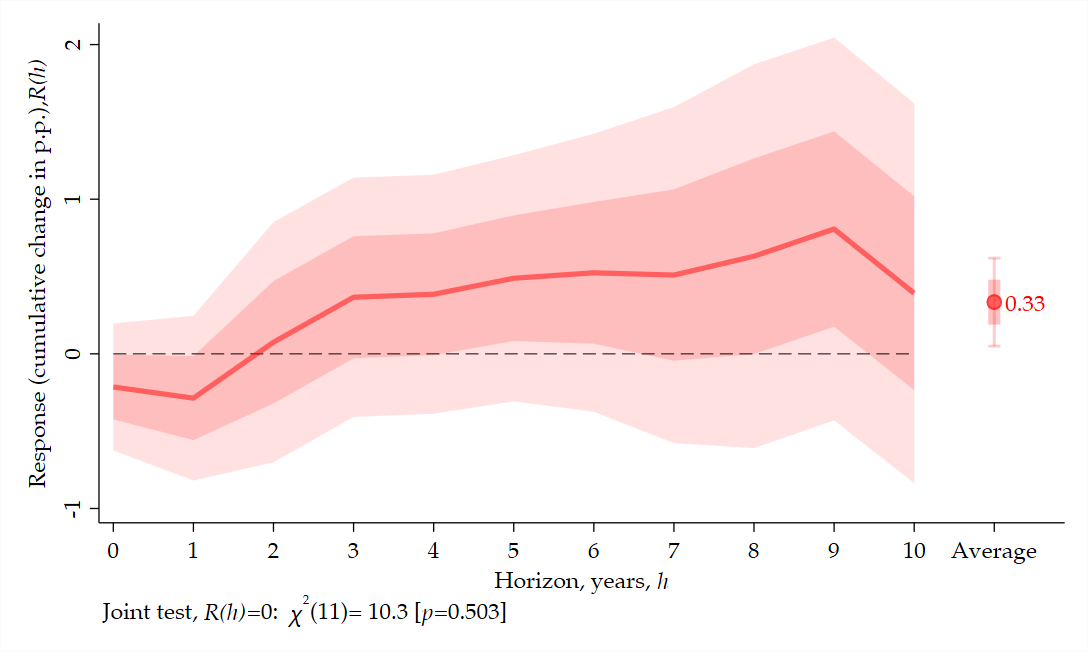
Notes: The dependent variable is the cumulative change in external balances—relative to t{-}1. Responses are normalized to a one-percentage-point increase in the contribution rate to private pension pillars. The specification includes one lag of the dependent variable, contemporaneous values, and three lags of the old-age dependency ratio, the unemployment rate, the age (first) factor, and a crisis dummy, along with horizon-specific country and year fixed effects. Inferences based on bootstrapped standard errors (1000 replications). Wald test statistics for joint significance and p-values are reported below each chart. Darker (lighter) shaded areas indicate 68% (95%) pointwise confidence intervals.
Productivity. The Capitalisation factor, by contrast, is associated with a negative response in both productivity indicators (Figure 20). TFP declines from impact, reaches a trough around horizons 1–3, and gradually reverts toward zero by horizons 4–5, leaving the average response close to zero over the full window (panel a). GDP per worker exhibits a more severe and persistent contraction, averaging −0.06% and remaining significantly below zero across most of the ten-year window (panel b). These results partly diverge from Testable Implication 9, which allowed for a negative short-run effect and a positive longer-run effect if funded pension savings translated into capital deepening. A plausible interpretation is that the demand contraction associated with the Capitalisation factor depresses output and investment while labour input adjusts only gradually. This mechanically lowers GDP per worker and may also weigh on measured TFP through lower capacity utilization or weaker investment in productivity-enhancing capital. The persistence of the negative GDP-per-worker response suggests that the capital-accumulation channel does not materialise within the ten-year horizon of our analysis.
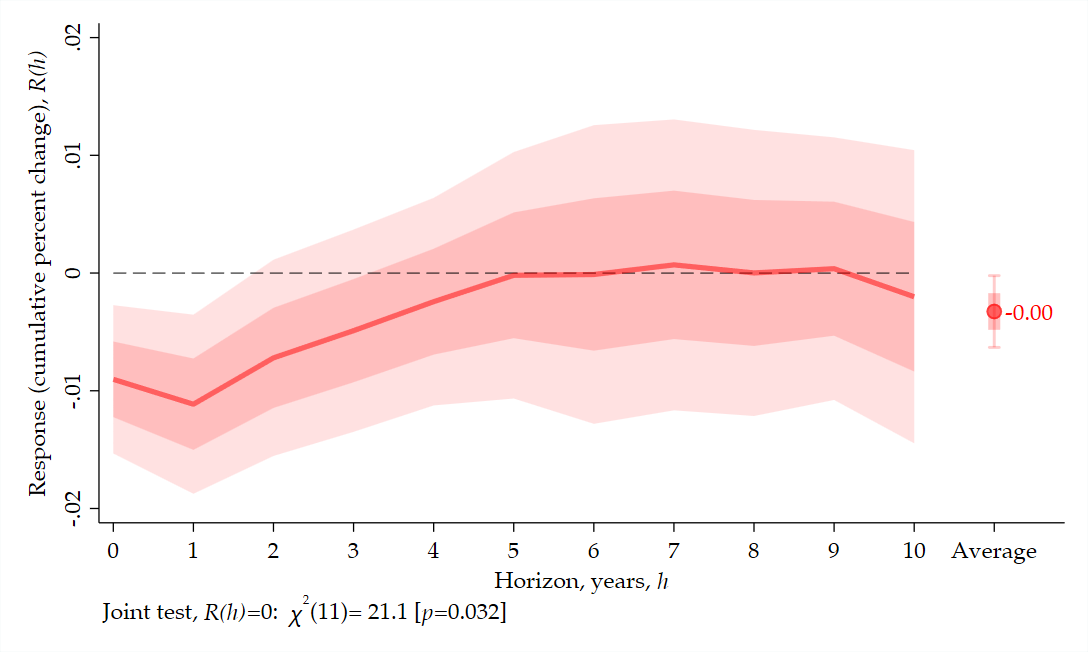
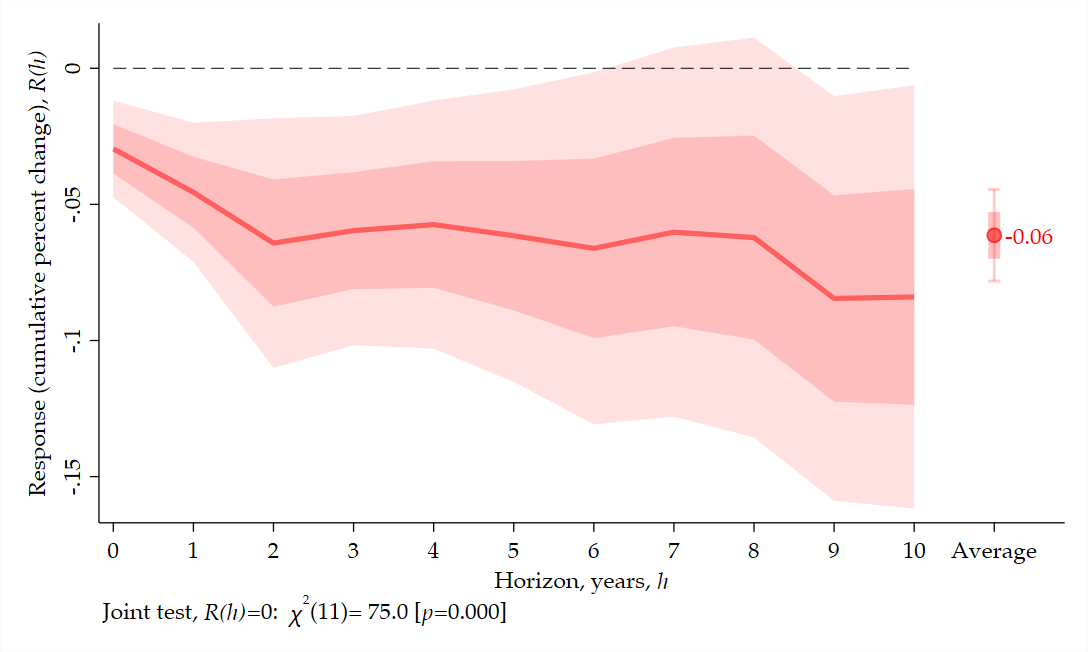
Notes: The dependent variable is the cumulative change in total factor productivity (TFP) or GDP per worker —relative to t{-}1. Responses are normalized to a one-percentage-point increase in the contribution rate to private pension pillars. The specification includes one lag of the dependent variable, contemporaneous values, and three lags of the old-age dependency ratio, the unemployment rate, the age (first) factor, and a crisis dummy, along with horizon-specific country and year fixed effects. Inferences based on bootstrapped standard errors (1000 replications). Wald test statistics for joint significance and p-values are reported below each chart. Darker (lighter) shaded areas indicate 68% (95%) pointwise confidence intervals.
6.2 Saving outflows and capitalisation reforms
Results in Section 6.1 point to an overall contractionary pattern associated with the Capitalisation factor, operating through both supply and demand. We now provide suggestive evidence on a possible channel underlying these results. Figure 21 and Figure 22 report, respectively, the responses of GDP (real and potential) and investment (in real terms and as a share of GDP) for two subsamples split at the median of the ratio of foreign assets to gross domestic savings. Foreign assets are defined as the sum of the stocks of portfolio equity assets, portfolio debt assets, other investment assets, and FDI assets.7 This indicator provides a proxy for the extent to which domestic savings are invested abroad rather than in the domestic economy.
7 Data are from Lane & Milesi-Ferretti (2018).
The depressing effects are concentrated exclusively in observations above the median. Real GDP decreases significantly over the entire horizon, by 0.06% on average, and most of this contraction stems from potential GDP, which shrinks by 0.05% on average. This erosion of potential output is consistent with the negative response of investment, both in real terms (-0.08% on average) and as a share of GDP (-0.78 pp on average for total investment and -0.64 pp for fixed investment). Conversely, no significant effect emerges, for either GDP or investment, in observations below the median. Overall, these results show that the negative responses associated with the Capitalisation factor are concentrated in observations with higher foreign asset holdings relative to domestic savings. This pattern is consistent with the hypothesis that the domestic benefits of higher pension savings are weaker when a larger share of savings is invested abroad.
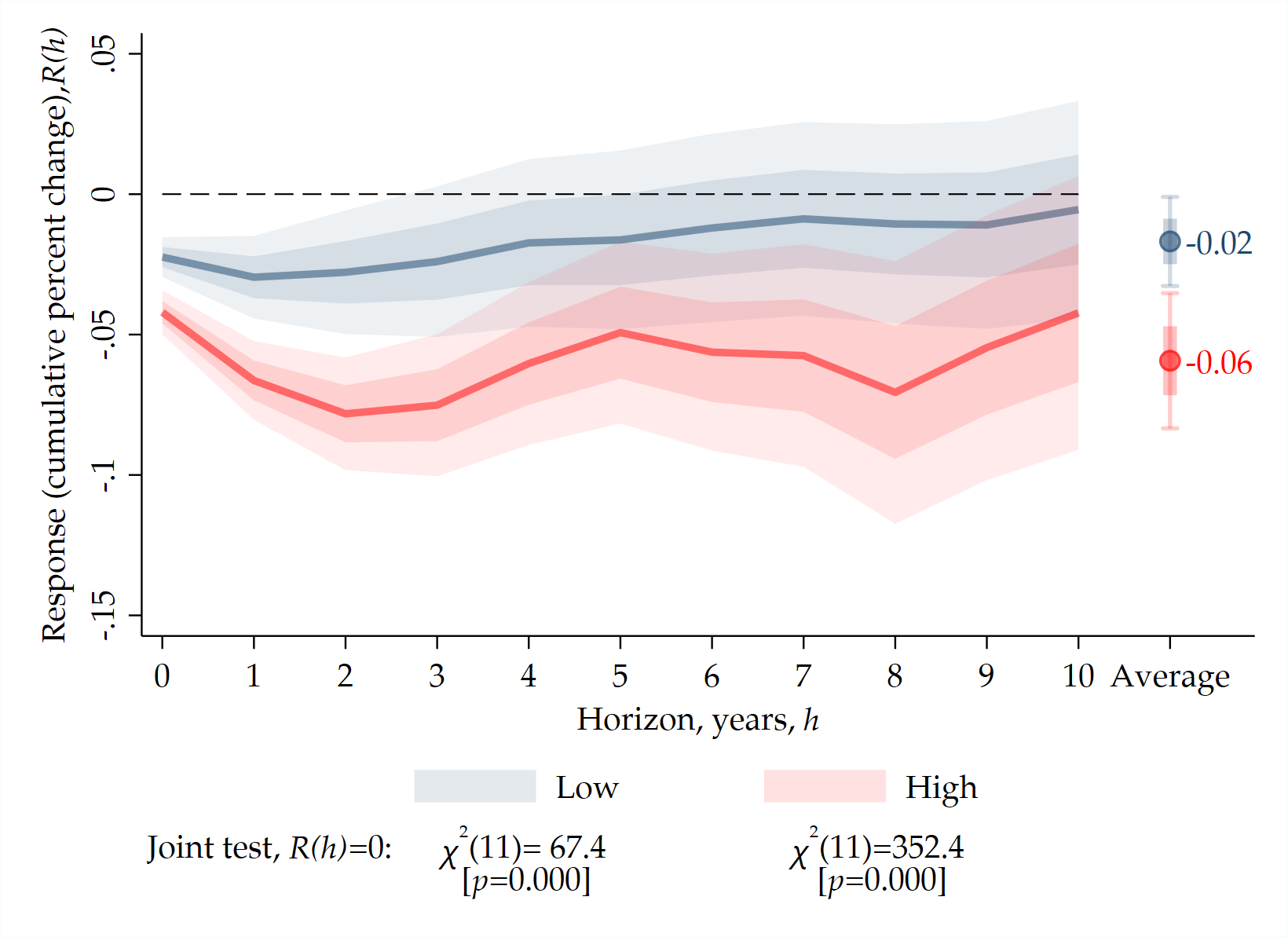
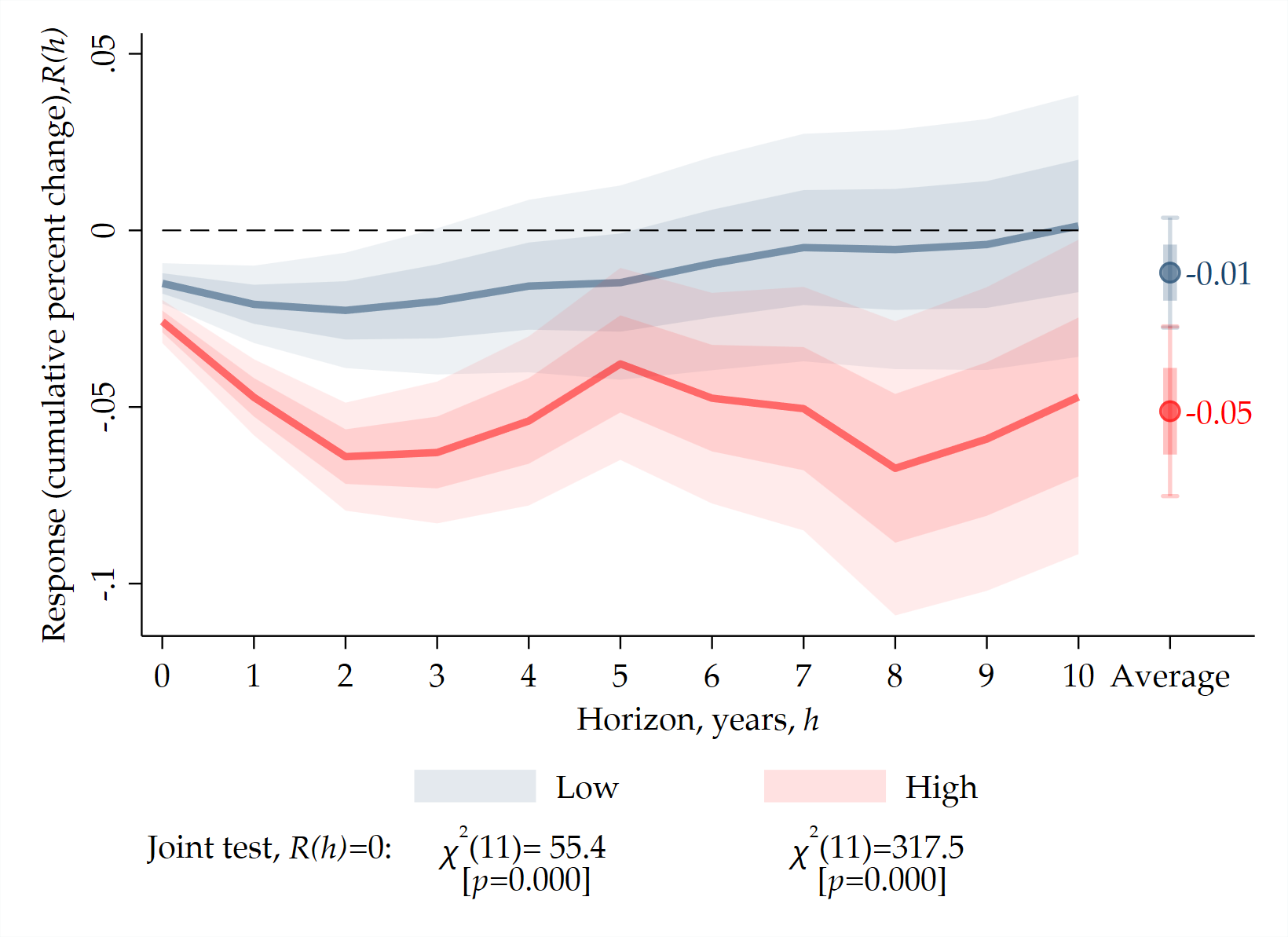
Notes: The dependent variable is the cumulative change in real GDP and potential GDP —relative to t-1. Responses are normalized to a one-percentage-point increase in the contribution rate to private pension pillars. The specification includes one lag of the dependent variable, contemporaneous values, and three lags of the old-age dependency ratio, the unemployment rate, the age (first) factor, and a crisis dummy, along with horizon-specific country and year fixed effects. Inferences based on bootstrapped standard errors (1000 replications). Wald test statistics for joint significance and p-values are reported below each chart. Darker (lighter) shaded areas indicate 68% (95%) pointwise confidence intervals.
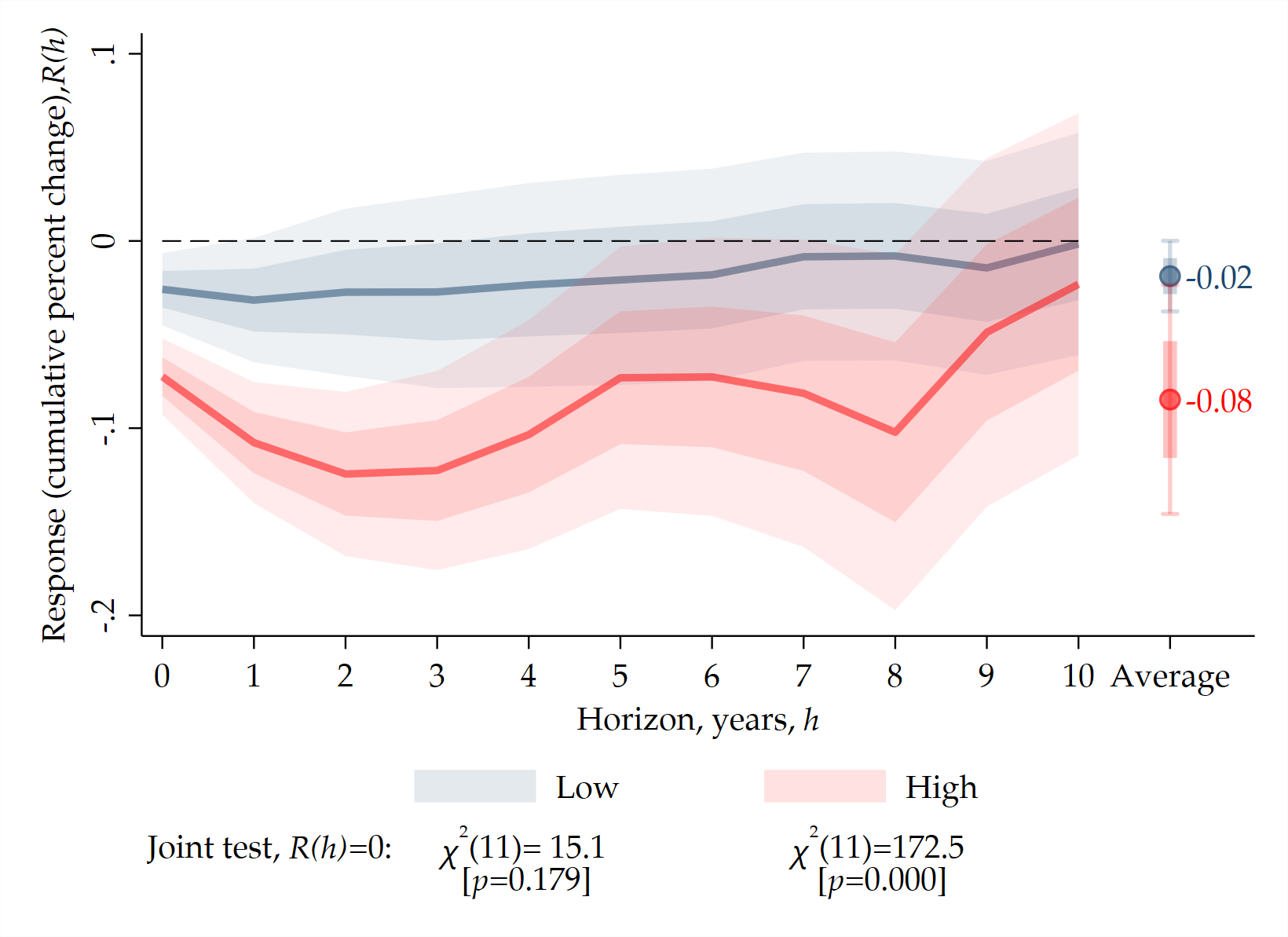
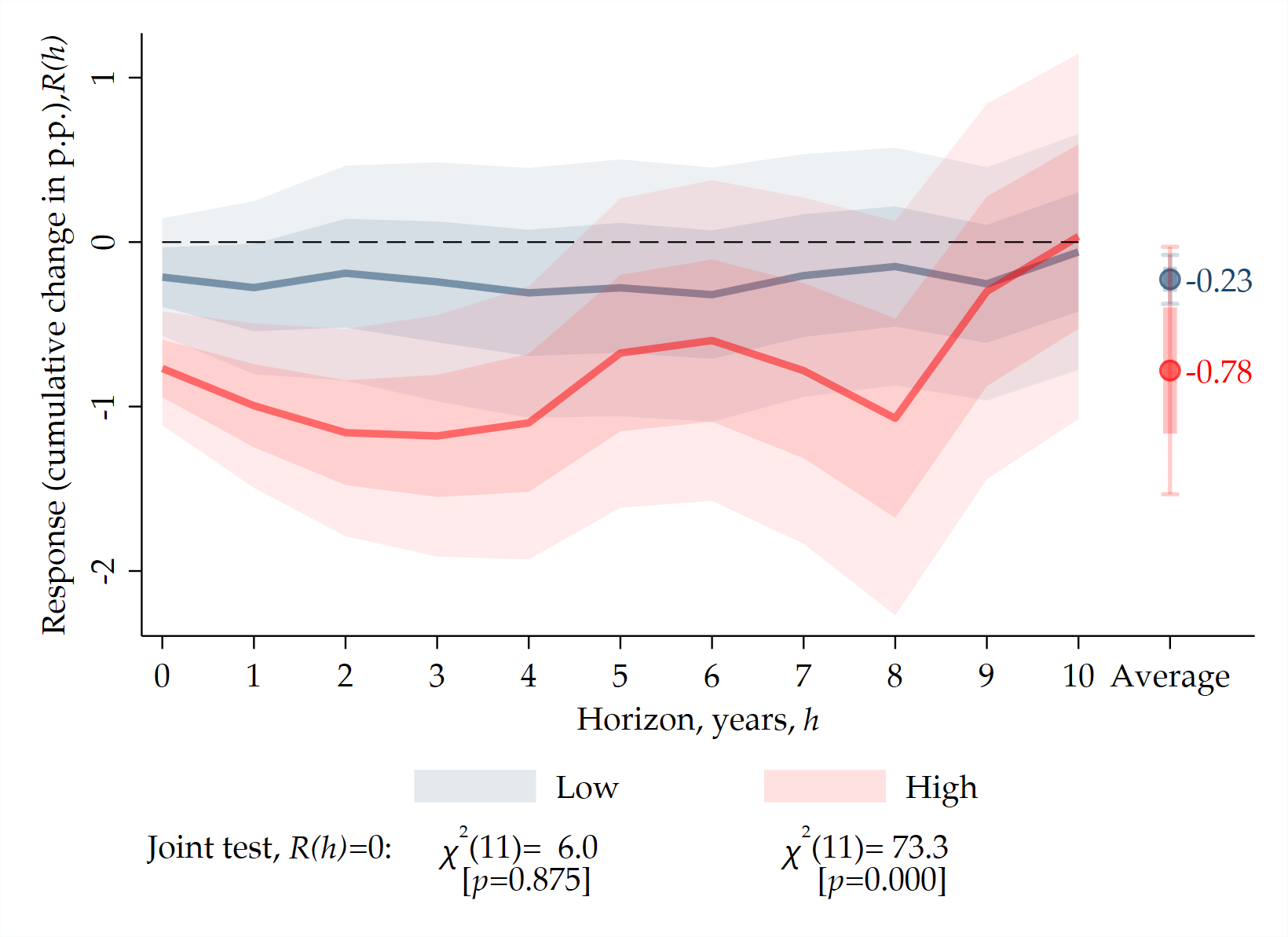
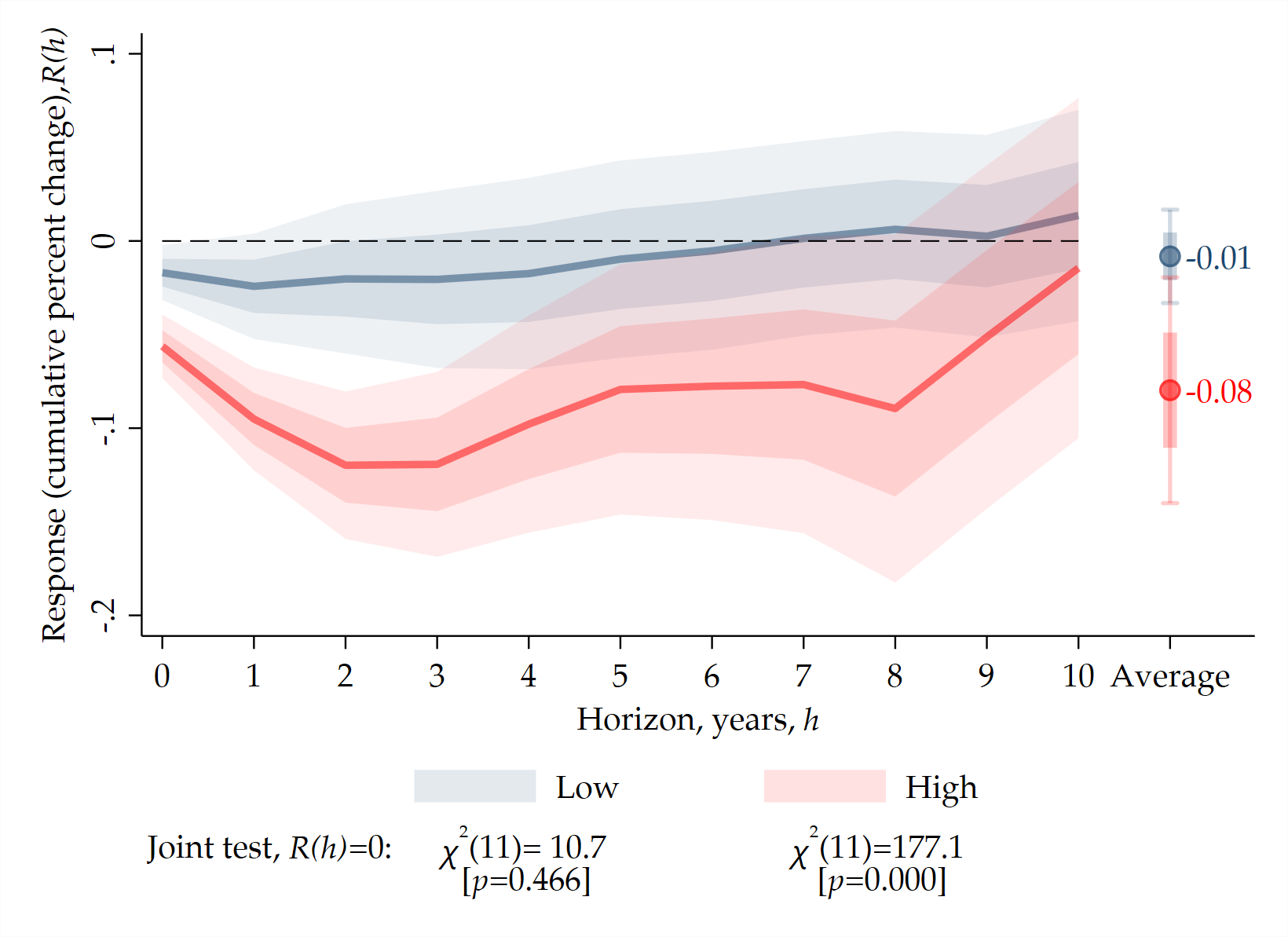
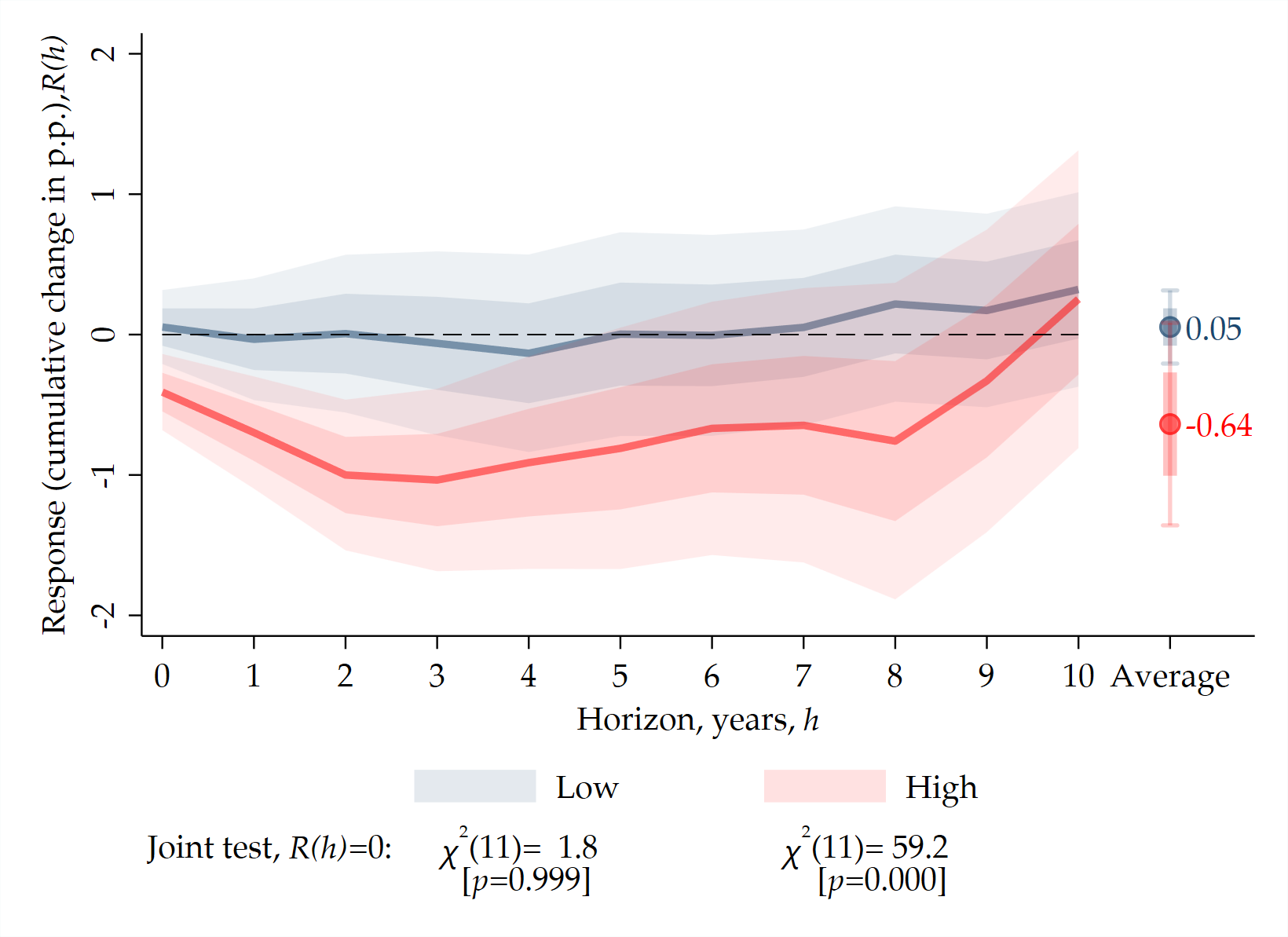
Notes: The dependent variable is the cumulative change in investment—relative to t{-}1. Responses are normalized to a one-percentage-point increase in the contribution rate to private pension pillars. The specification includes one lag of the dependent variable, contemporaneous values, and three lags of the old-age dependency ratio, the unemployment rate, the age (first) factor, and a crisis dummy, along with horizon-specific country and year fixed effects. Inferences based on bootstrapped standard errors (1000 replications). Wald test statistics for joint significance and p-values are reported below each chart. Darker (lighter) shaded areas indicate 68% (95%) pointwise confidence intervals.
6.3 Robustness checks
This section presents robustness analyses aimed at strengthening the causal interpretation of our findings along four dimensions: falsification (placebo) tests, controls for concurrent fiscal adjustments, spillovers and external pressures, and uncertainty. Each addresses a distinct identification threat: spurious relationships, omitted-variable bias from concurrent fiscal consolidations, contamination through spillovers or external pressures, and the possibility that economic uncertainty — domestic or foreign — surrounding the reforms may itself affect the outcomes of interest.
Falsification tests. Are our results merely artefacts, or could they arise by chance? We investigate this question through a falsification exercise. More specifically, we conduct permutation-based placebo tests in which reform shocks are randomly reassigned across country-year observations and the local projections are re-estimated. The exercise can be interpreted as a Monte Carlo permutation test: rather than drawing artificial shocks from a parametric distribution, we permute the observed reform shocks in order to preserve the empirical distribution of our reform measures. This is important because pension reforms are discrete, infrequent, and unevenly distributed across countries and years, and are therefore not well approximated by standard parametric distributions. The procedure breaks the link between the actual timing of reforms and subsequent macroeconomic outcomes, while keeping the distribution of reform shocks unchanged. For each horizon, we provide ridgeline plots reporting the empirical distribution of impulse responses obtained from 1000 permutations. If the baseline estimates reflect the actual timing of pension reforms rather than a mechanical feature of the estimation procedure, randomly reassigned reform shocks should not generate systematic response patterns.
The resulting placebo distributions are reported in Appendix Figure 1. Overall, the distributions appear centered around zero and do not display systematic dynamic patterns across horizons. This supports the interpretation that the baseline results are not driven mechanically by the estimation procedure or by the unconditional distribution of reform shocks.
Additional control for fiscal adjustments. We do control for business cycles at various stages of our empirical exercise: firstly, in the conditional factor analysis, by adjusting variables for GDP growth ; secondly, by including unemployment rate and a crisis dummy in the set of regressors in the local projections. However, in order to be sure our estimates do not confound pension reforms with coinciding fiscal consolidations, we include, as an additional precaution, explicit measures of fiscal consolidations based on the narrative dataset by Guajardo, Leigh, & Pescatori (2014).
More specifically, our baseline LP specification is extended to include, contemporaneously and with up to three lags, three alternative measures of fiscal consolidation: (i) the overall size of the fiscal consolidation, (ii) the associated spending cuts, and (iii) the corresponding tax increases. Despite the loss of observations due to the more limited time coverage of these measures –up to 2019–, results reported on Appendix Figure 2 remain highly consistent with our previous findings, qualitatively identical and quantitatively very close.
Spillovers and external pressure. Our specifications include country fixed effects and year dummies. While the latter capture common dynamics across countries, they do not account for the possibility that exogenous foreign developments affect country-specific dynamics. For instance, pension reforms enacted abroad may raise expectations of similar reforms at home, with macroeconomic effects that would then be wrongly attributed to domestic dynamics.
To control for such spillovers and this “external reform pressure”, we augment the baseline LP specification with the leave-one-out means of our age and funded-pension reform measures, as well as the leave-one-out mean of an indicator for reform-voting years, both contemporaneously and with up to three lags. Results, reported in Appendix Figure 3, are virtually indistinguishable from the baseline.
Uncertainty. In a similar vein, pension reforms are often hotly debated and sometimes trigger social unrest, which may disrupt the implementation of the reforms as initially planned. The resulting uncertainty may significantly affect our macroeconomic outcome variables. We therefore augment the baseline LP specification with controls for uncertainty based on Google Trends data, which are only available from 2004 onwards. Specifically, we include, both contemporaneously and with up to three lags, the domestic Google Trends index (as a measure of domestic uncertainty) and its leave-one-out mean (as a measure of foreign uncertainty).
Results are reported in Appendix Figure 4. They are fairly noisy, owing to the smaller post-2004 sample. Nonetheless, they are qualitatively close to the baseline, with no systematic difference in the direction of the responses.
7 Conclusion
Population ageing places advanced economies under increasing pressure to reform their pension systems. Yet pension reforms are not homogeneous policy shocks. They differ in the instruments they use, in the timing of their implementation, and in the macroeconomic channels through which they operate. This paper has studied the dynamic macroeconomic effects of pension reforms by combining a new narrative database of major pension reforms in 17 OECD countries over the period 1980-2025 with a conditional factor-analysis approach and local projections.
Our first contribution is to construct reform measures that capture not only the occurrence of pension reforms but also their magnitude and gradual implementation path, going beyond standard dummy-based approaches. Our second contribution is to summarise the multidimensional structure of pension reforms into two orthogonal dimensions: the Age factor, which captures increases in statutory or early-retirement ages, and the Capitalisation factor, which is related to shifts toward funded private pension schemes. Because the latter is identified from a smaller and more geographically concentrated set of reform episodes, the main analysis focuses on the Age factor, while results for the Capitalisation factor are interpreted as complementary and more suggestive evidence.
The main results show that reforms delaying retirement generate a broad expansionary response. They raise the labour force participation rate of workers aged 55-64 and increase aggregate labour force participation. They also increase real GDP and potential GDP, suggesting that the output gains are not merely cyclical but reflect an expansion of productive capacity. Consumption and investment rise in levels, and investment also increases as a share of GDP. On the fiscal side, public pension expenditure declines as a share of GDP and government debt ratios fall persistently. These results suggest that retirement-age reforms should not be interpreted as standard fiscal retrenchment shocks. Rather, they operate as positive labour-supply shocks that also generate demand effects through higher labour income .
The complementary results on the Capitalisation factor point to a different pattern, but should be interpreted more cautiously. In our sample, the Capitalisation factor is associated with declines in GDP, consumption, investment, and GDP per worker over the ten-year horizon considered. Although public pension expenditure falls in levels, debt ratios increase, consistent with transition costs and the adverse denominator effect of lower GDP. We do not find evidence, within this horizon, that the Capitalisation factor is associated with a rise in aggregate saving or investment. Instead, the results are more consistent with a demand-compression channel and fiscal transition costs that may outweigh any positive capital-accumulation effect in the medium run. In this regard, we find that the negative responses are concentrated in observations with higher foreign asset holdings relative to domestic savings, a pattern consistent with a possible role for savings outflows.
The main findings on retirement-age reforms are robust to various sensitivity checks. The results have two broader implications. First, the macroeconomic effects of pension reforms depend crucially on the instrument used. Treating all pension retrenchments as equivalent fiscal consolidation measures risks obscuring important differences between reforms that expand labour supply and reforms that alter pension financing arrangements. Second, the design and timing of reforms matter. Retirement-age reforms can improve both growth and fiscal sustainability when the labour-supply and labour-income channels dominate anticipation and adjustment effects. The results on capitalisation reforms suggest that shifts toward funded schemes may entail transition costs and contractionary demand effects, especially if higher private pension contributions do not translate into higher national saving and productive investment.
Several caveats are warranted. Our results may depend on country-specific features — labour-market institutions, pension-system credibility, financial-market depth — and the evidence on capitalisation reforms rests on a more limited set of reform episodes. The ten-year horizon may also be insufficient to capture the full effects of funded schemes on capital accumulation. Future research could examine heterogeneity across institutional settings and assess whether capitalisation reforms deliver different outcomes over longer horizons or under deeper financial markets.
Overall, the paper shows that pension reforms have macroeconomic effects that go well beyond their direct impact on pension expenditure. The main evidence indicates that delaying retirement can simultaneously support output, investment, and fiscal sustainability by expanding labour supply and sustaining labour income. Complementary evidence for the Capitalisation factor suggests that a greater reliance on funded private pensions does not necessarily deliver the expected macroeconomic gains within the horizon studied here. The choice of pension reform instrument is therefore central to understanding the macroeconomic consequences of ageing and the policy trade-offs involved in restoring pension-system sustainability.
References
Reuse
Citation
@article{blomme2026,
  author = {Blomme, Océane and Grekou, Carl and Grjebine, Thomas and
    Héricourt, Jérôme},
  title = {The {Macroeconomic} {Effects} of {Pension} {Reforms}},
  journal = {Institut français d’économie working paper},
  number = {2026-14},
  date = {2026-11-18},
  url = {https://www.ofce.fr/wp/2026/14/},
  langid = {en},
  abstract = {This paper studies the macroeconomic effects of pension
    reforms in advanced economies. We build a new narrative database of
    major pension reforms in 17 OECD countries over 1980-2025, recording
    their timing, magnitude, and phase-in across retirement ages,
    early-retirement rules, contribution requirements, and private
    pillars. A conditional factor analysis extracts two orthogonal
    reform dimensions: an *Age* factor (delayed retirement) and a
    *Capitalisation* factor (a financing-related dimension associated
    with funded schemes). Local projections show that retirement-age
    reforms are broadly expansionary: they raise older workers’
    participation, actual and potential GDP, consumption, and
    investment, while lowering pension expenditure and public debt
    ratios. They act as positive labour-supply shocks rather than fiscal
    retrenchments. By contrast, based on fewer episodes, we find
    suggestive evidence that the *Capitalisation* factor is associated
    with persistent declines in GDP, consumption, investment, GDP per
    worker, and higher debt ratios, consistent with transition costs and
    demand compression outweighing capital-accumulation effects over the
    medium run. Overall, the instrument matters: delaying retirement can
    improve both growth and fiscal sustainability, whereas shifting to
    funded schemes does not appear to deliver macroeconomic gains within
    ten years.}
}